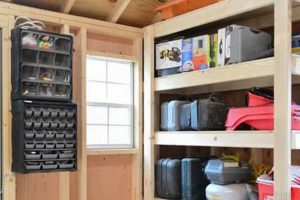
Creating customized organizational units for the home or workspace through individual construction represents a practical approach to space management. These units, typically assembled from readily available materials, offer tailored solutions for decluttering and optimizing storage capacity. An example includes assembling a set of tiered platforms from reclaimed wood to house books and decorative items.
The significance of this approach lies in its cost-effectiveness and adaptability to specific spatial requirements. Historically, individuals have crafted their own shelving to address unique storage challenges, predating the mass production of standardized units. This practice yields economic benefits, allowing allocation of resources to materials rather than labor costs, and fosters a sense of ownership and personalization within the living environment.
The following sections will explore various design considerations, material choices, and construction techniques relevant to this form of space optimization. Emphasis will be placed on ensuring structural integrity and aesthetic appeal within the resulting units.
Essential Considerations for Self-Constructed Organizational Units
This section provides fundamental recommendations for the successful design and construction of user-assembled shelving systems. Adherence to these guidelines enhances both the structural integrity and aesthetic value of the finished product.
Tip 1: Material Selection: Prioritize durable materials suited to the intended load. Solid wood, plywood, or metal offer superior strength compared to particleboard for heavy items. Research material properties to ensure appropriate load-bearing capacity.
Tip 2: Accurate Measurement: Precise measurements of the intended space are crucial. Account for wall irregularities and potential obstructions. Erroneous dimensions lead to fitment issues and compromise structural stability.
Tip 3: Structural Integrity: Reinforce joints with screws, dowels, or metal brackets. Glue alone is often insufficient for long-term support. Consider the weight distribution and implement bracing where necessary to prevent sagging.
Tip 4: Level Installation: Employ a level during installation to ensure horizontal alignment. Uneven shelving detracts from the visual appeal and potentially compromises the stability of stored items. Shims can be utilized to compensate for uneven surfaces.
Tip 5: Surface Treatment: Apply a protective finish to prevent moisture damage and enhance aesthetic appeal. Staining, painting, or sealing prolongs the lifespan of the unit and integrates it seamlessly with the surrounding decor. Sanding is recommended for the best surface finishing.
Tip 6: Safety Considerations: When working with power tools, adherence to safety protocols is paramount. Eye protection and appropriate work gloves mitigate the risk of injury. Ensure adequate ventilation when applying finishes containing volatile organic compounds (VOCs).
Tip 7: Weight Distribution: Distribute weight evenly across the shelving unit. Concentrating heavy items in one area creates undue stress and increases the likelihood of failure. Lower shelves should house heavier objects to maintain a low center of gravity.
Implementing these recommendations contributes to the creation of robust and visually appealing storage solutions. Proper planning and execution mitigate potential structural weaknesses and ensure the longevity of the shelving unit.
The subsequent sections will delve into specific design approaches and detailed construction methodologies for various shelving configurations.
1. Material Strength
The selection of appropriate materials constitutes a foundational aspect of constructing durable and functional storage solutions. Material strength, specifically, dictates the load-bearing capacity and overall lifespan of self-assembled shelving units. Inadequate material selection directly contributes to structural instability, manifesting as sagging, warping, or complete collapse under load. This relationship represents a direct cause-and-effect: insufficient strength leads to compromised integrity. The importance of recognizing material properties is paramount in the context of independently constructed organizational elements.
For example, employing particleboard for shelving intended to support heavy books or appliances invariably results in deformation over time. Conversely, utilizing solid hardwood or reinforced metal for similar applications provides the necessary rigidity and resistance to bending. The practical significance of understanding material strength lies in the prevention of structural failure and the maximization of usable storage space. Improper selection not only risks damage to stored items but also presents a potential safety hazard.
In summary, material strength serves as a critical determinant in the successful design and implementation of independently built shelving systems. A thorough understanding of the load-bearing capabilities of various materials, coupled with a careful assessment of the intended use, mitigates the risk of structural deficiencies and ensures the long-term functionality of the storage solution. The challenges inherent in this process involve balancing cost considerations with the need for adequate strength, often requiring a compromise between affordability and durability.
2. Spatial Constraints
Spatial constraints represent a primary driver in the design and implementation of user-constructed storage solutions. The available area, architectural limitations, and existing infrastructure directly dictate the feasible dimensions, configuration, and placement of shelving units. Effective utilization of space through independent construction necessitates a thorough assessment of these limitations to maximize storage capacity and minimize functional impediments.
- Dimensional Limitations
Available width, height, and depth of a given area define the maximum dimensions of a shelving unit. In constrained spaces, this necessitates compact designs, potentially utilizing vertical space through tall, narrow units. Examples include fitting shelving into alcoves or designing units to conform to sloping ceilings. Failure to account for dimensional limits results in unusable or poorly integrated storage solutions.
- Architectural Obstructions
Existing structural elements, such as pipes, electrical boxes, or support beams, impose limitations on the placement and design of shelving. Modifications may be required to either reroute these elements or design units to accommodate their presence. An example involves creating shelving with cutouts to fit around existing plumbing. Ignoring these obstructions leads to installation challenges and potential damage to existing infrastructure.
- Accessibility and Ergonomics
The design must consider ease of access to stored items and user ergonomics. High shelves may require the use of ladders or step stools, while deep shelves may obscure items at the back. Designing pull-out shelves or adjustable-height configurations can improve accessibility. Overlooking these aspects results in inconvenient or unsafe storage solutions.
- Load-Bearing Capacity of Walls
The structural integrity of the wall supporting the shelving unit must be considered, particularly when dealing with heavy loads. Drywall, for example, has a limited weight-bearing capacity and may require reinforcement or the use of wall studs for secure mounting. Examples include utilizing ledger boards to distribute weight across multiple studs. Ignoring wall capacity leads to potential wall damage or structural failure.
Addressing spatial constraints through careful measurement, consideration of existing infrastructure, and ergonomic design principles ensures the successful integration of user-built shelving into its intended environment. The efficient utilization of available space optimizes storage capacity and enhances the overall functionality of the living or working area. Tailoring a shelving unit to the specific confines of a room often yields a superior storage solution compared to prefabricated, one-size-fits-all alternatives.
3. Joint Reinforcement
Joint reinforcement represents a critical element within the realm of independently constructed shelving systems. Its primary function is to enhance the structural integrity of the unit by mitigating the stresses concentrated at the points where individual components are joined. The absence of adequate joint reinforcement invariably leads to structural instability, manifested as wobbling, sagging, or complete failure under load. This cause-and-effect relationship highlights the importance of robust joint construction in ensuring the longevity and functionality of these storage solutions. A practical example involves the use of screws and wood glue in conjunction with dowels to strengthen the connection between shelves and vertical supports, preventing separation under sustained weight. Understanding this is of practical significance for safe, long-lasting storage.
Effective joint reinforcement techniques vary depending on the materials used and the intended load. When working with wood, options include utilizing screws, nails, dowels, mortise and tenon joints, or biscuit joints, often combined with adhesives for added strength. For metal construction, welding, bolting, or riveting provide robust connections. Consider a bookshelf where the shelves are simply butted against the vertical supports and attached with nails only. Over time, the nails will likely loosen, causing the shelves to sag. Conversely, if the shelves were joined to the vertical supports using screws and wood glue, the connection would be significantly stronger and less prone to failure.
In summary, joint reinforcement is indispensable for the successful construction of durable and reliable independently built storage systems. Ignoring this aspect results in compromised structural integrity and reduced lifespan. The challenge lies in selecting the appropriate reinforcement method for the materials and intended load, requiring a balance between cost, complexity, and structural performance. Proper execution of joint reinforcement techniques ensures a stable and safe storage solution.
4. Level Installation
Level installation represents a non-negotiable aspect of user-constructed shelving units. Deviation from a true horizontal plane introduces instability and compromises the intended functionality. The relationship between level installation and safe storage is causative; improper leveling can induce uneven weight distribution, leading to potential structural failure. Consider a scenario where a shelving unit is installed on an uneven floor without proper leveling. The inherent imbalance will concentrate stress on specific joints and supports, increasing the risk of collapse or damage to stored items. The practical significance of adhering to a level installation is thus directly tied to the safety and longevity of the shelving system. The absence of a horizontal plane affects the visual aesthetics as well, reducing the unit’s quality and effectiveness.
Achieving accurate level installation necessitates the use of appropriate tools, such as a spirit level or laser level. These instruments facilitate the precise measurement of horizontal alignment, enabling corrective adjustments using shims or other leveling devices. A common application involves the construction of wall-mounted shelves, where adherence to a level plane is paramount to prevent items from sliding off or to ensure the secure placement of decorative objects. In these cases, failing to level the structure can easily lead to damages on displayed items, in addition to the shelving unit itself.
In summary, level installation is an essential prerequisite for the creation of stable, functional, and visually appealing self-assembled storage systems. Neglecting this crucial step introduces inherent risks and undermines the intended benefits of independent construction. By prioritizing accuracy and employing appropriate tools, individuals can ensure the successful implementation of this critical element.
5. Surface Protection
Surface protection constitutes a critical, often underestimated, element in the creation and longevity of user-constructed storage solutions. It encompasses a range of treatments applied to the exposed surfaces of the shelving material, designed to mitigate degradation caused by environmental factors and physical wear. Implementing effective surface protection strategies extends the lifespan of the unit and preserves its aesthetic appeal.
- Moisture Resistance
Many common shelving materials, particularly wood and wood-based composites, are susceptible to moisture damage. Humidity, spills, and condensation can cause warping, swelling, and the growth of mold or mildew. Applying moisture-resistant sealants, paints, or varnishes forms a barrier that prevents water penetration and mitigates these effects. For example, shelving in a garage or basement benefits significantly from a waterproof coating.
- Scratch and Abrasion Resistance
Shelving units are subjected to repeated contact with stored items, leading to scratches, abrasions, and surface wear. Durable finishes, such as polyurethane or epoxy coatings, provide a resilient layer that protects the underlying material from physical damage. This is particularly relevant for shelves used to store heavy or abrasive items, such as tools or books.
- UV Protection
Exposure to ultraviolet (UV) radiation from sunlight can cause fading, discoloration, and degradation of certain materials, especially plastics and some wood finishes. Applying UV-resistant coatings or incorporating UV absorbers into the finish helps to prevent these effects. Shelving positioned near windows or in direct sunlight benefits from this protection.
- Chemical Resistance
Shelving used in environments where exposure to chemicals is likely, such as garages or workshops, requires finishes that resist corrosion, staining, and degradation caused by solvents, oils, and other chemicals. Epoxy coatings or specialized chemical-resistant paints provide a protective barrier. Shelving for storing cleaning supplies or automotive fluids necessitates this type of protection.
The implementation of appropriate surface protection measures significantly enhances the durability and longevity of independently constructed shelving. The selection of a specific protection strategy depends on the materials used, the intended environment, and the type of items to be stored. Prioritizing surface protection during the construction phase minimizes the need for future repairs and maintains the visual appeal of the shelving unit.
6. Weight Distribution
Weight distribution stands as a critical element in the design and utilization of self-constructed storage shelves. The principle dictates the placement of items across the shelving structure to maintain equilibrium and prevent structural failure. Improper weight distribution constitutes a primary cause of shelving collapse or deformation. The concentration of heavy objects in a single area of a shelving unit generates undue stress on supporting members, potentially exceeding their load-bearing capacity. A practical example involves a bookshelf where all heavy books are placed on the uppermost shelf, leading to sagging and instability. The significance of understanding weight distribution lies in its direct impact on the safety and longevity of the storage solution.
Effective weight distribution in independently built shelving involves several key considerations. First, heavier items should be placed on lower shelves to lower the center of gravity and enhance overall stability. Secondly, weight should be distributed evenly across each shelf to prevent localized stress concentrations. For instance, storing multiple heavy items side-by-side on one side of a shelf is less desirable than distributing them more uniformly across the shelf’s surface. Furthermore, the design of the shelving unit itself can contribute to improved weight distribution. Incorporating vertical supports at regular intervals and using thicker shelving materials increases the load-bearing capacity and reduces the risk of sagging.
In summary, weight distribution is an indispensable factor in the successful implementation of self-constructed storage shelves. Neglecting this aspect compromises structural integrity and diminishes the useful lifespan of the unit. By adhering to principles of balanced loading and employing appropriate design considerations, users can ensure the safety, stability, and longevity of their storage solutions. The challenge resides in maintaining awareness of weight limits and practicing conscientious item placement, a task integral to the responsible utilization of any storage system.
7. Design Aesthetics
Design aesthetics plays a crucial role in independently constructed storage solutions, extending beyond mere functionality to encompass visual harmony and integration with existing decor. Considerations of style, color, and material selection elevate the utility of shelving units, transforming them from purely practical fixtures into integral components of a cohesive interior design scheme.
- Material Palette and Texture
The choice of materials profoundly impacts the aesthetic character of storage shelves. The selection of wood species, metal finishes, or synthetic laminates contributes to the overall visual impression. For instance, reclaimed wood introduces a rustic aesthetic, while stainless steel conveys a modern, industrial sensibility. The texture of the materials, whether smooth, rough, or patterned, further refines the design statement and interacts with ambient lighting to create visual interest.
- Color Harmony and Contrast
Color plays a pivotal role in integrating storage shelves into a space. The selection of colors should complement existing wall colors, furniture, and accessories to establish visual coherence. Contrasting colors can be employed to create focal points or highlight specific items displayed on the shelves. A monochromatic color scheme offers a minimalist approach, while a vibrant palette adds energy and personality to a room.
- Form and Proportion
The shape and dimensions of storage shelves significantly influence their visual impact. Streamlined, geometric forms convey a modern aesthetic, while ornate, curvilinear designs evoke a traditional style. The proportions of the shelves, including their height, width, and depth, should be carefully considered to ensure visual balance and harmony. Vertical shelves can visually elongate a space, while horizontal shelves create a sense of expansiveness.
- Hardware and Embellishments
The selection of hardware, such as shelf brackets, drawer pulls, and door handles, provides an opportunity to enhance the aesthetic details of storage shelves. Decorative brackets add visual interest and reinforce a particular design style, while minimalist hardware complements a modern aesthetic. Embellishments, such as decorative molding or textured panels, can further personalize the shelving unit and integrate it with the surrounding decor.
Integrating design aesthetics into the construction of user-built shelving transcends functional storage, resulting in a customized feature that reflects individual style and enhances the overall ambiance of a space. Attention to material palette, color harmony, form, and hardware transforms storage solutions into visually appealing elements of interior design.
Frequently Asked Questions
This section addresses common inquiries and concerns related to the design, construction, and implementation of independently built storage shelving. The information provided aims to clarify potential challenges and facilitate informed decision-making.
Question 1: What are the primary factors determining the structural integrity of user-built storage shelves?
The structural integrity is primarily determined by material selection, joint reinforcement methods, and load distribution. Choosing materials appropriate for the intended weight and reinforcing joints adequately mitigates the risk of sagging or collapse. Furthermore, distributing weight evenly across the shelf prevents localized stress concentrations.
Question 2: How can level installation be ensured, particularly on uneven flooring surfaces?
Level installation is best achieved by employing a spirit level or laser level to establish a horizontal plane. Shims or adjustable feet can compensate for uneven flooring surfaces. Regular monitoring with the leveling tool during installation guarantees consistent alignment.
Question 3: What surface protection methods are most effective for shelving exposed to moisture?
Effective surface protection against moisture involves the application of waterproof sealants, paints, or varnishes. Multiple coats are recommended to provide a robust barrier against water penetration. Regular inspection and reapplication may be necessary in environments with high humidity.
Question 4: How does weight distribution impact the longevity of independently built shelving?
Proper weight distribution extends the longevity of shelving by minimizing stress on individual components. Placing heavier items on lower shelves and distributing weight evenly across each shelf reduces the risk of sagging, warping, or structural failure. Neglecting this principle shortens the lifespan and compromises the safety of the storage unit.
Question 5: What tools are essential for the safe and accurate construction of storage shelving?
Essential tools include a measuring tape, level, drill, saw (hand saw or power saw depending on skill level), screwdriver, and safety glasses. Precise measurement, accurate cutting, and secure fastening are critical for a stable and safe finished product.
Question 6: How can user-built storage shelves be integrated aesthetically into an existing interior design scheme?
Aesthetic integration involves careful consideration of material selection, color palette, and hardware. Choosing materials and finishes that complement existing furniture and decor creates a cohesive visual effect. The shape, size, and arrangement of the shelving should also align with the overall design style of the space.
In summary, addressing these key questions and considerations contributes to the successful design, construction, and long-term performance of independently built storage shelves. A thorough understanding of these principles promotes safety, durability, and aesthetic integration.
Conclusion
This exploration of storage shelves diy underscored critical factors influencing structural integrity, installation precision, and design integration. From material selection and joint reinforcement to level installation and surface protection, the principles outlined directly impact the longevity, safety, and aesthetic value of self-constructed storage solutions. The importance of weight distribution and aesthetic considerations further refines the creation of both functional and visually appealing storage units.
The principles and methodologies discussed equip individuals to undertake informed construction projects. Whether seeking space optimization, cost-effective storage, or personalized design, a commitment to sound construction techniques and informed material choices remains paramount. The successful implementation of storage shelves diy represents a significant opportunity to enhance living spaces while fostering practical skills and resourcefulness. Further exploration into advanced construction methods and material innovations will undoubtedly continue to refine this domain.