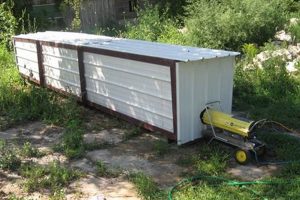
The process of reducing the moisture content of lumber utilizing a self-constructed or modified drying chamber is a method employed to render timber suitable for various woodworking and construction applications. This involves carefully controlling temperature and humidity within the enclosure to expedite the evaporation of water from the wood cells. Examples include converting a shipping container or shed into an insulated, heated space equipped with fans and vents.
Properly desiccated timber offers increased dimensional stability, reduced susceptibility to fungal decay and insect infestation, and improved workability. Historically, air drying was the prevalent method, often requiring extended periods. The adoption of accelerated drying techniques significantly reduces the time investment, allowing for more efficient processing of raw materials and greater control over the final moisture level, ultimately improving the quality and longevity of finished wood products.
The following sections will delve into the construction of suitable drying chambers, optimal temperature and humidity management techniques, and methods for monitoring the moisture content of the timber throughout the desiccation procedure.
Effective Practices for Timber Desiccation
The following practices aim to optimize the artificial seasoning of lumber, ensuring quality and minimizing potential defects.
Tip 1: Chamber Sealing is Paramount: Ensure that the structure used for drying is adequately sealed to minimize heat loss and maintain consistent internal conditions. Utilize weather stripping, insulation, and caulking to eliminate air leaks.
Tip 2: Implement Precise Temperature Control: Install a reliable thermostat connected to the heating element. Gradual temperature increases prevent rapid moisture release, which can lead to cracking and warping. A consistent, controlled temperature regime is vital for uniform drying.
Tip 3: Ventilation is Crucial: Incorporate strategically placed vents to exhaust moisture-laden air. The rate of ventilation should be adjustable to correspond to the drying rate of the wood. Insufficient ventilation prolongs the process, while excessive ventilation may lead to uneven desiccation.
Tip 4: Optimize Air Circulation: Employ fans to promote uniform airflow throughout the chamber. Direct airflow parallel to the lumber’s surfaces facilitates even moisture evaporation. Regularly check and adjust fan placement for optimal performance.
Tip 5: Employ Accurate Moisture Measurement: Use a calibrated moisture meter to regularly monitor the moisture content of the lumber. Take readings from multiple boards and various locations within each board to assess drying progress accurately. Consistent monitoring is essential for preventing over- or under-drying.
Tip 6: Proper Stacking Techniques: Stack lumber with consistent spacing between boards using dry stickers. Proper stacking allows for uniform air circulation around each board, resulting in a more consistent reduction in moisture content throughout the entire batch.
Tip 7: Consider Wood Species and Thickness: Adjust the drying schedule based on the wood species and board thickness. Denser woods and thicker boards require longer and more gradual drying periods to prevent defects. Research appropriate drying schedules for the specific materials being processed.
Implementing these practices fosters a controlled environment conducive to effective and consistent artificial seasoning, leading to improved lumber quality and reduced instances of defects.
The subsequent section provides an overview of potential challenges and recommended solutions.
1. Chamber construction

The physical structure housing the artificial seasoning process directly dictates its effectiveness and efficiency. Chamber construction for lumber drying is not merely enclosure; it represents a carefully engineered environment designed to regulate temperature, humidity, and airflow. Inadequate chamber construction leads to uncontrolled heat loss, uneven drying rates, and ultimately, compromised lumber quality. For example, an improperly insulated chamber necessitates excessive energy consumption to maintain target temperatures, rendering the process economically unsustainable. Conversely, a poorly sealed structure allows uncontrolled air exchange, disrupting humidity levels and potentially inducing stress fractures within the wood.
Successful drying chambers utilize materials with high insulation values to minimize heat transfer with the surrounding environment. Vapour barriers must be integrated to prevent moisture penetration into the insulation, which would degrade its effectiveness and promote mold growth. The dimensions of the chamber should be appropriately sized to accommodate the volume of lumber being processed, ensuring adequate space for air circulation. Furthermore, the chambers structural integrity must withstand the sustained high temperatures and humidity levels inherent to the drying process. A common example is the repurposing of shipping containers. While structurally sound, significant modification is necessary to ensure adequate insulation, ventilation control, and door sealing.
In conclusion, competent chamber construction is a prerequisite for effective artificial lumber seasoning. It serves as the foundation upon which controlled temperature, humidity, and airflow are maintained. Ignoring the principles of proper construction results in inefficient energy utilization, increased drying times, and a higher incidence of wood defects. Therefore, meticulous planning and execution of the chamber design are essential components of any successful operation, underscoring its integral connection to the entire endeavor.
2. Temperature regulation

Temperature regulation is a critical component of controlled artificial seasoning. The precise manipulation of heat within the drying environment directly impacts the rate of moisture evaporation from the wood. Elevated temperatures accelerate water molecule movement, facilitating faster drying. However, uncontrolled increases in temperature can induce severe stress within the timber structure, leading to warping, cracking, and case hardening. Therefore, a carefully managed temperature regime is essential to balance the need for efficient drying with the preservation of wood quality. For example, rapidly increasing the temperature in a hardwood drying chamber beyond established thresholds can cause the outer layers of the wood to dry and shrink excessively before the inner layers have had sufficient time to release moisture. This differential in moisture content creates tensile stresses, resulting in surface checks and internal honeycombing.
The implementation of effective temperature regulation strategies requires the integration of several elements. A reliable and responsive heating system, coupled with precise sensors and a control system, is paramount. The control system must be capable of maintaining consistent temperatures within narrow tolerances, adjusting the heat output in response to fluctuations in ambient conditions or changes in the wood’s moisture content. For example, a proportional-integral-derivative (PID) controller is often employed to regulate temperature by continuously monitoring the difference between the target temperature and the actual temperature, adjusting the heating element output accordingly. This active feedback loop ensures that the drying environment remains stable, minimizing the risk of damaging the lumber.
In summary, temperature regulation directly influences both the speed and the quality of the artificial seasoning process. Failing to implement a controlled temperature regime results in defects and reduced material yield. The careful selection and implementation of appropriate heating systems, sensors, and control mechanisms are thus essential investments for any operation aiming to produce high-quality, dimensionally stable lumber. The synergy between temperature regulation and careful monitoring represents best practices.
3. Humidity control

Humidity control is a paramount aspect of effective artificial seasoning, directly influencing the rate at which moisture exits the wood and the degree to which defects develop. Relative humidity within the drying chamber determines the equilibrium moisture content (EMC) that the lumber will eventually reach. Maintaining high humidity levels slows the drying rate, while lower levels accelerate it. An uncontrolled reduction in humidity precipitates rapid moisture loss, leading to surface checking, warping, and internal stresses. For example, introducing kiln-dried lumber into a high-humidity environment without acclimation causes the wood to absorb moisture, leading to expansion and potential joint failure in finished products.
Effective humidity management involves a combination of strategies, including introducing moisture into the chamber via steam or water atomization and removing it through ventilation. The specific humidity profile must be tailored to the species and thickness of the lumber being dried, accounting for its initial moisture content. Sensors and automated control systems continuously monitor and adjust humidity levels to maintain the desired drying rate and minimize the risk of defects. For instance, drying thick oak boards requires a gradual reduction in humidity over an extended period, with periodic conditioning cycles where humidity is temporarily increased to relieve surface stresses.
In conclusion, competent humidity control is indispensable. Imprecise regulation precipitates irreversible damage, rendering the lumber unsuitable for its intended purpose. Understanding and implementing effective strategies, guided by accurate data and responsive control systems, is crucial for achieving high-quality, stable lumber. Effective control helps to mitigate problems of warping and cracking, while ensuring the lumber is dried appropriately.
4. Air circulation
Air circulation within a self-constructed drying chamber is not merely the movement of air; it is a critical determinant of drying uniformity, efficiency, and the overall quality of the seasoned lumber. Inadequate airflow leads to uneven moisture removal, resulting in variations in moisture content across individual boards and within the stack. This uneven drying induces stresses that manifest as warping, twisting, and cracking, rendering the wood unsuitable for many applications.
- Uniform Moisture Removal
Consistent airflow across all board surfaces promotes uniform evaporation. Without this, areas with stagnant air dry slower, leading to moisture gradients. An example of this is lumber stacked too tightly together without adequate spacing; the interior boards will retain more moisture than those on the exterior. This disparity necessitates longer drying times and increases the risk of defects as the drier boards shrink more than their wetter counterparts.
- Temperature Consistency
Air circulation ensures that the temperature within the chamber remains consistent, preventing localized hot spots or cold zones. Temperature variations exacerbate uneven drying, as warmer areas experience faster moisture loss. In the absence of proper circulation, heating elements can create temperature stratification, leading to differential drying rates within the lumber stack. Controlled and uniform temperatures are the key to minimizing defects.
- Surface Drying Mitigation
Rapid surface drying can lead to case hardening, where the outer layers of the wood dry and harden prematurely, trapping moisture within the core. Air circulation helps to moderate the rate of surface drying, preventing this phenomenon. By gently removing moisture from the surface, air circulation allows the interior moisture to migrate outwards without causing undue stress on the outer layers.
- Ventilation Enhancement
Effective air circulation facilitates the removal of moisture-laden air from the chamber, allowing for the introduction of drier air. Without adequate ventilation, the humidity within the chamber increases, slowing the drying process and increasing the risk of fungal growth. Airflow, therefore, not only moves air, but also expels moisture-rich air and draws in drier air, further facilitating the evaporation process. The ventilation design has to be balanced against the amount of heat being exhausted so as not to lose energy and waste resources.
These facets underscore the necessity of implementing a well-designed air circulation system within any self-managed lumber drying operation. From ensuring uniform moisture removal to moderating surface drying and enhancing ventilation, proper airflow is a cornerstone of producing high-quality, dimensionally stable lumber. The system implemented should be both energy-efficient and effective. Without it, the potential for defects such as warping, twisting, and cracking becomes substantially elevated, impacting the usability and value of the finished material.
5. Moisture monitoring

Accurate moisture monitoring is integral to successful artificial lumber seasoning operations. Within the context of self-managed drying, this process is not merely a formality; it is the primary means of assessing progress, preventing defects, and ensuring the final product meets desired specifications. The moisture content of lumber directly influences its dimensional stability, strength, and susceptibility to decay. Without diligent monitoring, wood may be either over-dried, leading to brittleness and cracking, or under-dried, increasing the risk of warping, fungal growth, and structural instability after installation. For instance, if lumber intended for furniture construction is not dried to the appropriate moisture content for the service environment, subsequent shrinking or swelling can compromise joinery and lead to structural failure.
Effective moisture monitoring strategies involve the use of calibrated moisture meters, employing both pin-type and pinless technologies. Pin-type meters measure electrical resistance between two probes inserted into the wood, while pinless meters use radio frequency signals to assess moisture content non-invasively. Regular measurements should be taken from multiple boards within the stack, at various depths, to account for potential moisture gradients. For example, readings taken only from the surface of a board may indicate a lower moisture content than the core, potentially leading to premature termination of the drying process and subsequent problems with the under-dried interior. Furthermore, it is vital to maintain detailed records of moisture readings throughout the drying cycle. Analyzing these records reveals drying trends, allowing for adjustments to temperature, humidity, and airflow to optimize the process and prevent defects. For example, a sudden increase in moisture content readings may indicate a need for increased ventilation or a reduction in humidity within the drying chamber.
In summary, the diligent monitoring of moisture content is not an optional add-on but a fundamental requirement for artificial lumber seasoning. It is the feedback mechanism that enables operators to make informed decisions, control the drying process, and produce high-quality, dimensionally stable lumber suitable for a wide range of applications. Accurate measurement is not just about achieving the target moisture content; it is about preventing costly mistakes. The consequences of neglecting this crucial aspect can range from minor cosmetic defects to significant structural failures, underscoring the importance of prioritizing proper moisture monitoring techniques.
6. Wood Species and diy kiln dry wood

The selection of wood species is a primary determinant in the planning and execution of artificial lumber seasoning operations. The physical properties and cellular structure inherent to each species significantly influence the rate and method by which moisture is extracted. Understanding these differences is essential for preventing defects and achieving the desired final moisture content. The intricacies of wood species interact uniquely with the controlled environment of drying chambers, demanding specific drying schedules.
- Density and Drying Rate
Wood density directly impacts the rate of moisture diffusion. Denser hardwoods, such as oak and maple, possess tighter cellular structures, impeding moisture movement and necessitating longer, more gradual drying schedules. Attempting to dry dense species too rapidly results in case hardening and internal stresses. Conversely, less dense softwoods, like pine and fir, dry more quickly but require careful monitoring to prevent over-drying and warping. The intrinsic density of the lumber will dramatically affect timelines and energy use.
- Resin Content
The resin content of certain wood species, notably pines and other softwoods, affects the drying process. Resin impedes moisture evaporation and can lead to uneven drying patterns. Kiln schedules must account for resin content by employing lower initial temperatures and extended drying times. Excess resin may also exude from the wood during drying, requiring specialized cleaning procedures after seasoning.
- Grain Orientation and Stability
Grain orientation influences the dimensional stability of lumber during and after drying. Species with interlocked or spiral grain patterns are more prone to warping and twisting as moisture content changes. Drying schedules for these species must incorporate strategies to minimize stress, such as slower drying rates and the application of restraint during the process.
- Hardness and Surface Checking
The hardness of a wood species affects its susceptibility to surface checking. Hardwoods are more prone to surface checks if dried too quickly, as the outer layers shrink faster than the inner layers. Species with low hardness may be more susceptible to collapse. Control over the rate of drying of hardwoods can reduce surface checking by careful airflow and humidity control.
In conclusion, wood species is not merely a passive variable in artificial lumber seasoning; it is an active agent shaping the entire process. Failing to account for the unique characteristics of each species increases the risk of defects and reduces the overall efficiency. Tailoring drying schedules to specific species characteristics is essential for optimizing the process and producing high-quality, dimensionally stable lumber.
7. Stacking methods

Stacking methods are a critical component within the realm of self-managed lumber drying. The arrangement of lumber within the drying chamber directly influences airflow, which in turn dictates the uniformity and rate of moisture extraction. Improper stacking inhibits air circulation, creating localized zones of high humidity that lead to uneven drying. This results in differential shrinkage, leading to warping, twisting, and ultimately, a compromised final product. For instance, lumber piled tightly together without proper spacing restricts airflow, causing the outer layers to dry more rapidly than the interior, generating stress and potential surface checks. The layout for stacking wood requires careful consideration for maximizing proper airflow.
Effective stacking methods involve the use of “stickers,” thin strips of dry wood placed between layers of lumber to create consistent spacing. Sticker placement must be uniform and aligned vertically to prevent localized sagging and distortion. The sticker material should be of the same species and moisture content as the lumber being dried to prevent staining or imprinting. For example, the implementation of a 12-inch sticker spacing for 4/4 red oak ensures adequate airflow and support, whereas wider spacing may induce bowing. Furthermore, the orientation of the stack within the drying chamber should align with the direction of airflow to maximize efficiency and minimize the formation of stagnant zones.
In conclusion, the meticulous application of proper stacking techniques is paramount for successfully accomplishing the drying of timber. Incorrect stacking creates uneven moisture loss leading to damaged product. Understanding of basic physics of drying wood along with diligence can result in success. The proper implementation reduces drying time and energy usage which can lead to lower operating costs.
Frequently Asked Questions
This section addresses common inquiries regarding the process of artificially seasoning lumber using self-constructed or modified drying chambers. The information presented aims to provide clarity and informed guidance.
Question 1: Is the construction of a suitable drying chamber a complex undertaking?
Chamber construction varies in complexity depending on factors such as the desired scale of operation, the availability of materials, and the degree of environmental control sought. A simple, passively vented solar chamber may be constructed with relatively basic skills and readily available materials. However, a more sophisticated, actively heated and humidity-controlled chamber demands more advanced carpentry, electrical, and HVAC expertise.
Question 2: What are the critical parameters to monitor during artificial lumber seasoning?
The critical parameters include temperature, relative humidity, and the moisture content of the lumber. These parameters must be monitored regularly and adjusted to maintain optimal drying conditions for the specific wood species and thickness. Failure to monitor these parameters adequately increases the risk of defects.
Question 3: How does species impact artificial seasoning?
Wood species significantly affect the rate and method of moisture extraction. Denser hardwoods typically require slower, more controlled drying schedules than less dense softwoods to prevent defects such as warping, cracking, and case hardening. Each species exhibits unique drying characteristics that must be considered when establishing a drying schedule.
Question 4: What are common indicators of improperly dried lumber?
Common indicators include surface checking, warping, twisting, cupping, case hardening, and honeycombing. These defects are often the result of excessive temperature, insufficient humidity control, inadequate airflow, or an inappropriate drying schedule for the specific wood species.
Question 5: Can lumber be over-dried? What are the consequences?
Yes, lumber can be over-dried. Over-drying leads to brittleness, reduced strength, and increased susceptibility to cracking and splitting. Over-dried lumber may also exhibit excessive shrinkage, making it unsuitable for applications requiring dimensional stability.
Question 6: What is the importance of stickers?
Stickers are essential for promoting uniform airflow between layers of lumber during drying. Properly placed stickers facilitate even moisture removal, preventing the formation of stagnant zones and minimizing the risk of warping, twisting, and other drying-related defects. The species and moisture content of the stickers can also impact the final product.
Effective operation balances initial investment and recurring operating costs. Factors such as chamber construction, heating source, energy efficiency, and lumber volume will affect cost projections.
The subsequent section explores troubleshooting common issues encountered during artificial lumber seasoning.
diy kiln dry wood
The preceding exploration has detailed the complexities inherent in the construction and operation of lumber drying systems. From chamber design and temperature regulation to humidity control, air circulation, moisture monitoring, species-specific considerations, and stacking methodologies, each element plays a critical role in determining the success or failure of the seasoning process. Understanding these principles is essential for achieving consistent, high-quality results.
Mastery of diy kiln dry wood techniques demands diligent application of acquired knowledge, careful monitoring of conditions, and a commitment to continuous refinement. This effort translates to reduced material waste, enhanced product quality, and improved operational efficiency. Further research and experimentation are encouraged to optimize techniques and advance the art of lumber preparation.