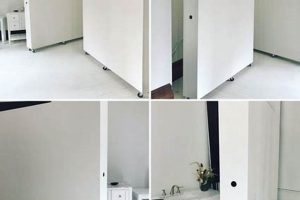
A do-it-yourself firearm display involves constructing a customized storage and presentation system for firearms, typically within a residential setting. Such constructions range from simple racks to elaborate, wall-mounted displays incorporating locking mechanisms and aesthetic design elements. The intent is to provide secure, organized, and visually appealing firearm storage.
The creation of personalized firearm displays offers benefits including optimized space utilization, enhanced security through controlled access, and the opportunity to showcase firearms as part of a collection or for personal enjoyment. Historically, firearm storage has evolved from basic containment to sophisticated systems that reflect both the value placed on these items and the emphasis on responsible ownership.
The following sections will explore the planning, construction, and safety considerations relevant to building a personalized firearm display, including materials selection, security protocols, and legal compliance issues.
Considerations for Firearm Display Construction
Effective firearm display construction necessitates meticulous planning and adherence to safety protocols. The following considerations are essential for responsible and secure implementation.
Tip 1: Secure Mounting is Paramount: Utilize heavy-duty mounting hardware appropriate for the wall type. Ensure anchors are rated to support the combined weight of the display structure and the firearms it will contain. Periodically inspect the mounting system for any signs of stress or loosening.
Tip 2: Concealed Locking Mechanisms: Integrate concealed locking mechanisms to prevent unauthorized access. Biometric locks, keypad entry systems, or hidden manual locks offer discrete security solutions that maintain aesthetic integrity.
Tip 3: Environmental Control Measures: Implement climate control measures to mitigate moisture and temperature fluctuations, which can damage firearms. Consider installing a dehumidifier or using desiccant packs within the display enclosure.
Tip 4: Strategic Lighting Placement: Employ strategic lighting to enhance visual appeal while minimizing heat exposure. LED lighting is recommended due to its low heat output and energy efficiency.
Tip 5: Compliance with Legal Regulations: Adhere to all applicable federal, state, and local regulations pertaining to firearm storage and display. Consult with legal counsel to ensure full compliance.
Tip 6: Inventory and Documentation: Maintain a comprehensive inventory of all firearms displayed, including serial numbers, descriptions, and photographs. Store this documentation securely and separately from the display itself.
These considerations ensure responsible and secure firearm display, prioritizing safety and regulatory compliance. The subsequent section will summarize the key aspects of effective firearm display creation.
The next section summarizes key takeaways from building a safe and legal firearm display.
1. Secure Mounting Methods

The integrity of a do-it-yourself firearm display hinges critically on the implementation of secure mounting methods. Inadequate or improperly executed mounting presents a significant risk of structural failure, potentially leading to firearm dislodgement and unintended access. The causal link between secure mounting and display integrity is direct: robust mounting prevents collapse, while weak mounting invites it. Real-world examples of collapses due to insufficient anchoring underscore the practical importance of this connection.
The selection of appropriate mounting hardware is paramount. Factors such as wall type (drywall, concrete, wood studs), the weight of the firearms to be displayed, and the distribution of that weight across the mounting points must be considered. Furthermore, the installation process demands precision. Anchors must be correctly sized and installed according to manufacturer specifications. Visual inspection of the mounting system, along with periodic load testing, can identify potential weaknesses before they manifest as failures.
In summation, secure mounting methods are not merely an ancillary detail in do-it-yourself firearm display construction; they are a foundational requirement for ensuring the safety, security, and long-term viability of the installation. Neglecting this aspect compromises the entire display and introduces unacceptable risks. Diligence in selecting and implementing appropriate mounting techniques is therefore essential for responsible firearm ownership and display.
2. Concealed Locking Systems

Concealed locking systems represent a critical safety and security component within do-it-yourself firearm displays. Their integration addresses the inherent risk of unauthorized access while maintaining the aesthetic integrity of the presentation.
- Discreet Access Control
Concealed locking mechanisms provide access control without being immediately apparent. Examples include hidden magnetic locks, biometric scanners integrated into the display’s frame, and combination locks disguised as decorative elements. The implications are twofold: enhanced security against casual intrusion and preservation of the display’s visual appeal.
- Multi-Tiered Security Implementation
A comprehensive security strategy often incorporates multiple concealed locking systems. This layered approach involves combining different types of locks, such as a hidden key lock with a secondary biometric scanner, to increase the difficulty of unauthorized access. This multifaceted security plan offers increased protection against different intrusion attempts.
- Integration with Display Design
Effective concealed locking systems are seamlessly integrated into the overall design of the display. This requires careful planning during the construction phase to ensure that the locking mechanisms are both functional and aesthetically consistent with the display’s theme. Poor integration can compromise both the security and the visual appeal of the firearm display.
- Compliance Considerations
The selection and implementation of concealed locking systems must adhere to all applicable legal regulations pertaining to firearm storage. Certain jurisdictions may mandate specific types of locking mechanisms or security protocols. Therefore, builders of firearm displays must be cognizant of and compliant with these regulations to avoid legal ramifications.
The strategic implementation of concealed locking systems within do-it-yourself firearm displays is essential for balancing security and aesthetics. Responsible design and construction prioritizes both the prevention of unauthorized access and the maintenance of a visually appealing presentation.
3. Environmental Control Measures

The preservation of firearms within a do-it-yourself firearm display necessitates the implementation of rigorous environmental control measures. Fluctuations in temperature and humidity can lead to corrosion, warping, and degradation of firearm components, thereby compromising their functionality and value. Proper environmental control mitigates these risks, ensuring the longevity and operability of displayed firearms.
- Humidity Regulation
Maintaining consistent humidity levels is paramount. High humidity accelerates corrosion, while excessively low humidity can damage wooden stocks and grips. Dehumidifiers, desiccant packs, and climate-controlled rooms serve as practical examples of humidity regulation strategies. The implications are clear: unchecked humidity leads to irreversible damage, while controlled humidity preserves firearm integrity.
- Temperature Stabilization
Extreme temperature variations can cause condensation, further exacerbating corrosion. Insulating the display area and employing temperature-controlled environments are essential measures. Examples include using climate-controlled storage rooms or ensuring that the display area is not subject to direct sunlight or proximity to heat sources. Temperature stabilization minimizes condensation risk and preserves the structural integrity of firearms.
- Air Circulation
Adequate air circulation prevents the formation of localized humidity pockets, which can contribute to corrosion. Incorporating ventilation systems or strategically placing fans within the display area ensures consistent air movement. Examples include small, unobtrusive fans circulating air within the display cabinet or a more comprehensive ventilation system for the entire room. Air circulation inhibits localized corrosion and promotes even environmental conditions.
- UV Light Mitigation
Exposure to ultraviolet (UV) light can fade finishes and degrade certain materials. Implementing UV-blocking films on windows and employing UV-free lighting within the display area minimizes this risk. Examples include using LED lighting, which emits minimal UV radiation, and applying UV-blocking window film to prevent sunlight-induced degradation. UV light mitigation preserves the aesthetic appearance and material integrity of firearms.
The interconnectedness of these environmental control measures underscores their importance in preserving firearms within a do-it-yourself display. By implementing comprehensive humidity regulation, temperature stabilization, air circulation, and UV light mitigation strategies, builders can ensure the long-term integrity and value of their displayed firearms.
4. Legal Regulatory Compliance

The intersection of do-it-yourself firearm displays and legal regulatory compliance presents a critical area for responsible firearm ownership. Failure to adhere to applicable laws and regulations can result in severe legal consequences, including fines, imprisonment, and forfeiture of firearms. Therefore, understanding and abiding by all relevant statutes is a non-negotiable aspect of constructing such a display.
Federal, state, and local laws govern various aspects of firearm storage and display. These laws may dictate specific requirements for locking mechanisms, accessibility, and security measures, particularly in households with minors or individuals prohibited from owning firearms. For example, some jurisdictions mandate that firearms be stored unloaded and in a locked container or equipped with a trigger lock when not in use. A failure to meet these requirements, even within a home, can constitute a criminal offense. Furthermore, homeowner’s insurance policies may be affected by non-compliance with firearm storage regulations, potentially leading to denial of claims in the event of theft or accidental discharge. Cases exist where individuals faced legal repercussions due to inadequate storage practices, even when no harm occurred, highlighting the proactive nature of these regulations.
Construction of a home firearm display, therefore, necessitates thorough research into applicable laws and regulations. Consultation with legal counsel or local law enforcement agencies may be advisable to ensure full compliance. The financial and personal costs associated with non-compliance far outweigh the effort required to ensure responsible and legal firearm storage practices. This understanding fosters a culture of responsible gun ownership, emphasizing safety and adherence to the legal framework surrounding firearms.
5. Comprehensive Inventory Records

The maintenance of comprehensive inventory records is an indispensable element of responsible firearm ownership, particularly when constructing a do-it-yourself firearm display. Such records provide a detailed account of each firearm, facilitating accountability, theft prevention, and compliance with legal requirements.
- Detailed Firearm Documentation
Comprehensive inventory records should encompass detailed information for each firearm, including serial numbers, make, model, caliber, and any unique identifying features. Photographs of each firearm should also be included. This level of detail is critical for accurate identification in the event of theft or loss. Examples include providing law enforcement with verifiable information for recovery and insurance claim purposes. Incomplete or missing documentation hinders these processes significantly.
- Purchase and Ownership History
The inventory should document the purchase date, source, and any subsequent transfers of ownership. Maintaining records of all transactions establishes a clear chain of custody, which is valuable for legal and regulatory compliance. Examples include demonstrating legal ownership to authorities or providing proof of sale for private transfers. The absence of such historical data can raise legal concerns and complicate ownership disputes.
- Storage Location and Security Measures
Inventory records should detail the specific location of each firearm within the display and outline the security measures in place. This information aids in assessing the effectiveness of security protocols and identifying vulnerabilities. Examples include documenting the type of locking mechanism used for each firearm and noting any alarm systems connected to the display area. Inadequate documentation of storage and security measures weakens the ability to protect against theft or unauthorized access.
- Regular Audits and Updates
The inventory must be subject to regular audits and updates to ensure accuracy. This includes verifying the presence of each firearm, noting any changes in condition, and updating records to reflect any modifications or transfers. Examples include conducting annual audits to confirm inventory and documenting any repairs or alterations. Failure to conduct regular audits can lead to discrepancies and undermine the reliability of the inventory.
The connection between comprehensive inventory records and do-it-yourself firearm displays is undeniable. These records are not merely administrative tasks but are integral to responsible firearm ownership, security, and legal compliance. They represent a proactive approach to safeguarding firearms and upholding the obligations of firearm ownership within the context of a home display.
Frequently Asked Questions
The following questions address common concerns and misconceptions surrounding the creation of personalized firearm displays, offering insight into responsible construction practices.
Question 1: Is a permit required to build a firearm display within a residence?
Permitting requirements vary by jurisdiction. Local building codes may apply, particularly if structural modifications are involved. Consultation with local authorities is advised to ascertain specific requirements.
Question 2: What are the recommended security measures for a firearm display?
Recommended security measures include concealed locking mechanisms, reinforced display cases, alarm systems, and adherence to all applicable firearm storage regulations. The level of security should be commensurate with the value and accessibility of the firearms.
Question 3: How does environmental control affect the condition of displayed firearms?
Uncontrolled humidity and temperature fluctuations can cause corrosion, warping, and material degradation. Environmental control measures, such as dehumidifiers and temperature stabilization systems, are essential for preserving firearm integrity.
Question 4: What type of insurance coverage is needed for a home firearm display?
Standard homeowner’s insurance policies may not adequately cover valuable firearms. Supplemental insurance coverage, specifically designed for firearms and collectibles, is recommended to mitigate potential losses due to theft, damage, or other unforeseen events.
Question 5: How often should a firearm display be inspected for security and structural integrity?
Firearm displays should undergo regular inspections, at least quarterly, to assess the functionality of locking mechanisms, the stability of mounting hardware, and the overall condition of the display structure. Prompt repairs should be made to address any identified issues.
Question 6: What legal ramifications arise from improper firearm storage within a display?
Improper firearm storage can result in criminal charges, civil liability, and forfeiture of firearms. Strict adherence to all applicable federal, state, and local laws pertaining to firearm storage is imperative.
These FAQs underscore the significance of safety, security, and legal compliance in the creation of personalized firearm displays. Responsible construction practices are essential for mitigating risks and ensuring the long-term preservation of displayed firearms.
The concluding section will summarize the key considerations in firearm display construction.
DIY Gun Wall
The exploration of the do-it-yourself firearm display, or diy gun wall, encompasses critical elements ranging from secure construction and environmental control to legal adherence and meticulous record-keeping. This examination has underscored the responsibilities inherent in firearm ownership, particularly when considering a home display. Each aspectmounting, locking, climate control, regulatory compliance, and inventorycontributes to the overall safety and security of the displayed firearms.
Responsible creation of a diy gun wall necessitates a proactive approach to mitigating risk and upholding the highest standards of firearm safety and legal compliance. Continued vigilance and adherence to best practices are paramount for ensuring the long-term preservation and responsible presentation of firearms within a home environment. The future of such displays hinges on embracing safety and security as core principles.