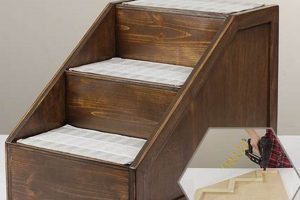
Constructing a miniature staircase or ramp to assist canines in accessing elevated surfaces is a practical solution for pets experiencing mobility limitations. This adaptation provides easier access to beds and other furniture, particularly beneficial for small breeds, senior dogs, or those recovering from injuries.
These assistive devices offer a significant advantage by reducing strain on a dog’s joints, minimizing the risk of injury associated with jumping. The historical context reveals a growing awareness of canine health and well-being, leading to increased demand for products that enhance their quality of life. They also empower pet owners to provide accessible options while creating solutions tailored to their dog’s specific needs and preferences.
The subsequent sections will address various designs, material selections, construction techniques, and safety considerations for creating such a structure. Detailed instructions and potential modifications will be provided to accommodate diverse dog breeds and home environments.
Construction Considerations for Canine Access Solutions
Effective fabrication of canine access solutions requires attention to detail and safety. The following tips provide guidance for constructing durable and functional structures.
Tip 1: Material Selection: Prioritize durable, non-toxic materials such as solid wood or high-density plywood. Ensure surfaces are free of splinters or sharp edges to prevent injury.
Tip 2: Stable Base: A wide, stable base is crucial for preventing tipping. Calculate dimensions based on the dog’s size and weight to ensure adequate support.
Tip 3: Step Height and Depth: Adjust step height and depth to accommodate the dog’s stride. Shallow steps are preferable for smaller breeds and those with limited mobility. A gradual incline is more accommodating than steep steps.
Tip 4: Surface Traction: Apply a non-slip surface to each step to enhance grip. Carpet remnants, rubber mats, or textured paint can provide secure footing.
Tip 5: Secure Fasteners: Utilize screws and wood glue for robust assembly. Counter-sink screws and fill holes to prevent protrusions. Inspect fasteners regularly to ensure integrity.
Tip 6: Weight Capacity: Determine the maximum weight capacity to ensure the structure can safely support the dog. Reinforce construction as needed for larger breeds.
Tip 7: Gradual Introduction: Introduce the structure gradually to the dog, using positive reinforcement. Guide the dog with treats and praise to encourage use.
These guidelines assist in creating a safe and functional structure, promoting the dog’s ease of movement and reducing the risk of injury. Careful planning and execution are essential for a successful outcome.
The concluding section will summarize key aspects and provide final considerations for ensuring a positive and lasting impact on the dog’s well-being.
1. Dimensions

Dimensional accuracy is a pivotal factor in the successful construction and functionality of assistive structures for canines accessing elevated surfaces. The height, depth, and width of each step directly influence the ease and safety with which a dog can utilize the device. Insufficient step depth may cause instability, while excessive height can exacerbate joint stress, particularly in smaller breeds or those with pre-existing orthopedic conditions. The overall width of the structure must accommodate the dog’s body size to ensure comfortable and balanced ascent or descent. Therefore, dimensional miscalculations can render the structure ineffective or, worse, pose a potential hazard.
Practical application of dimensional considerations involves precise measurement of both the target surface (e.g., bed height) and the canine’s physical attributes, such as leg length and stride. For instance, a miniature Dachshund requires steps with significantly lower rise and greater depth compared to a Labrador Retriever. Failure to account for these variations can result in the dog avoiding the structure altogether, thereby negating its intended purpose. Empirical data collected from veterinary rehabilitation centers underscores the correlation between appropriately scaled dimensions and improved compliance rates among canine patients utilizing assistive devices.
In conclusion, dimensional precision constitutes a non-negotiable element in the construction of assistive structures. Accurate measurement, careful calculation, and customization to the individual dog’s needs are paramount. While aesthetic considerations may influence material choices, the dimensional integrity of the structure must take precedence to ensure both its utility and the dog’s well-being. Challenges arise primarily from a lack of detailed planning and measurement, reinforcing the need for thorough pre-construction assessment.
2. Materials

The selection of materials is critical to the integrity, safety, and longevity of canine assistive devices. The chosen materials directly influence structural stability, resistance to wear, and potential toxicity. For example, the use of untreated softwood may lead to splintering, posing a risk of injury to the animal. Conversely, durable hardwoods, such as oak or maple, provide superior strength and resistance to damage from canine use. The effect of material choice is thus a direct determinant of the device’s usability and safety.
The practical significance of understanding material properties extends to the selection of appropriate surface coverings. Carpet remnants, while providing traction, can harbor allergens and become difficult to clean. Alternatively, rubberized coatings offer improved grip and are easily sanitized, thereby reducing the risk of bacterial contamination. Furthermore, fasteners, such as screws and bolts, must be selected with consideration for their resistance to corrosion and their ability to maintain structural integrity under repeated stress. Real-world examples of improperly constructed devices highlight the consequences of neglecting these considerations, resulting in premature failure and potential injury to the canine user.
In summary, material selection transcends mere aesthetic preference, representing a foundational element of canine assistive device construction. A comprehensive understanding of material properties, coupled with careful consideration of the device’s intended use, is essential for ensuring a safe and functional outcome. Challenges in material selection often arise from budgetary constraints or a lack of awareness regarding material properties. These challenges necessitate a balanced approach, prioritizing safety and durability over purely cost-driven decisions. The ultimate goal is to provide an assistive device that enhances the canine’s quality of life without compromising its well-being.
3. Stability

The concept of stability is paramount in the design and construction of canine assistive devices. The structural integrity of “diy bed steps for dogs” directly impacts the safety and well-being of the animal utilizing it. A lack of stability can lead to tipping, collapse, or other failures, potentially causing injury.
- Base Width and Support
The width of the base is crucial for preventing lateral instability. A wider base provides a lower center of gravity, making the structure more resistant to tipping. Real-world examples demonstrate that structures with narrow bases are more prone to toppling, particularly when a dog shifts its weight during ascent or descent. Proper weight distribution across the entire base is critical to preventing localized stress points that could lead to structural failure.
- Material Rigidity
The materials used in construction must possess sufficient rigidity to withstand the dog’s weight without significant deflection or deformation. Flexible materials can compromise the structural integrity of the steps, leading to instability and potential collapse. Rigid materials, such as solid wood or reinforced composites, provide a stable platform for the dog to navigate. The selection of appropriate materials with adequate rigidity is a fundamental requirement for ensuring structural stability.
- Joint Integrity
The joints connecting the various components of the structure must be strong and secure to prevent loosening or separation over time. Weak joints can compromise the overall stability of the steps, creating a hazard for the dog. The use of robust fasteners, such as screws and bolts, in conjunction with adhesives, can enhance joint integrity. Regular inspection and maintenance of the joints are essential for detecting and addressing any signs of weakening or deterioration.
- Surface Contact
Adequate contact between the base of the structure and the floor is necessary to prevent slippage or movement. A smooth, hard floor can reduce the stability of the steps, particularly if the base is not equipped with non-slip pads or feet. Maximizing surface contact and utilizing materials with high friction coefficients can improve the overall stability of the device.
In conclusion, stability is a multifaceted consideration in the context of canine assistive devices. Addressing each of these components contributes to a safer and more reliable product, enhancing the dog’s ability to access elevated surfaces without risk of injury. Prioritizing stability through thoughtful design and construction is crucial for ensuring the longevity and effectiveness of “diy bed steps for dogs”.
4. Incline
Incline, referring to the angle of ascent, represents a critical design parameter in constructing canine assistive devices, and directly impacts the ease and safety with which dogs navigate elevated surfaces. A steeper incline necessitates greater effort and range of motion, posing a potential hazard, particularly for senior dogs, those with arthritis, or breeds predisposed to spinal issues. Conversely, a gentler incline minimizes strain on joints and muscles, promoting smoother and more comfortable ambulation. The relationship between incline and canine well-being is therefore a primary consideration.
The practical application of incline optimization is observed in custom-built ramps and steps. Real-world examples include veterinary rehabilitation settings where graduated inclines are employed to assist post-surgical patients in regaining mobility. Similarly, in home environments, a carefully calibrated incline can enable aging dogs to maintain independence and access favored resting places, thus improving their quality of life. The significance of incline is further exemplified in cases where excessively steep steps led to dogs refusing to use the device, highlighting the need for a design that aligns with the animal’s physical capabilities and limitations.
The design of these assistive devices must balance the desired reach with the dog’s limitations. Finding a moderate slope is vital. While a gentler incline is generally preferable, excessively shallow inclines increase the device’s overall footprint, potentially rendering it impractical in confined spaces. A reasonable trade-off between slope and spatial considerations is necessary to maximize both safety and functionality. The optimal incline is determined by an analysis of the dog’s physical abilities, the height of the elevated surface, and the available space for the assistive structure. Failing to carefully adjust incline will lead to injury.
5. Traction
Traction is a fundamental consideration in the construction of assistive devices for canines, specifically impacting their safety and ease of use. Insufficient traction can lead to slips, falls, and potential injuries, negating the intended benefits of such structures. Adequate traction provides the necessary grip for secure ambulation, ensuring the dog can confidently ascend and descend.
- Surface Material
The choice of surface material directly influences traction. Smooth surfaces, such as polished wood or bare plastic, offer minimal grip and increase the risk of slippage. Conversely, materials with higher friction coefficients, such as carpet, rubber, or textured coatings, provide enhanced traction. The selection of an appropriate surface material is paramount in ensuring the safety and effectiveness of the assistive device.
- Textural Enhancement
Applying textural enhancements to the surface can further improve traction. This can include the addition of non-slip strips, grooved patterns, or textured paint. These enhancements create additional points of contact, increasing friction and reducing the likelihood of slipping. Textural enhancements are particularly beneficial for dogs with limited mobility or those prone to instability.
- Maintenance and Cleanliness
Maintaining a clean surface is essential for preserving traction. Dirt, debris, and moisture can reduce friction and increase the risk of slippage. Regular cleaning with appropriate cleaning agents helps to remove contaminants and maintain the effectiveness of the traction-enhancing features. Proper maintenance is crucial for ensuring the long-term safety and functionality of the assistive device.
- Environmental Considerations
The surrounding environment can also impact traction. Wet or slippery floors adjacent to the assistive device can pose a hazard. Providing a clear and dry pathway leading to and from the steps or ramp is essential for preventing accidents. Addressing environmental factors contributes to a safer overall experience for the canine user.
The integration of appropriate traction-enhancing measures into the design and construction of canine assistive devices is a critical factor in ensuring their safety and usability. A holistic approach, considering surface materials, textural enhancements, maintenance practices, and environmental factors, is necessary for providing a secure and stable environment for canine ambulation. By prioritizing traction, these devices can effectively enhance the quality of life for dogs with mobility limitations.
6. Durability

The durability of canine assistive devices is inextricably linked to their long-term effectiveness and safety. The longevity of “diy bed steps for dogs” is directly proportional to the quality of materials used, construction techniques employed, and the anticipated level of use. Inferior materials or poorly executed construction can lead to premature failure, requiring frequent repairs or replacements. Such failures not only incur additional costs but also pose a safety risk to the canine user. A durable device, conversely, provides a stable and reliable platform, reducing the likelihood of accidents and ensuring consistent support over an extended period.
The practical significance of durability is evident in households with multiple dogs or larger breeds. Assistive devices in these environments are subjected to increased stress and wear. For example, steps constructed from softwood may quickly become damaged or unstable under the weight of a large dog, necessitating reinforcement or replacement. Devices built from hardwood or reinforced composites, however, are better equipped to withstand repeated use and maintain their structural integrity. Regular inspection and maintenance contribute to extending the lifespan of the device. Examples of this include tightening fasteners, reapplying protective coatings, and addressing minor damage before it escalates.
In summary, the concept of durability is not merely a desirable attribute but a fundamental requirement for canine assistive devices. It is a cornerstone of safety, reliability, and cost-effectiveness. The challenge lies in balancing durability with affordability, requiring careful consideration of material selection and construction methods. Investing in durable materials and sound construction practices ultimately yields a greater return in terms of long-term performance, reduced maintenance, and enhanced canine safety. Ignoring durability has negative impact on the outcome.
7. Safety

Safety is a paramount consideration in the design and construction of canine assistive devices, given the potential for injury associated with improperly built or maintained structures. These devices aim to improve accessibility but can become hazardous if fundamental safety principles are not adhered to.
- Structural Integrity
The overall stability and load-bearing capacity are foundational to safety. Steps must be able to withstand the dog’s weight without collapsing or tipping. Real-world examples of poorly constructed steps reveal instances of structural failure leading to injuries. Ensuring a robust frame and secure connections is critical to mitigate this risk.
- Surface Traction
Adequate traction on each step minimizes the risk of slips and falls. Smooth surfaces are inherently dangerous, particularly for dogs with mobility issues. The incorporation of non-slip materials, such as carpet or rubberized coatings, provides enhanced grip. Regular inspection and replacement of worn traction surfaces are essential to maintain safety.
- Material Toxicity
Materials used in construction must be non-toxic to prevent health hazards if ingested. Pressure-treated lumber, certain paints, and adhesives can contain harmful chemicals. Selecting pet-safe materials and finishes eliminates the risk of poisoning or allergic reactions. Verification of material safety is a critical step in the construction process.
- Edge and Corner Mitigation
Sharp edges and corners present a physical hazard, increasing the risk of cuts and abrasions. Rounding off edges and covering sharp corners with protective materials reduces the likelihood of injury. Paying attention to detail in finishing the structure is essential for ensuring a safe environment for the dog.
The convergence of these safety facets underscores the importance of diligent planning and execution in the construction of canine assistive devices. Adhering to these principles not only minimizes the risk of injury but also ensures the long-term usability and effectiveness of the device, ultimately enhancing the dog’s quality of life. Each element requires attention.
Frequently Asked Questions
This section addresses prevalent queries regarding the construction and utilization of assistive devices designed to aid canines in accessing elevated surfaces. The information provided aims to clarify common misconceptions and offer practical guidance.
Question 1: What is the recommended step height for a small breed dog?
The optimal step height is contingent upon the dog’s leg length and overall size. Generally, step heights ranging from four to six inches are appropriate for smaller breeds. Precise measurements should be taken to ensure comfortable and safe ambulation.
Question 2: Which materials are considered non-toxic and safe for canine use?
Untreated hardwoods, such as maple and oak, are generally considered safe. Water-based, VOC-free paints and sealants are preferable. Avoid pressure-treated lumber and finishes containing heavy metals.
Question 3: How can stability be ensured during construction?
A wide base, robust joints, and a low center of gravity are essential for stability. Employ screws and glue for secure assembly. Reinforce weak points with additional supports as needed.
Question 4: What type of surface covering is most suitable for providing traction?
Carpet remnants, rubber mats, or textured paint can enhance traction. Ensure the covering is securely attached and free of loose edges that could pose a tripping hazard.
Question 5: How should a canine be introduced to a newly constructed assistive device?
A gradual introduction using positive reinforcement techniques is recommended. Guide the dog with treats and praise, allowing it to explore the structure at its own pace. Avoid forcing the dog to use the device.
Question 6: What maintenance is required to ensure the device remains safe and functional?
Regular inspection for loose fasteners, damaged surfaces, and signs of wear is necessary. Tighten screws, replace worn traction materials, and address any structural issues promptly.
Proper construction and maintenance are paramount. These guidelines can ensure safety and efficiency.
The following section will summarize all the information.
Conclusion
“diy bed steps for dogs” has been examined through various critical lenses, encompassing design considerations, material selection, construction techniques, and safety protocols. The multifaceted nature of this assistive device necessitates a thorough understanding of each element to ensure both functionality and canine well-being. Adherence to established guidelines and careful attention to detail are paramount in creating a structure that effectively addresses the needs of dogs with mobility limitations.
The successful implementation of such a project hinges upon a commitment to prioritizing the dog’s safety and comfort. Diligent application of the principles outlined herein will contribute to the creation of a valuable resource that enhances the quality of life for canine companions. Further research and development in this area may lead to even more innovative and effective solutions for canine accessibility.