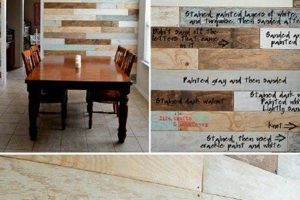
The construction and installation of decorative wall features by a homeowner represents a cost-effective approach to interior design. This process involves affixing pre-made or custom-cut panels to existing walls, thereby transforming the aesthetic of a room. Examples include applying wainscoting to a dining room or creating a full-wall panel effect in a living space.
Adding these features offers several advantages. They can increase property value, provide insulation, and conceal imperfections in the underlying wall structure. Historically, this type of wall treatment was a hallmark of affluent homes, signifying status and architectural refinement. Now, through accessible materials and techniques, this enhancement is available to a broader range of individuals.
The subsequent sections will delve into material selection, installation techniques, design considerations, and cost analysis for home improvement projects involving decorative wall cladding. Detailed instructions and potential challenges will also be addressed to facilitate a successful outcome.
Guidance for Decorative Wall Paneling Installation
This section provides essential guidance to ensure a successful and aesthetically pleasing outcome when undertaking decorative wall paneling projects.
Tip 1: Material Selection is Crucial. Opt for materials appropriate for the room’s environment. Moisture-resistant MDF is suitable for bathrooms, while solid wood may be preferable for living areas. Consider the long-term durability and aesthetic appeal of each option.
Tip 2: Precise Measurement and Planning are Essential. Accurately measure the wall surface and create a detailed plan before cutting any materials. This ensures proper alignment and minimizes material waste. Use a laser level to establish a perfectly horizontal line as a reference point.
Tip 3: Prioritize Wall Preparation. Ensure the existing wall surface is clean, smooth, and free from imperfections. Patch any holes or cracks and lightly sand the surface to promote proper adhesion of the paneling.
Tip 4: Employ a High-Quality Adhesive. Choose an adhesive specifically designed for paneling installation. Apply it evenly to the back of the panels, following the manufacturer’s instructions. Consider using construction adhesive in conjunction with finishing nails for added security.
Tip 5: Maintain Consistent Spacing. Use spacers or shims to maintain consistent spacing between panels. This ensures a uniform appearance and accommodates potential expansion and contraction due to temperature and humidity changes.
Tip 6: Utilize Proper Cutting Techniques. Employ a miter saw or a fine-toothed hand saw for accurate and clean cuts. When cutting, work on a stable surface and wear appropriate safety gear, such as eye protection.
Tip 7: Secure Panels Properly. Use finishing nails or a nail gun to secure the panels to the wall studs. Countersink the nails and fill the holes with wood filler for a seamless finish.
These guidelines promote a successful project execution, resulting in a visually appealing and durable wall paneling installation. Proper planning and execution contribute to long-term satisfaction and enhanced property value.
The subsequent sections will explore design inspiration, advanced techniques, and troubleshooting common challenges encountered during the installation process.
1. Material Suitability
Material suitability forms a cornerstone of any successful decorative wall paneling project. The chosen material directly impacts the installation process, the aesthetic outcome, and the longevity of the finished wall treatment. Inappropriate material selection can lead to premature degradation, structural instability, and diminished visual appeal, ultimately undermining the entire endeavor. For instance, installing standard MDF in a high-humidity environment like a bathroom will inevitably result in swelling, warping, and eventual failure of the paneling.
Conversely, selecting materials appropriate for the intended environment and design specifications yields significant benefits. Solid wood panels, while more expensive, offer superior durability and aesthetic character in living rooms or dining areas. Moisture-resistant MDF, engineered specifically for humid conditions, provides a cost-effective and long-lasting solution for bathrooms and kitchens. Further, lighter materials ease installation, while denser materials may necessitate stronger adhesives and fastening methods. Consider the selection of reclaimed wood for a rustic aesthetic; however, ensure proper treatment to prevent insect infestation or rot.
Therefore, a thorough understanding of material properties and their interaction with environmental factors is essential for executing a durable and visually pleasing decorative wall paneling project. Ignoring material suitability introduces significant risks, potentially leading to costly repairs or complete replacement. Prioritizing informed material selection ensures a successful and sustainable outcome, maximizing the value and longevity of the wall treatment.
2. Precise Measurements
Accurate dimensional assessment forms the foundational basis for successful decorative wall paneling projects. Deviations from precise measurements introduce complexities that impact both the aesthetic outcome and the structural integrity of the finished installation. Meticulous attention to detail during the measurement phase mitigates potential issues and ensures a professional-grade result.
- Minimizing Material Waste
Accurate measurements allow for efficient material utilization, reducing waste and associated costs. Determining exact dimensions enables precise cutting, minimizing scrap and maximizing the yield from purchased materials. For example, calculating the exact square footage needed for a wainscoting project prevents over-purchasing materials, contributing to budgetary control and environmental responsibility.
- Ensuring Proper Panel Alignment
Precise measurements are crucial for achieving proper alignment and a seamless appearance. Inaccurate dimensions lead to misaligned panels, gaps, and an unprofessional finish. For instance, discrepancies in wall height measurements can result in uneven panel placement, detracting from the overall aesthetic appeal. Accurate measurements facilitate consistent spacing and alignment, enhancing visual coherence.
- Facilitating Accurate Cuts
Detailed measurements are essential for executing accurate cuts, particularly when dealing with complex shapes or architectural features. Precise dimensions enable the creation of clean, professional edges and corners. As an example, accurately measuring angles around windows or doors allows for seamless panel integration, resulting in a refined and visually appealing finish.
- Mitigating Installation Challenges
Thorough dimensional assessments preemptively identify potential installation challenges, enabling proactive problem-solving. Accurate measurements reveal irregularities in wall surfaces or discrepancies in room dimensions, allowing for necessary adjustments to panel sizes or installation techniques. By anticipating these challenges, the process avoids costly rework and ensures efficient project completion.
The integration of precise measurements throughout the decorative wall paneling process contributes significantly to the overall success and aesthetic appeal of the finished product. From minimizing material waste to ensuring proper panel alignment, accurate dimensional assessments are paramount. The implementation of rigorous measurement protocols enhances both the efficiency and the quality of the installation, yielding a visually cohesive and professionally executed outcome.
3. Surface Preparation
Surface preparation is an indispensable preliminary phase in decorative wall paneling projects. Its efficacy directly influences the adhesion, alignment, and longevity of the installed panels. Neglecting this foundational step invariably leads to compromised aesthetics and potential structural instability.
- Cleaning and Degreasing
The removal of accumulated dirt, dust, grease, and other contaminants from the existing wall surface is paramount. These substances impede the proper bonding of adhesives, thereby compromising the integrity of the installation. For instance, residual grease from a kitchen environment can prevent adhesive from forming a secure bond with the wall, leading to panel delamination over time. Effective cleaning agents and degreasers are required to ensure a pristine surface for optimal adhesion.
- Patching Imperfections
The presence of holes, cracks, or other surface irregularities necessitates remediation prior to panel installation. These imperfections not only detract from the aesthetic uniformity of the finished wall but also create weak points that can undermine the structural stability of the paneling. Appropriate patching compounds and techniques are essential for creating a smooth, even substrate that supports the panels and distributes stress evenly.
- Priming for Adhesion
The application of a primer serves multiple functions, including enhancing adhesion, sealing porous surfaces, and providing a uniform base for panel installation. Primers specifically designed for use with adhesives create a micro-textured surface that promotes optimal bonding. They also prevent the absorption of adhesive into the wall, ensuring sufficient adhesive remains on the surface to form a strong bond with the panels. Different primers exist for different material types, such as drywall or plaster, and selecting the correct primer is critical.
- Ensuring Levelness and Flatness
Significant deviations from levelness or flatness in the underlying wall surface can manifest as visible distortions in the installed paneling. Corrective measures, such as shimming or furring strips, may be necessary to create a level and flat substrate. Failure to address these issues can result in panels that appear uneven, misaligned, or bowed, detracting from the overall aesthetic quality. Accurate measurement tools, such as laser levels, are essential for assessing and correcting these deviations.
The multifaceted nature of surface preparation underscores its criticality in achieving successful decorative wall paneling outcomes. By systematically addressing cleaning, patching, priming, and leveling, project implementers ensure a stable, uniform, and adhesive-receptive substrate that supports the long-term integrity and aesthetic appeal of the installed panels. Attention to detail during this phase is an investment that yields significant returns in the form of enhanced durability and visual quality.
4. Secure Fastening
Secure fastening represents a critical determinant in the success and longevity of any decorative wall paneling endeavor. The method by which panels are affixed to the underlying wall structure directly influences the stability, appearance, and overall durability of the finished installation. Insufficient or inappropriate fastening techniques can lead to panel detachment, misalignment, and potential safety hazards. The implementation of robust fastening strategies, tailored to material properties and structural considerations, is therefore paramount.
The choice of fastening method should consider several factors. Panel weight, wall material, and desired aesthetic are primary determinants. Lightweight panels applied to drywall may be adequately secured with construction adhesive and finishing nails. Heavier panels, or installations over plaster or concrete, often necessitate the use of screws anchored directly into wall studs or masonry anchors. Improperly secured panels may exhibit bowing, warping, or even complete detachment over time, particularly in environments subject to temperature or humidity fluctuations. Securing baseboards using only adhesive, for example, might appear sufficient initially, but the lack of mechanical fastening leads to separation and movement. Equally vital is the correct choice of fastener material to prevent corrosion and staining.
In summary, secure fastening is not merely a step in the decorative wall paneling process; it is a foundational principle that governs the installation’s structural integrity and aesthetic appeal. Careful consideration of material properties, wall construction, and environmental factors is essential to selecting and implementing the most appropriate fastening method. Prioritizing secure fastening mitigates potential risks and ensures a durable, visually cohesive, and professionally executed wall paneling project. The ramifications of inadequate fastening, such as panel detachment and potential hazards, underscore the critical importance of this element.
5. Level Installation
Maintaining precise horizontal and vertical alignment during the installation of decorative wall panels is critical to achieving a professional and aesthetically pleasing result. Deviations from level can introduce visual distortions and compromise the overall visual impact of the wall treatment.
- Aesthetic Harmony
Level installation directly contributes to the visual harmony of the space. Panels that are not installed level can create a sense of unease and disharmony, detracting from the intended aesthetic. For example, slightly askew panels in a living room may subtly disrupt the visual balance, leading to a subconscious feeling of unease despite the overall design being well-executed.
- Structural Integrity
Ensuring level installation is not merely an aesthetic concern; it can also impact the structural integrity of the paneling. Uneven pressure distribution caused by panels being out of level can lead to stress points and potential warping or detachment over time. For instance, panels pressed together at an angle can create undue pressure on the adhesive or fasteners, leading to premature failure.
- Alignment with Architectural Features
Level installation ensures that the paneling aligns correctly with existing architectural features such as windows, doors, and ceilings. Misalignment with these elements can create jarring visual inconsistencies and detract from the overall design. An example would be wainscoting that slopes slightly downwards relative to a level door frame, creating a noticeable and undesirable visual discrepancy.
- Ease of Subsequent Installations
Prioritizing level installation simplifies subsequent additions or modifications to the paneled wall. If the initial paneling is not level, any future additions will require careful adjustments to compensate for the existing misalignment, increasing the complexity and difficulty of the project. Starting with a level foundation ensures that subsequent installations will seamlessly integrate with the existing paneling.
The importance of level installation in wall paneling transcends mere aesthetic considerations. It influences the long-term structural integrity of the paneling and its harmonious integration with existing architectural elements. Accurate leveling techniques contribute significantly to the creation of a visually cohesive and professionally executed interior design. Consideration must always be given, because it can greatly impact the result.
6. Seamless Finish
Achieving a seamless finish in do-it-yourself paneled walls is paramount for creating a polished, professional aesthetic. This entails careful attention to detail throughout the installation process, minimizing visible joints and imperfections to yield a unified and visually appealing surface. The success of this endeavor hinges on meticulous execution and the selection of appropriate materials and techniques.
- Joint Compound Application
Effective application of joint compound is crucial for concealing the seams between individual panels. This involves multiple thin coats, each meticulously sanded smooth to blend seamlessly with the panel surfaces. Insufficient compound or inadequate sanding will result in visible ridges and imperfections, detracting from the overall aesthetic. The process of joint compound application requires patience and precision, for instance, the compound must be feather out, to create an illusion of seamless walls.
- Caulking and Filling Gaps
Caulking is employed to fill any remaining gaps or imperfections along edges and corners. This prevents the intrusion of moisture and creates a clean, finished appearance. The color of the caulk should closely match the panel color to ensure a cohesive look. In corners where the panel meets the ceiling the caulk is applied, to prevent damage from humidity.
- Paint Selection and Application
The selection of appropriate paint is a critical component of achieving a seamless finish. The paint should be of high quality and formulated for use on the panel material. Multiple thin coats, applied using a consistent technique, will produce a uniform and durable finish. Using a high quality paint ensures the color consistency, and less layering.
- Concealing Fasteners
Proper concealment of fasteners, such as nails or screws, is essential for a seamless appearance. This involves filling the fastener holes with wood filler or putty, sanding the filler flush with the panel surface, and then painting or staining to match the surrounding area. Exposed fasteners detract significantly from the aesthetic and should be meticulously addressed. The fillers must be color corrected, to provide best results.
The successful integration of these techniques is fundamental to achieving a seamless finish in paneled walls. By meticulously addressing each aspect of the installation process, from joint compound application to fastener concealment, homeowners can create a visually stunning and professionally executed wall treatment. The meticulous application results in a long-lasting and appealing aesthetic of the paneled walls.
Frequently Asked Questions
The following section addresses common inquiries regarding the installation, maintenance, and overall suitability of decorative wall paneling in residential settings. These questions aim to provide clarity and guidance for homeowners considering this type of interior renovation.
Question 1: What is the expected lifespan of decorative wall paneling?
The longevity of decorative wall paneling is contingent upon material selection, installation quality, and environmental factors. Solid wood paneling, properly maintained, can last for several decades. Engineered wood products, such as MDF, may have a shorter lifespan, particularly in humid environments. Periodic inspection and maintenance, including cleaning and minor repairs, will extend the paneling’s durability.
Question 2: Can decorative wall paneling be installed over existing wallpaper?
Installing paneling over existing wallpaper is generally not recommended. Wallpaper can compromise the adhesion of the paneling and may harbor moisture, leading to mold growth. Removal of the wallpaper is advisable to ensure a secure and long-lasting installation.
Question 3: Does decorative wall paneling increase property value?
High-quality decorative wall paneling can enhance the aesthetic appeal of a home and potentially increase its market value. The impact on property value depends on the design, materials used, and the overall quality of the installation. Well-executed paneling projects can contribute to a more sophisticated and desirable interior.
Question 4: What is the best way to clean decorative wall paneling?
Cleaning methods vary depending on the paneling material. Solid wood paneling can be cleaned with a damp cloth and a mild wood cleaner. Engineered wood products may require specialized cleaning solutions. Avoid abrasive cleaners or excessive moisture, which can damage the paneling.
Question 5: Is decorative wall paneling suitable for bathrooms?
Paneling can be used in bathrooms, but material selection is crucial. Moisture-resistant MDF or solid wood treated with a water-repellent sealant are suitable choices. Adequate ventilation is essential to prevent moisture buildup and potential damage to the paneling.
Question 6: What are the common mistakes to avoid during installation?
Common installation errors include improper surface preparation, inaccurate measurements, inadequate adhesion, and failure to ensure level installation. Thorough planning, precise execution, and adherence to recommended installation techniques are essential to avoid these mistakes.
In summary, decorative wall paneling presents a viable option for enhancing the aesthetic and potentially increasing the value of a residential property. However, careful consideration of material selection, installation techniques, and maintenance practices is crucial for ensuring a successful and long-lasting outcome.
The subsequent section explores advanced design considerations and innovative approaches to decorative wall paneling projects.
Conclusion
This exploration of DIY paneled walls has underscored the multifaceted nature of this interior design project. From material selection and precise measurements to surface preparation, secure fastening, level installation, and a seamless finish, each element contributes significantly to the overall success and longevity of the installation. The importance of informed decision-making, meticulous execution, and a thorough understanding of material properties cannot be overstated.
As homeowners consider embarking on such projects, a rigorous assessment of their skills, resources, and the environmental conditions of the intended space is paramount. A commitment to quality materials, adherence to best practices, and a willingness to adapt to unforeseen challenges will yield the most rewarding and enduring results. The potential for aesthetic enhancement and increased property value warrants a deliberate and well-informed approach to the DIY paneled walls endeavor. Prior planning is key.