A self-assembled picture display, generously sized, allows for showcasing images or artwork. This frequently involves utilizing readily available materials and basic construction techniques to create a personalized presentation piece. For example, individuals might use reclaimed wood and simple tools to build a structure capable of holding a panoramic photograph.
The advantage of constructing a substantial display structure oneself lies in the cost savings compared to purchasing a pre-made item, particularly at larger dimensions. Furthermore, the process enables complete customization of size, material, and aesthetic, aligning perfectly with the intended dcor and the image it will hold. Historically, such endeavors reflect a tradition of resourcefulness and personal expression in home furnishing.
Subsequent sections will delve into various material options appropriate for this construction, detail the necessary tools and techniques, and provide guidance on design considerations for ensuring a durable and visually appealing outcome.
Tips for Constructing a Substantial Photographic Display
The following guidelines are offered to enhance the success and longevity of a self-made, sizable structure designed to showcase photographic or artistic works.
Tip 1: Material Selection is Paramount. Opt for lumber that is kiln-dried to minimize warping or twisting over time. Consider hardwoods such as oak or maple for increased durability, particularly for larger dimensions. Alternatively, engineered wood products like MDF can provide a stable and cost-effective substrate for painted finishes.
Tip 2: Precise Measurements are Essential. Before commencing construction, meticulously measure the intended image and add allowance for a secure border or mounting system. Inaccurate dimensions will compromise the overall aesthetic and functionality of the finished piece.
Tip 3: Corner Reinforcement is Crucial. Large formats are susceptible to stress at the corners. Implement robust corner joints utilizing techniques such as mitered corners with splines, dowels, or metal corner brackets to ensure structural integrity.
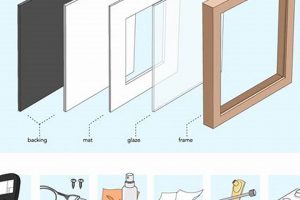
Tip 4: Consider Glazing Options Carefully. When incorporating a protective covering, evaluate acrylic or glass options. Acrylic offers shatter resistance but can scratch more easily than glass. Opt for UV-protective glazing to minimize fading of the displayed image over extended periods.
Tip 5: Implement a Secure Hanging System. The weight of a substantial display requires a robust hanging mechanism. Employ heavy-duty D-rings or wire systems appropriately rated for the anticipated load. Ensure secure attachment to wall studs for optimal stability.
Tip 6: Finishing Enhances Longevity and Aesthetics. Apply a protective finish appropriate for the chosen material. This may involve staining, painting, or sealing the wood to prevent moisture damage and enhance visual appeal. Consider multiple coats for increased durability.
Tip 7: Backing Boards Provide Stability. Adding a solid backing board, such as hardboard or foam core, to the structure will prevent warping and provide a smooth surface for mounting the photograph or artwork. Ensure the backing is securely attached to the structure.
Adhering to these recommendations will contribute to the creation of a stable, visually pleasing, and enduring showcase piece.
The subsequent section will address the practical aspects of assembling the components and achieving a professional-looking finish.
1. Material Suitability
Material suitability is a foundational consideration in the successful creation of any self-made, sizable photographic display. The selected materials directly impact the structure’s stability, aesthetic qualities, and resistance to environmental factors. Therefore, informed choices regarding material selection are paramount to achieving a durable and visually appealing outcome.
- Wood Species and Stability
The type of wood chosen significantly affects the structural integrity of the frame. Hardwoods such as oak, maple, or cherry offer superior strength and resistance to warping compared to softwoods like pine. However, hardwoods are typically more expensive and require specialized tools for precise cutting and joining. Kiln-dried lumber is essential to minimize moisture content and prevent future distortion.
- Engineered Wood Alternatives
Engineered wood products, such as MDF (Medium-Density Fiberboard) or plywood, present alternatives to solid wood. These materials offer greater dimensional stability and are less prone to warping, making them suitable for larger format displays. MDF provides a smooth surface ideal for painting, while plywood offers a more natural wood grain appearance. However, engineered woods may lack the aesthetic appeal and perceived value of solid hardwoods.
- Fastening Method Compatibility
The chosen fastening method (e.g., screws, nails, glue, dowels) must be compatible with the selected material. Softwoods require different fastening techniques than hardwoods to ensure secure joints. MDF and plywood may require specialized screws or adhesives to prevent splitting or delamination. The load-bearing capacity of the chosen fasteners must be sufficient to support the weight of the entire structure, including the image and any glazing.
- Finish Compatibility and Longevity
The chosen finish (e.g., paint, stain, sealant) must be compatible with the selected material to ensure proper adhesion and longevity. Certain wood species may require specific primers or sealers to prevent bleed-through or uneven absorption. The finish should provide adequate protection against moisture, UV radiation, and scratches to preserve the appearance of the frame and the displayed image over time.
In summary, the selection of appropriate materials is not merely an aesthetic consideration but a critical determinant of the stability, durability, and long-term performance of a self-constructed photographic display. Careful evaluation of factors such as wood species, engineered wood alternatives, fastening compatibility, and finish requirements is essential for achieving a professional-looking and enduring result.
2. Dimensional Accuracy
In the context of crafting a sizable self-made picture display, dimensional precision is paramount. Errors in measurement and execution directly impact the final product’s aesthetic appeal and functional integrity. Incorrect dimensions can lead to visible gaps, misaligned corners, and an inability to properly secure the image within the structure.
The effect of dimensional inaccuracies is magnified in larger formats. A slight deviation of even a millimeter, multiplied across the span of a large frame, can result in significant discrepancies. For instance, if the internal dimensions are smaller than the image being displayed, the image will buckle or require trimming, compromising its original composition. Conversely, if the internal dimensions are too large, the image will shift within the structure, detracting from its visual presentation. Moreover, inconsistencies in the dimensions of individual frame components, such as rails and stiles, can result in a visibly uneven or warped appearance.
To achieve dimensional accuracy, several techniques are essential. The use of precision measuring tools, such as digital calipers and accurate measuring tapes, is fundamental. Careful attention to detail during the cutting process, ensuring that all pieces are precisely square and of the correct length, is equally critical. Furthermore, meticulous alignment during assembly, employing clamps and jigs to maintain consistent angles and dimensions, is necessary to prevent cumulative errors. The pursuit of dimensional accuracy in this construction endeavor directly correlates with the attainment of a professional-quality and visually appealing showcase piece.
3. Joint Strength
The structural integrity of any self-assembled, sizable photographic display hinges critically on the robustness of its joints. Weak joints compromise the overall stability of the structure, leading to potential failure under its own weight or external forces. Effective joint construction is therefore a fundamental consideration in the design and execution of such projects.
- Mitered Joints and Reinforcement
Mitered joints, characterized by angled cuts that meet to form a corner, offer an aesthetically pleasing seamless appearance. However, they inherently possess a limited surface area for adhesion, making them structurally weak without reinforcement. Techniques such as splines, dowels, or metal corner brackets are essential to bolster the joint’s resistance to tensile and shear forces. Without such reinforcement, mitered corners in larger frames are prone to separation and eventual failure.
- Mortise and Tenon Joints
Mortise and tenon joints, involving a projecting tenon inserted into a corresponding mortise, offer superior strength compared to mitered joints alone. This type of joint provides a larger surface area for adhesive bonding and offers mechanical interlocking, significantly increasing resistance to racking forces. While more complex to execute, mortise and tenon joints are particularly well-suited for supporting the weight of large frames.
- Butt Joints with Fasteners
Butt joints, where two pieces of material are joined end-to-end, represent the simplest form of construction. However, they are inherently weak and require reinforcement with mechanical fasteners such as screws, nails, or staples. The effectiveness of a butt joint is directly proportional to the number and size of the fasteners used, as well as the holding power of the material being joined. Glue can be used to supplement the strength but cannot replace fasteners entirely.
- Adhesive Selection and Application
The choice of adhesive plays a crucial role in joint strength, regardless of the joint type. Wood glue, epoxy, or construction adhesive should be selected based on the specific materials being joined and the anticipated environmental conditions. Proper surface preparation, including cleaning and sanding, is essential for optimal adhesion. Applying the adhesive uniformly and clamping the joint securely during the curing process ensures maximum bond strength. Insufficient adhesive application or inadequate clamping significantly reduces the joint’s load-bearing capacity.
The implementation of robust jointing techniques, coupled with appropriate adhesive selection and meticulous execution, directly influences the long-term stability and durability of a sizable photographic display. Compromising on joint strength can lead to structural failure, jeopardizing the displayed image and the integrity of the entire piece.
4. Support Mechanism
The integration of a suitable support mechanism is non-negotiable in the creation of a substantial self-made photographic display. The size and weight inherent in such constructions necessitate a system capable of securely and reliably suspending the structure. Without adequate support, the display risks detachment, leading to potential damage to the image, the frame itself, and surrounding objects or individuals. The effectiveness of the chosen support directly influences the safety and longevity of the displayed artwork.
Various support mechanisms exist, each suited to different weight capacities and wall types. Wire systems, employing heavy-gauge wire attached to D-rings on the frame’s back, are common for medium-sized displays. However, for larger and heavier frames, multiple D-rings and reinforced wire are crucial to distribute the load evenly. Alternatively, French cleats, consisting of interlocking beveled strips of wood, offer a robust and concealed mounting solution. In this scenario, one cleat is affixed to the wall, while the matching cleat is attached to the frame. For extremely heavy displays, specialized mounting hardware designed for commercial applications might be required, necessitating professional consultation to ensure proper installation. A scenario illustrating the importance of appropriate support is the collapse of a poorly mounted, self-made display in a public gallery, resulting in damage to a valuable photograph and posing a safety hazard to visitors. This underscores the practical significance of understanding and implementing a robust support strategy.
In conclusion, selecting and implementing an appropriate support system is paramount to the successful realization of a large-scale self-made photographic display. Factors such as weight, wall type, and mounting hardware must be carefully considered to ensure the safety and stability of the installation. Neglecting this crucial aspect can lead to disastrous consequences, highlighting the inextricable link between the support mechanism and the overall success of the project.
5. Surface Treatment
Surface treatment profoundly influences both the aesthetic appeal and the long-term durability of a self-assembled, large-format photographic display. The chosen treatment acts as a protective barrier against environmental factors, mitigating damage from moisture, ultraviolet radiation, and physical abrasion. Untreated or improperly treated surfaces are susceptible to degradation, leading to warping, discoloration, and eventual structural failure. Consequently, the application of appropriate surface treatments is a critical component of the overall construction process, directly affecting the longevity and visual quality of the finished piece. For example, a raw wood structure exposed to high humidity environments will absorb moisture, causing the wood to swell and potentially distort the entire frame, rendering it unusable.
The selection of a specific surface treatment should align with the chosen material and the intended aesthetic. Options range from clear sealants that enhance the natural grain of the wood to opaque paints that provide a uniform color and texture. Each option necessitates specific preparation techniques, such as sanding and priming, to ensure proper adhesion and prevent imperfections. Furthermore, UV-resistant coatings are essential for frames exposed to direct sunlight, as they minimize fading and discoloration of both the frame itself and the displayed image. Consider a scenario where a handcrafted frame intended for outdoor display is treated with a non-UV resistant sealant. Over time, the frame finish might yellow and crack, and the photograph it holds might experience significant fading, diminishing the artwork’s visual impact.
In summary, surface treatment represents a crucial element in the successful realization of a self-made, large photographic display. It not only enhances the visual presentation but also provides essential protection against environmental factors, ensuring the structure’s longevity. The careful selection and application of appropriate surface treatments are therefore integral to achieving a durable, visually appealing, and enduring showcase piece.
6. Image Protection
Image protection, in the context of self-constructed large format picture displays, constitutes a critical component in preserving the integrity and longevity of the displayed artwork. The absence of adequate protective measures renders the image vulnerable to environmental degradation, physical damage, and irreversible alteration. This section explores essential facets of image protection relevant to the construction and utilization of such displays.
- UV Radiation Mitigation
Ultraviolet (UV) radiation, a component of natural and artificial light, poses a significant threat to photographic prints and artwork. Prolonged exposure to UV light induces fading, discoloration, and embrittlement of the image substrate. The implementation of UV-protective glazing, such as acrylic or specialized glass, filters out harmful UV rays, thereby mitigating the risk of irreversible damage. For example, archival-quality prints encased behind UV-filtering acrylic maintain their original color fidelity and tonal range for extended periods, while unprotected prints exhibit noticeable degradation within a comparable timeframe. This measure extends the lifespan and preserves the aesthetic value of the displayed image.
- Physical Barrier against Dust and Airborne Contaminants
Dust, dirt, and other airborne contaminants accumulate on the surface of displayed images, obscuring detail and accelerating deterioration. A physical barrier, such as glazing or a sealed enclosure, prevents the ingress of these contaminants, maintaining the image’s clarity and preventing the need for frequent cleaning. For instance, a large-format photograph exhibited in a dusty environment without protective glazing requires regular cleaning, which can abrade the surface and introduce scratches. Conversely, an enclosed display minimizes the need for cleaning and safeguards the image from physical damage.
- Protection from Physical Damage
Large-format images, particularly those displayed in high-traffic areas, are susceptible to accidental damage from impacts, scratches, and handling. A protective layer, such as acrylic or glass, shields the image from these potential hazards. Acrylic, while more prone to scratching than glass, offers superior shatter resistance, making it a suitable choice for environments where safety is a primary concern. In the event of an accidental impact, the protective layer absorbs the force, preventing damage to the underlying image. This safeguards the artwork from irreparable harm and ensures its continued display.
- Control of Humidity and Temperature
Fluctuations in humidity and temperature can induce warping, cracking, and mold growth in photographic prints and artwork. While complete environmental control is often impractical, certain measures can mitigate these risks. The use of acid-free backing boards and archival-quality mounting materials minimizes the potential for chemical degradation. Furthermore, avoiding direct exposure to extreme temperature or humidity fluctuations, such as placing the display near a heating vent or in a damp basement, contributes to the long-term preservation of the image. For example, high humidity levels promote the growth of mold spores on the surface of unprotected paper prints, leading to irreversible staining and deterioration.
The aforementioned facets of image protection are integral to the creation of enduring and visually appealing self-made large format photographic displays. By implementing these measures, individuals can safeguard their treasured images from the detrimental effects of environmental factors and physical damage, ensuring their continued enjoyment for years to come. The investment in appropriate image protection is therefore a prudent measure, preserving the value and aesthetic integrity of the displayed artwork.
Frequently Asked Questions
This section addresses common inquiries and misconceptions surrounding the construction and utilization of self-made, large-format photographic displays.
Question 1: What is the optimal wood type for constructing a frame intended for outdoor display?
For outdoor applications, rot-resistant wood species such as cedar, redwood, or treated lumber are recommended. These materials exhibit inherent resistance to moisture and fungal decay, extending the lifespan of the structure. Ensure that all fasteners and hardware are also corrosion-resistant to prevent premature failure.
Question 2: How can warping be prevented in large frames constructed from multiple pieces of wood?
Warping can be minimized by selecting kiln-dried lumber, which has reduced moisture content. Employing robust jointing techniques, such as mortise and tenon or mitered corners with splines, provides structural stability. Additionally, applying a sealant or finish to all surfaces of the wood prevents moisture absorption and subsequent distortion.
Question 3: What is the recommended thickness for glazing materials used in large photo displays?
The appropriate thickness for glazing materials depends on the overall size of the display and the level of protection required. Acrylic or glass with a thickness of at least 3mm is generally recommended for large formats to provide adequate support and prevent bowing or breakage. For high-traffic areas or environments where safety is a concern, thicker and more shatter-resistant materials may be necessary.
Question 4: How should a large photograph be securely mounted within the display structure?
Acid-free mounting techniques are essential to prevent damage to the photograph over time. Archival-quality mounting corners, photo tabs, or acid-free adhesive tapes can be used to secure the image to a backing board. Avoid using pressure-sensitive adhesives directly on the photograph, as these can cause irreversible damage. Ensure that the mounting method allows for expansion and contraction of the image due to temperature and humidity changes.
Question 5: What hanging hardware is appropriate for supporting the weight of a large photo display?
The selection of appropriate hanging hardware depends on the weight of the display and the type of wall it will be mounted on. Heavy-duty D-rings or wire systems, rated for the anticipated load, are recommended. For drywall installations, utilize wall anchors or mount the display directly to wall studs. French cleats offer a secure and concealed mounting option for heavier displays. Ensure that the hanging hardware is installed according to the manufacturer’s instructions.
Question 6: How can the accumulation of dust and contaminants within the display be minimized?
Sealing the display structure and glazing materials effectively prevents the ingress of dust and airborne contaminants. Applying a bead of caulk or sealant along the edges of the glazing minimizes gaps. Regular cleaning of the display surface with a soft, lint-free cloth removes accumulated dust and prevents buildup. In high-dust environments, consider using air filtration systems to reduce the overall concentration of airborne particles.
This FAQ underscores the importance of informed decision-making throughout the process, from material selection to mounting techniques, to ensure the creation of a durable and visually appealing photographic display.
Subsequent sections will explore advanced design considerations and aesthetic enhancements for these structures.
DIY Large Photo Frame
The preceding exposition detailed the multifaceted considerations inherent in the construction of a substantial self-made picture display. From the crucial selection of appropriate materials and the implementation of robust jointing techniques to the imperative of image protection and secure mounting, each aspect contributes significantly to the overall integrity and longevity of the finished piece. The dimensions, support mechanisms, and surface treatments require precise execution to prevent structural failure and aesthetic degradation.
The diligent application of the principles outlined herein enables the creation of a visually compelling and enduring showcase for photographic or artistic works. Future endeavors in this domain should prioritize sustainable material sourcing and explore innovative techniques for enhancing both the structural stability and the aesthetic appeal of these large-format displays. The craftsmanship applied to a picture’s housing is as important as the picture itself.