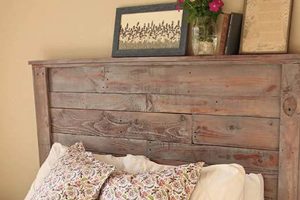
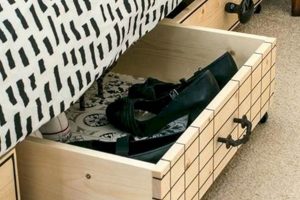
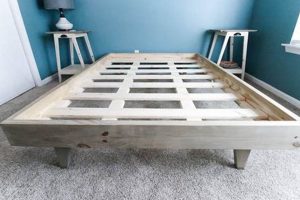
A self-constructed sleeping platform designed to accommodate a king-size mattress offers an alternative to purchasing commercially manufactured bed frames. These projects typically involve utilizing readily available materials, such as lumber, and employing fundamental carpentry techniques to create a structurally sound and aesthetically personalized piece of furniture. For instance, an individual might choose to construct a platform with integrated storage drawers or a headboard crafted from reclaimed wood.
Creating one’s own oversized bed frame can provide substantial cost savings when compared to retail prices, particularly for models featuring specialized designs or premium materials. Furthermore, this approach allows for customization to perfectly suit individual spatial constraints and aesthetic preferences. Historically, building personal furniture has been a practical necessity and a reflection of craftsmanship; the concept persists today as a method to exert control over design and budget.
The subsequent discussion will elaborate on essential design considerations, material selection, step-by-step construction methodologies, and relevant safety precautions necessary for the successful completion of such an undertaking. The exploration extends to optimizing the build for durability, ensuring proper mattress support, and incorporating desired aesthetic elements.
Construction Guidance
The following guidelines are intended to improve the structural integrity, longevity, and overall quality of a self-made oversized bed frame. Adherence to these recommendations will contribute to a more satisfactory outcome.
Tip 1: Prioritize Accurate Measurements: Precise dimensions are critical for ensuring the mattress fits snugly within the frame. Double-check all measurements against the manufacturer’s specifications for standard king-size mattresses (typically 76 inches wide by 80 inches long). Inaccuracies can lead to instability or the inability to properly accommodate the mattress.
Tip 2: Select Appropriate Lumber: The choice of wood directly impacts the bed’s load-bearing capacity and visual appeal. Hardwoods, such as oak or maple, offer superior strength and durability, suitable for heavier individuals or those desiring a long-lasting structure. Softwoods, like pine, provide a more economical option but may require reinforcement in weight-bearing areas.
Tip 3: Employ Robust Joinery Techniques: Proper joinery is essential for a stable and secure structure. Options include mortise and tenon joints, dowel joints, or reinforced butt joints with metal fasteners. Avoid relying solely on screws, as they can loosen over time. Glue, in conjunction with mechanical fasteners, provides added strength and stability.
Tip 4: Incorporate Adequate Support: A center support beam running the length of the bed frame is crucial for preventing mattress sagging. This beam should be constructed of a material comparable in strength to the side rails and be adequately supported by legs or a central vertical support structure.
Tip 5: Sand and Finish Surfaces Thoroughly: Proper sanding prepares the wood surface for finishing, ensuring a smooth and even application of stain, paint, or sealant. This step not only enhances the aesthetic appeal but also protects the wood from moisture damage and wear.
Tip 6: Ensure Adequate Ventilation: If the design incorporates a solid platform beneath the mattress, consider adding ventilation holes to prevent moisture buildup and potential mold growth. Strategically placed holes allow for airflow and maintain a drier environment beneath the mattress.
Tip 7: Prioritize Safety: Sand all edges and corners to prevent splinters or sharp points. Ensure all fasteners are countersunk and flush with the surface to avoid injury. Apply non-toxic finishes to minimize off-gassing and potential health concerns.
These tips underscore the importance of careful planning, material selection, and execution in achieving a functional and aesthetically pleasing outcome. Applying these principles will contribute to a more robust and reliable sleeping platform.
Following this guidance ensures a solid foundation for subsequent stages of the project. The next section will address common challenges encountered and potential solutions to maintain project momentum.
1. Design blueprint

A design blueprint serves as the foundational document for the creation of a self-assembled king-sized bed frame. It translates conceptual ideas into actionable plans, mitigating potential errors and material waste. A meticulously crafted blueprint ensures the finished product aligns with the intended aesthetic and functional specifications.
- Dimensional Accuracy
The blueprint dictates the precise dimensions of all components, including the overall frame size, headboard height, and leg placement. Accurate dimensional specifications are crucial for ensuring the mattress fits correctly and the bed frame integrates seamlessly into the intended space. Discrepancies in dimensional accuracy can result in structural instability or an inability to accommodate the mattress.
- Material Quantification
The blueprint facilitates the accurate quantification of necessary materials, such as lumber, fasteners, and finishing products. This quantification enables efficient procurement and minimizes material waste, contributing to cost-effectiveness. An itemized material list derived from the blueprint reduces the likelihood of unforeseen expenses due to material shortages.
- Structural Integrity Planning
The blueprint outlines the structural design of the bed frame, including the placement of support beams, joint types, and load-bearing elements. This planning ensures the finished product can safely support the weight of the mattress and occupants. A detailed structural plan minimizes the risk of structural failure or premature wear.
- Aesthetic Detailing
The blueprint incorporates aesthetic details such as the design of the headboard, the type of finish, and the overall style of the bed frame. These details contribute to the visual appeal of the finished product and allow for customization to suit individual preferences. The blueprint serves as a visual guide throughout the construction process, ensuring aesthetic consistency.
In summary, the design blueprint provides a comprehensive roadmap for the construction of a self-assembled king-sized bed frame. It ensures dimensional accuracy, facilitates efficient material procurement, promotes structural integrity, and guides aesthetic detailing. The absence of a well-defined blueprint increases the likelihood of errors, material waste, and a structurally unsound or aesthetically displeasing final product.
2. Material Selection

The selection of appropriate materials is paramount in the successful fabrication of a self-constructed king-size bed frame. The chosen materials dictate the bed’s durability, aesthetic qualities, and overall structural integrity. Consequently, informed decisions regarding material selection are essential for achieving a satisfactory and long-lasting outcome.
- Lumber Type and Grade
The type of lumber selected directly influences the bed’s structural capacity and visual characteristics. Hardwoods, such as oak or maple, offer superior strength and resistance to wear, making them suitable for individuals requiring a robust frame. Softwoods, like pine, provide a more economical alternative but may necessitate reinforcement in high-stress areas. The lumber grade, indicating the presence of knots and imperfections, also affects structural integrity and aesthetic appeal. Clear, knot-free lumber is typically preferred for visible surfaces.
- Fasteners and Adhesives
The selection of fasteners, including screws, bolts, and nails, plays a critical role in the stability of the bed frame. High-quality fasteners constructed from durable materials, such as steel, are essential for preventing loosening or breakage over time. Adhesives, such as wood glue, enhance joint strength and prevent movement between components. The compatibility of adhesives with the chosen lumber type is an important consideration to ensure proper bonding.
- Finishing Materials
The choice of finishing materials, such as stains, paints, and sealants, impacts the bed frame’s aesthetic appearance and its resistance to environmental factors. Stains can enhance the natural grain of the wood, while paints provide a uniform color and protective layer. Sealants, such as polyurethane or varnish, protect the wood from moisture, scratches, and UV damage. Non-toxic, low-VOC (volatile organic compound) finishes are preferable to minimize off-gassing and potential health concerns.
- Platform/Slat Material
If the design requires platform material or slats for mattress support, the type and quality significantly affects comfort and mattress longevity. Solid platforms of plywood or OSB should be of sufficient thickness to prevent sagging. Slats, typically constructed of wood, should be properly spaced to provide adequate support while allowing for mattress ventilation. Inferior slat material can lead to uneven support, premature mattress wear, and decreased comfort.
The aforementioned factors highlight the crucial link between material selection and the overall success of a self-constructed king-size bed. Prioritizing high-quality materials and making informed decisions based on structural requirements, aesthetic preferences, and environmental considerations will contribute to a durable, visually appealing, and safe sleeping platform. The careful consideration of these factors represents a crucial step in transforming a concept into a functional and aesthetically pleasing piece of furniture.
3. Joint Strength

In the context of constructing a king-size bed frame independently, joint strength represents a critical determinant of structural integrity and long-term durability. Insufficient joint strength directly translates to instability, potential component failure, and compromised user safety. The bed frame, designed to support significant static and dynamic loads, relies fundamentally on the robust connection of its constituent parts. The type of joinery employed, therefore, constitutes a primary factor in evaluating the overall quality of the finished product. A practical example illustrates this: a bed frame utilizing only butt joints secured with screws is substantially more vulnerable to racking and eventual failure compared to a frame incorporating mortise and tenon joints or reinforced corner brackets.
The selection of appropriate joint types must align with the anticipated stress levels within the bed frame’s structure. Areas subject to high tensile or shear forces necessitate stronger joinery techniques. Furthermore, material selection interfaces directly with joint strength. For instance, hardwoods, owing to their higher density, generally facilitate more secure and durable joints than softwoods. Adhesives, when used in conjunction with mechanical fasteners, augment joint strength significantly by distributing stress and preventing localized failure points. Real-world implications extend to the prevention of structural collapse, ensuring a stable and safe sleeping environment.
Ultimately, prioritizing robust joint construction in a self-made king-size bed frame is paramount. Challenges may arise in mastering advanced joinery techniques or procuring specialized tools. However, the long-term benefits of enhanced stability and longevity outweigh the initial investment in time and resources. A properly constructed bed frame, characterized by strong and durable joints, not only provides a safe and comfortable sleeping surface but also embodies the principles of sound craftsmanship and enduring quality.
4. Support System

A structurally sound support system forms the essential foundation of a self-constructed king-size bed. Its primary function is to uniformly distribute the weight of the mattress and occupants, preventing sagging, premature wear, and potential structural failure. Insufficient support results in discomfort, compromised sleep quality, and a reduced lifespan for both the mattress and the bed frame itself. Consider, for example, a frame lacking a central support beam: the mattress will likely develop a noticeable depression in the middle, leading to uneven weight distribution and eventual damage.
Various approaches exist for constructing an effective support system. Solid platforms, constructed from plywood or oriented strand board (OSB), provide a continuous surface, distributing weight evenly across the entire mattress area. Alternatively, slat systems, consisting of individual wooden or metal supports spaced at regular intervals, offer adequate support while promoting air circulation beneath the mattress. The choice between a solid platform and a slat system often depends on individual preferences and the specific type of mattress being used. For instance, memory foam mattresses typically benefit from the consistent support of a solid platform, whereas innerspring mattresses may perform better with the ventilation provided by slats. The spacing and material of the slats are also important; wider spacing or weaker materials can compromise support.
The efficacy of the support system directly impacts the user’s long-term satisfaction with the completed bed. A well-designed and properly implemented support structure enhances comfort, extends the lifespan of the mattress, and ensures the structural integrity of the entire bed frame. Therefore, careful planning and execution of this critical component are indispensable for a successful self-made king-size bed construction. Failing to adequately address the support system undermines all other efforts expended on the project.
5. Finish Quality

The achieved standard of finish on a self-constructed king-size bed significantly influences its long-term durability, aesthetic appeal, and overall user satisfaction. A subpar finish can lead to premature degradation of the wood, diminished visual appeal, and potential health hazards. Conversely, a carefully executed finish protects the underlying material, enhances its natural beauty, and contributes to a healthier sleeping environment. The connection between finish quality and the longevity of the structure is direct: inadequately sealed wood is susceptible to moisture absorption, leading to warping, cracking, and the proliferation of mold. A properly applied finish acts as a barrier against such environmental factors.
The selection of finishing materialsstains, paints, sealantsdirectly impacts the final outcome. Incorrectly applied stains can result in blotchy, uneven color distribution, detracting from the aesthetic value. Similarly, paints that are not properly primed or sealed are prone to chipping and peeling, necessitating frequent repairs. The choice of sealant is equally critical; polyurethane provides a durable, water-resistant surface, whereas varnish offers a more traditional, glossy appearance. The application technique, whether brushing, spraying, or wiping, also influences the uniformity and smoothness of the finish. Success requires diligent surface preparation, including thorough sanding and cleaning, to ensure optimal adhesion and a flawless final appearance. For example, a bed frame finished with multiple coats of properly applied polyurethane will withstand years of use and cleaning without significant deterioration.
In conclusion, the level of attention paid to finish quality is a crucial determinant of the success of a self-made king-size bed. A meticulous approach to surface preparation, material selection, and application technique ensures a durable, aesthetically pleasing, and safe sleeping platform. Neglecting the finish invites premature degradation and diminishes the overall value of the project. The practical significance of this understanding lies in the tangible benefits of a bed frame that not only functions effectively but also retains its beauty and structural integrity for an extended period.
6. Accurate Dimensions

The correlation between precise dimensional measurements and the successful construction of a self-made king-size bed is direct and consequential. Incorrect dimensions, even minor deviations, can precipitate structural instability, aesthetic inconsistencies, and functional inadequacies. Accurate dimensional adherence serves as the foundation upon which the entire construction process rests. As a direct cause and effect, discrepancies in the initial measurements translate into compounding errors during assembly, potentially rendering the finished product unusable or structurally unsound. For instance, a frame constructed with dimensions slightly smaller than the standard king-size mattress specifications will preclude proper fit, leading to discomfort and accelerated mattress wear.
The practical significance of accurate dimensions extends beyond mere mattress accommodation. Precisely measured components ensure proper load distribution, preventing localized stress points and potential structural failure. The dimensions of support beams, side rails, and legs must be meticulously calculated to withstand the combined weight of the mattress and occupants. Failure to account for these factors can result in sagging, warping, or even catastrophic collapse. Furthermore, aesthetic considerations hinge upon dimensional accuracy. Consistent and precise measurements create visually appealing proportions, enhancing the overall aesthetic value of the finished product. Variations in component sizes or angles detract from the intended design, resulting in an amateurish appearance.
In conclusion, the criticality of accurate dimensions cannot be overstated within the context of self-constructing a king-size bed. This precision dictates not only the functional viability of the final product but also its structural integrity, longevity, and aesthetic qualities. While challenges may arise in achieving and maintaining dimensional accuracy throughout the construction process, the investment in meticulous measurement and execution yields a finished product that is both functional and visually appealing. Neglecting dimensional precision compromises the entire project, leading to potential structural deficiencies and aesthetic disappointments.
Frequently Asked Questions About Self-Constructed King Beds
The following elucidates common inquiries regarding the construction of king-sized bed frames without professional assistance. This information is intended to provide clarity on critical aspects of the process.
Question 1: What is the expected lifespan of a self-built king bed frame?
The longevity of a self-constructed king-sized bed frame hinges on material quality, construction techniques, and usage intensity. A frame built with hardwoods and employing robust joinery can reasonably be expected to last for several decades. Conversely, a frame constructed from softwoods and utilizing less durable joints may exhibit a significantly shorter lifespan, potentially requiring repairs or replacement within a few years.
Question 2: What tools are essential for creating a king bed frame independently?
Essential tools include a circular saw or table saw for cutting lumber, a drill for creating pilot holes and driving screws, a measuring tape and level for ensuring accuracy, sandpaper for smoothing surfaces, and appropriate safety gear (eye protection, ear protection, and a dust mask). More advanced projects may necessitate the use of a router, a joiner, or specialized clamping systems.
Question 3: How much weight can a typical homemade king bed frame support?
The weight-bearing capacity is directly correlated with material selection and structural design. A well-constructed frame utilizing hardwoods and incorporating a central support beam can typically support upwards of 500 pounds. However, frames constructed from weaker materials or lacking adequate support may have a significantly lower weight capacity, potentially posing a safety risk.
Question 4: What are the primary safety considerations during the construction process?
Safety precautions must include wearing appropriate personal protective equipment (PPE), such as eye protection and a dust mask, to prevent injury from flying debris or inhalation of particulate matter. Ensuring a stable work surface is also crucial to avoid accidents. All power tools should be used in accordance with manufacturer’s instructions, and electrical safety must be prioritized to prevent electrocution.
Question 5: Is it more cost-effective to construct a king bed frame versus purchasing a commercially manufactured one?
The cost-effectiveness is contingent on material choices and the complexity of the design. A basic frame constructed from inexpensive lumber can be significantly cheaper than a commercially available model. However, complex designs utilizing premium materials may approach or even exceed the cost of a manufactured bed frame, particularly when factoring in the time investment required for construction.
Question 6: What are the implications of using reclaimed lumber for a king bed frame construction?
Reclaimed lumber offers aesthetic and environmental benefits, but it presents unique challenges. Reclaimed wood may contain nails, screws, or other foreign objects, necessitating careful inspection and removal prior to use. Furthermore, the structural integrity of reclaimed lumber may be compromised due to prior use or exposure to the elements, requiring additional reinforcement or selective use.
In conclusion, while the construction of a king-sized bed frame offers opportunities for customization and cost savings, it demands careful planning, precise execution, and adherence to safety protocols. The answers provided above address fundamental concerns regarding feasibility and best practices.
The next section will delve into design inspiration for self-constructed sleeping platforms.
Conclusion
The preceding examination of “diy king bed” projects elucidates the multifaceted considerations inherent in constructing a sleeping platform. Aspects such as material selection, joint integrity, and dimensional precision directly impact structural integrity and longevity. A clear understanding of these principles, coupled with diligent execution, is paramount to realizing a functional and aesthetically pleasing outcome.
The decision to undertake a self-constructed king-size bed warrants careful assessment of individual skill sets, available resources, and desired design complexity. While the potential for customization and cost savings exists, success hinges on meticulous planning and unwavering attention to detail. Prospective builders should meticulously evaluate these factors before embarking on such an endeavor.