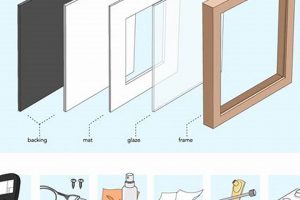
A do-it-yourself enclosure for a stretched painting offers an avenue for customization and cost-effectiveness in art presentation. Constructed by the individual, this type of structure typically employs wood, though alternative materials are viable, and is assembled to surround and support a stretched canvas. For instance, a simple design might involve four pieces of wood, mitered at the corners and joined to create a rectangular border.
Providing a completed artistic work with a defined edge, this type of construction enhances visual appeal and offers physical protection. It can improve the perceived value of the artwork and ensures safe handling during transport and display. Historically, artists and artisans have created bespoke enclosures for their paintings, reflecting both artistic expression and practical necessity.
The subsequent sections will detail various construction techniques, material considerations, and design options for creating a custom support structure for stretched paintings. Factors such as canvas size, desired aesthetic, and skill level will influence the selection of appropriate methods and materials.
Construction Guidance
The following recommendations provide insight into effective practices for creating a custom support structure for stretched paintings, focusing on durability and aesthetic appeal.
Tip 1: Precise Measurement: Accurate measurements of the stretched canvas are paramount. Employ a reliable measuring tool and double-check dimensions before commencing any cutting or assembly.
Tip 2: Wood Selection: Choose wood appropriate for the size and weight of the canvas. Softwoods like pine are suitable for smaller pieces, while hardwoods offer enhanced stability for larger canvases.
Tip 3: Mitered Corners: Accurately miter the corners at 45-degree angles for a professional finish. Utilize a miter saw or miter box to ensure clean, precise cuts.
Tip 4: Secure Joining: Utilize wood glue and fasteners (nails or screws) to securely join the frame components. Clamping the corners during the gluing process ensures a strong, seamless bond.
Tip 5: Surface Preparation: Sand all wood surfaces smooth before applying any finish. This step removes imperfections and creates a better surface for paint or stain adhesion.
Tip 6: Appropriate Finish: Select a finish that complements the artwork and the surrounding decor. Consider paint, stain, or varnish, applying multiple coats for durability and a polished appearance.
Tip 7: Canvas Attachment: Employ canvas offset clips or similar hardware to securely attach the stretched canvas to the constructed support. This method prevents direct contact between the canvas and the wood, minimizing potential damage.
Effective execution of these recommendations ensures the creation of a durable, aesthetically pleasing support system for the presented artwork, enhancing both its visual impact and its longevity.
The subsequent section will offer alternative approaches and elaborate on advanced techniques for crafting a custom support structure for stretched paintings, catering to a wider range of artistic and practical considerations.
1. Wood Selection

The selection of wood is a foundational element in constructing a support for stretched paintings. The type of wood chosen directly influences the structural integrity, longevity, and aesthetic qualities of the completed enclosure. Different wood species possess varying properties, affecting workability, dimensional stability, and susceptibility to environmental factors. For example, pine, a softwood, is relatively inexpensive and easy to work with, making it a common choice for smaller paintings and beginner projects. However, its lower density and inherent flexibility may render it unsuitable for larger canvases requiring greater rigidity to prevent warping or sagging. Conversely, hardwoods such as oak or maple offer superior strength and dimensional stability but are more challenging to cut, join, and finish, necessitating specialized tools and woodworking skills. Therefore, the canvas size, weight, and intended display environment must be carefully considered to determine the appropriate wood species.
Furthermore, the aesthetic qualities of the wood are crucial. The grain pattern, color, and texture of the wood contribute to the overall visual impression of the completed piece. A rustic, unfinished look might be desired for certain artistic styles, while others may necessitate a smooth, uniformly painted surface. Knot-free wood is preferable for painted surfaces to prevent bleed-through and ensure consistent coverage. The presence of knots and variations in grain can, however, enhance the visual appeal of stained or naturally finished enclosures, adding character and visual interest. The choice of wood must therefore align with the desired aesthetic outcome and the artist’s or craftsperson’s skill level in woodworking and finishing techniques. The proper choice of wood significantly reduces the risk of structural failure, warping, or aesthetic imperfections.
In summary, the selection of wood is not merely a perfunctory step in constructing a support for stretched paintings; it is a critical decision with far-reaching implications. A thorough understanding of wood properties, combined with careful consideration of the artwork’s size, weight, and intended aesthetic, is essential for creating a robust, visually appealing, and enduring enclosure. Challenges in wood selection often arise from balancing cost considerations with the need for durability and aesthetic appeal. By prioritizing a well-informed decision-making process, these challenges can be effectively addressed, resulting in a high-quality, custom-made structure that enhances the presentation and protects the artwork.
2. Precise Measurements

The success of any do-it-yourself enclosure for a stretched painting hinges critically on accurate dimensional assessments. Precise measurements dictate the fit and structural integrity of the final product. Inaccurate measurements invariably lead to a frame that is either too large, resulting in instability and a poor aesthetic, or too small, making proper canvas insertion impossible. The connection is direct: precise measurements are a prerequisite for a functional and visually appealing outcome. For example, a frame constructed with dimensions off by even a quarter of an inch per side accumulates to a full inch discrepancy, potentially rendering the entire structure unusable or requiring extensive rework.
Practical application of this principle is evident in the initial stages of construction. Prior to any cutting, the stretched canvas must be measured with a high degree of accuracy. Calipers or precision rulers are often employed to obtain measurements down to the millimeter. These measurements then serve as the basis for calculating the necessary dimensions of each frame component, accounting for miter angles and joinery techniques. Without this initial precision, subsequent steps are compromised, ultimately affecting the stability and aesthetic appeal of the completed piece. Consider a scenario where the mitered corners are not cut precisely due to flawed initial measurements; gaps will appear at the joints, detracting from the overall quality.
In conclusion, precise measurements are not merely a procedural step; they are a foundational element that determines the viability and aesthetic success of the support structure for a stretched painting. The impact of inaccurate measurements cascades through the entire construction process, leading to structural weaknesses and visual imperfections. Understanding this connection is vital for achieving professional-quality results in do-it-yourself framing projects. Challenges often stem from using inadequate measuring tools or neglecting to account for material thicknesses; addressing these challenges through careful planning and execution ensures a more successful outcome.
3. Mitered Corners

Mitered corners represent a specific joinery technique frequently employed in the construction of enclosures for stretched paintings. Their proper execution is vital for achieving a professional aesthetic and structural integrity in a do-it-yourself project. Deviation from precise miter angles leads to visible gaps and a compromised overall appearance.
- Aesthetic Appeal
Mitered corners, when accurately cut and joined, provide a seamless, visually appealing transition between frame components. The 45-degree angle cuts create a continuous grain pattern, enhancing the perceived quality of the final product. For instance, a well-executed miter showcases craftsmanship, while misaligned miters detract from the artwork’s presentation. The choice of mitered corners over other joinery methods, such as butt joints, directly contributes to a more refined and elegant aesthetic.
- Structural Stability
While aesthetic considerations are paramount, mitered corners contribute to the structural stability of the enclosure. When properly glued and secured with fasteners, they create a strong, interlocking bond between the frame components. An example of inadequate mitered joints includes the use of insufficient glue or fasteners, leading to corner separation over time. Achieving optimal structural integrity with mitered corners necessitates precise cuts and secure fastening techniques.
- Tooling Requirements
Creating accurate mitered corners requires specialized tools and skills. A miter saw or miter box is essential for achieving precise 45-degree angle cuts. Furthermore, clamps and jigs facilitate accurate alignment during the gluing and fastening process. For instance, attempting to cut mitered corners freehand often results in inaccurate angles and a compromised aesthetic. The availability and proper use of appropriate tooling are directly linked to the successful execution of mitered corners.
- Material Waste
Mitered corners inherently generate material waste due to the angled cuts. Careful planning and precise measurement are crucial to minimize this waste and optimize material utilization. An example of inefficient material use involves excessive overcutting, leading to unusable scrap. Implementing techniques such as nesting cuts and utilizing scrap wood for smaller projects can mitigate material waste associated with mitered corner construction.
In summary, mitered corners are an integral aspect of creating a high-quality support structure for stretched paintings. Their proper execution requires careful attention to detail, appropriate tooling, and a thorough understanding of joinery techniques. Challenges, such as material waste and the need for specialized tools, can be addressed through careful planning and skill development, resulting in a visually appealing and structurally sound enclosure.
4. Secure Assembly

Secure assembly constitutes a critical phase in the creation of a do-it-yourself enclosure for a stretched canvas, directly influencing the structural integrity and longevity of the finished product. The method by which the frame components are joined significantly affects its ability to withstand stress, resist warping, and maintain its shape over time. Improper assembly techniques can lead to premature failure, compromising the artwork’s presentation and potentially causing damage.
- Adhesive Application
The judicious application of wood glue is paramount to secure assembly. High-quality wood glue provides a strong bond between the frame components, distributing stress evenly and preventing localized failures. For example, a frame assembled solely with mechanical fasteners is more susceptible to loosening and shifting over time compared to one where glue is strategically applied to all mating surfaces. The even distribution of glue, followed by adequate clamping pressure, optimizes the bond’s strength and durability. Insufficient or uneven glue application compromises the overall strength and stability of the completed enclosure.
- Mechanical Fasteners
Mechanical fasteners, such as nails or screws, complement adhesive bonds by providing immediate and sustained clamping pressure. The selection of appropriate fasteners depends on the type of wood used and the size of the frame. For instance, using excessively long screws can split the wood, while using too few fasteners can compromise the joint’s strength. Proper spacing and alignment of fasteners ensure uniform stress distribution and prevent localized weaknesses. Fasteners must be countersunk or filled to achieve a smooth, aesthetically pleasing surface. A combination of adhesive and well-placed mechanical fasteners represents an optimal approach to secure assembly.
- Clamping Techniques
Effective clamping techniques are indispensable for achieving tight, gap-free joints during assembly. Clamps apply consistent pressure to the frame components, ensuring intimate contact between the glued surfaces. For example, corner clamps are specifically designed to maintain accurate alignment during mitered corner assembly. Insufficient clamping pressure results in weak, inconsistent bonds, while excessive pressure can distort the frame components. Strategic placement of clamps and the use of protective cauls minimize the risk of damage and ensure uniform pressure distribution. Clamping techniques directly influence the strength and precision of the assembled frame.
- Joint Reinforcement
In certain applications, particularly with larger or heavier canvases, joint reinforcement may be necessary to enhance structural integrity. Techniques such as splines, dowels, or corner braces provide additional mechanical support to the frame joints. For example, a spline inserted into a mitered corner increases the surface area for adhesive bonding and provides resistance against racking forces. Reinforcement techniques should be implemented thoughtfully, considering the aesthetic impact and the specific demands of the artwork being framed. Strategic joint reinforcement can significantly extend the lifespan and stability of a custom enclosure.
The principles of secure assembly, encompassing adhesive application, mechanical fasteners, clamping techniques, and joint reinforcement, are fundamental to crafting durable and aesthetically pleasing enclosures for stretched canvases. Adherence to these principles ensures that the completed frame not only enhances the presentation of the artwork but also provides long-lasting structural support. Addressing challenges in assembly, such as choosing the right fasteners or applying adequate clamping pressure, contributes to the overall success of the do-it-yourself project.
5. Surface Finishing

Surface finishing, in the context of a do-it-yourself enclosure for stretched canvas, constitutes a crucial stage that directly impacts the aesthetic appeal, longevity, and protective qualities of the final product. This process involves the application of various materials and techniques to enhance the appearance and durability of the frame’s exposed surfaces, and to protect the underlying wood from environmental factors.
- Preparation Techniques
Prior to the application of any finishing material, proper surface preparation is essential. This typically involves sanding to achieve a smooth, uniform surface, filling imperfections with wood filler, and cleaning to remove dust and debris. For example, failure to adequately sand a frame before painting can result in an uneven finish with visible scratches or imperfections. Preparation directly influences the adhesion and appearance of subsequent finishing layers, and ensures optimal aesthetic outcome.
- Paint Application
Paint provides both color and a protective barrier against moisture and UV radiation. The type of paint selected acrylic, latex, or oil-based influences the durability, finish, and ease of application. For instance, applying multiple thin coats of paint, rather than one thick coat, results in a smoother, more professional finish. Correct paint application techniques, including proper brushwork or spray application, are critical for achieving a uniform and visually appealing surface. This process also contributes to the wood’s overall preservation.
- Staining and Sealing
Staining enhances the natural grain of the wood and adds depth and character to the frame’s appearance. Following staining, a sealant, such as varnish or polyurethane, is typically applied to protect the stain and provide a durable, water-resistant finish. For instance, applying a clear varnish over a stained wood frame protects the stain from fading and provides a smooth, easily cleanable surface. The choice of stain color and sealant type should complement the artwork and intended display environment, providing both aesthetic enhancement and long-term protection.
- Protective Coatings
The application of protective coatings, such as varnish or lacquer, fortifies the wood, augmenting resistance to physical damage, moisture, and ultraviolet light. The longevity of a diy frame can be enhanced by carefully choosing and applying coatings for protection. For instance, a varnish can shield the wooden structure of a do-it-yourself frame, contributing to the preservation of canvas art, making protective coatings indispensable for extended durability.
In summary, surface finishing plays a multifaceted role in creating a high-quality enclosure for a stretched canvas. From preparing the surface to applying protective coatings, each step contributes to the overall aesthetic appeal, durability, and protective qualities of the frame. Attention to detail during this phase is paramount for achieving a professional-looking finish that enhances the artwork and ensures its long-term preservation.
6. Canvas Attachment
Canvas attachment represents a critical juncture in the creation of a do-it-yourself enclosure for stretched paintings. It bridges the structural support provided by the frame with the artistic medium it is intended to showcase. A secure and appropriate attachment method ensures the artwork is both aesthetically presented and physically protected.
- Offset Clips
Offset clips are small metal or plastic fasteners designed to create a slight gap between the canvas and the wood. This prevents direct contact, minimizing the risk of abrasion or adhesion of the canvas to the wood over time. For instance, humidity fluctuations can cause expansion and contraction, potentially damaging the canvas if it is in direct contact with the frame. Offset clips mitigate this risk by allowing for slight movement without compromising the attachment’s security.
- Canvas Z-Clips
Canvas Z-clips offer a robust and concealed attachment solution. These clips, shaped like the letter ‘Z’, are screwed into the frame’s inner edge and then grip the back of the stretched canvas. They provide a strong and secure hold without any visible hardware on the face of the frame. This method is particularly well-suited for larger or heavier canvases requiring enhanced support. The Z-clip configuration ensures a firm and stable attachment, preventing the canvas from shifting or dislodging.
- Staples
While less refined than other methods, stapling represents a straightforward approach to canvas attachment. The staples are driven into the back of the frame through the canvas’s excess material. This method requires careful execution to avoid damaging the canvas or creating unsightly bulges. It is generally more appropriate for smaller, lightweight canvases and is often used in conjunction with adhesive to provide additional security. The staple placement and tension must be consistent to maintain an even appearance and prevent canvas distortion.
- Adhesive Mounting
Adhesive mounting involves using specialized tapes or adhesives to bond the canvas directly to the frame. This method requires careful selection of the adhesive to ensure compatibility with both the canvas and the wood. Improper adhesive selection can result in discoloration, delamination, or damage to the artwork. Adhesive mounting is often used in conjunction with other methods, such as offset clips, to provide supplemental support and prevent the canvas from sagging or shifting within the frame.
The choice of canvas attachment method is a critical consideration in do-it-yourself framing projects. Each approach offers distinct advantages and disadvantages, depending on the size, weight, and characteristics of the artwork. The effectiveness of any method is directly linked to the precision of execution and the quality of materials employed. By carefully selecting and implementing the appropriate attachment strategy, the structural integrity and aesthetic presentation of the framed canvas can be significantly enhanced. Consider that a canvas secured with Z-clips can enhance the visual appeal and safety of the entire piece.
Frequently Asked Questions
The following questions address common inquiries regarding the construction of custom enclosures for stretched paintings. The answers provide guidance on achieving structurally sound and aesthetically pleasing results.
Question 1: What wood type is most suitable for constructing a frame for a large canvas?
Hardwoods, such as oak or maple, are generally preferred for larger canvases due to their superior strength and dimensional stability. These species resist warping and sagging, providing robust support for heavier artwork.
Question 2: How can precise mitered corners be achieved without specialized equipment?
A miter box and hand saw can provide accurate 45-degree cuts for mitered corners. Ensure the miter box is securely clamped to a stable surface, and use a sharp saw for clean, precise cuts. A try square can be used to verify accuracy.
Question 3: What type of adhesive is recommended for joining frame components?
A high-quality wood glue, such as polyvinyl acetate (PVA) glue, is recommended. This type of glue provides a strong, durable bond and is specifically formulated for woodworking applications. Ensure adequate clamping pressure during the gluing process.
Question 4: How should the canvas be attached to the frame to prevent damage?
Offset clips or canvas Z-clips are recommended to create a gap between the canvas and the frame. These fasteners prevent direct contact and minimize the risk of abrasion or adhesion of the canvas to the wood over time.
Question 5: What steps can be taken to minimize material waste during the framing process?
Careful planning and precise measurement are crucial. Nesting cuts, where smaller components are cut from the same piece of wood, can reduce waste. Scrap wood can be repurposed for smaller projects or used as shims or spacers.
Question 6: How can a smooth, professional finish be achieved on a painted frame?
Proper surface preparation, including sanding and filling imperfections, is essential. Apply multiple thin coats of paint rather than one thick coat, and allow each coat to dry completely before applying the next. Lightly sand between coats for an ultra smooth finish.
These answers provide essential guidance for individuals undertaking do-it-yourself framing projects. Careful attention to these details will contribute to a high-quality, long-lasting result.
The subsequent section will explore advanced framing techniques, catering to specialized artistic and practical requirements.
Conclusion
The preceding discussion has elucidated the various facets of constructing a support structure for stretched paintings. From wood selection and precise measurement to secure assembly, surface finishing, and canvas attachment, each element plays a critical role in determining the structural integrity and aesthetic appeal of the finished product. The principles outlined herein provide a comprehensive framework for individuals seeking to create custom enclosures that both enhance and protect their artwork.
Mastery of these techniques not only empowers individuals to create bespoke frames tailored to their specific artistic needs but also fosters a deeper appreciation for the craftsmanship involved in art presentation. Further exploration and refinement of these methods will undoubtedly lead to innovative approaches and elevated standards in the realm of art display. The meticulous application of these principles ensures not only the longevity of artistic creations, but also enhances their inherent visual impact, ensuring enduring aesthetic value.