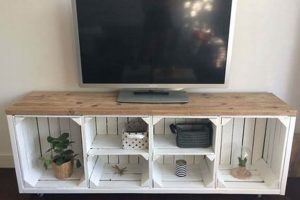
A structure crafted from timber, typically assembled by the user, designed to support backdrops for photography, videography, or event displays. These constructions provide a customizable and often cost-effective alternative to commercially manufactured supports. For example, individuals might construct one using readily available lumber and basic tools to create a photo booth for a party.
The utilization of self-constructed backdrop supports offers several advantages, including cost savings, dimensional flexibility, and the potential for aesthetic customization. The ability to tailor the size and appearance to specific needs proves particularly useful for photographers working in diverse locations or event planners seeking a unique visual element. Historically, resourceful individuals have opted for self-made solutions to address budget constraints or specific design requirements, fostering a culture of ingenuity and adaptability.
The subsequent sections will delve into the planning considerations, material selection, construction techniques, and finishing options associated with creating stable and visually appealing supports. Specific attention will be paid to ensuring structural integrity and ease of use for varied applications.
Construction Guidance for Timber-Based Backdrop Supports
The following recommendations address key aspects of fabricating a stable and functional support system, ensuring longevity and ease of use.
Tip 1: Material Selection: Opt for kiln-dried lumber to minimize warping and cracking post-construction. Pine or fir provides a cost-effective balance of strength and workability. Consider pressure-treated lumber for outdoor applications to resist decay.
Tip 2: Accurate Measurements: Precise cutting is crucial for structural integrity. Employ a measuring tape and a speed square to ensure right angles and consistent lengths across all components.
Tip 3: Secure Joinery: Utilize screws rather than nails for stronger, more durable connections. Pre-drilling pilot holes prevents wood splitting, particularly when working with hardwoods or near the ends of boards.
Tip 4: Stable Base Design: A wide base enhances stability. Flared legs or weighted feet can prevent tipping, especially when supporting heavier backdrops. Experiment with different base geometries to optimize stability relative to portability.
Tip 5: Adjustable Height Considerations: Incorporate a telescoping mechanism or multiple attachment points to allow for height adjustments, accommodating various backdrop sizes and shooting requirements. Secure locking mechanisms are essential.
Tip 6: Surface Treatment: Sanding smooths rough edges and prepares the surface for finishing. Apply paint, stain, or varnish to protect the wood from moisture and enhance the aesthetic appeal. Consider a matte finish to minimize glare.
Tip 7: Portability: Design for disassembly if frequent transport is anticipated. Wingnuts or quick-release clamps facilitate rapid assembly and disassembly without specialized tools. A dedicated carrying case protects the components during transit.
Adherence to these construction principles contributes to a robust and adaptable support structure suitable for a range of photographic and videographic applications. Prioritizing precision and quality materials will extend the lifespan and functionality of the finished product.
The subsequent section will explore alternative designs and advanced features that can be incorporated into timber backdrop supports.
1. Stable Base

The concept of a “Stable Base” is paramount in the design and construction of timber-based backdrop supports. This foundational element directly influences the safety and usability of the entire structure, dictating its ability to withstand external forces and maintain its position during operation. Neglecting base stability compromises the support’s primary function.
- Base Geometry and Footprint
The geometric configuration of the base significantly impacts its stability. A wider footprint, achieved through splayed legs or a broad rectangular frame, distributes the weight more effectively and increases resistance to tipping. The physical dimensions of the base should be proportional to the anticipated height and weight of the backdrop. Example: A tripod base with extended legs provides greater stability compared to a simple “A-frame” with a narrow stance. This geometric design is critical to maintaining balance.
- Material Weight and Distribution
The weight of the base components, and how that weight is distributed, contributes to overall stability. A heavier base resists movement from wind or accidental contact. Strategic placement of weights, such as sandbags or metal plates, can further enhance stability without significantly increasing the overall size. Example: Adding sandbags to the base of a timber support used outdoors mitigates the risk of it being blown over by wind gusts. This weighting principle is crucial for preventing unintended shifts.
- Surface Contact and Friction
The type of material used for the base’s feet, and the surface on which it rests, directly influences its grip and resistance to sliding. Rubber or non-slip pads increase friction, preventing the support from moving on smooth surfaces. The surface itself should be level and free from obstructions. Example: Rubber feet attached to the base of a timber support prevent it from sliding on a polished concrete floor. Maximizing surface contact ensures a secure foundation.
- Load Capacity and Weight Distribution of the Backdrop
The design of the base must account for the weight and distribution of the backdrop itself. A heavier backdrop requires a more robust base to prevent imbalance. The weight should be evenly distributed to avoid stressing individual components of the support structure. Example: A large fabric backdrop will exert more force on the base than a lightweight paper backdrop, requiring a corresponding increase in base stability. Understanding the load capacity is essential for safe operation.
The interplay of base geometry, material weight, surface contact, and anticipated load creates a stable foundation for a timber-based backdrop support. Careful consideration of these elements ensures a safe and reliable structure capable of fulfilling its intended purpose in photographic, videographic, or event-related applications. Stability is a non-negotiable design parameter.
2. Durable Wood

The selection of durable wood species directly impacts the longevity and structural integrity of self-constructed backdrop supports. The inherent properties of the chosen lumber, such as resistance to rot, insect infestation, and physical stress, determine the overall lifespan of the support. For example, untreated pine, while cost-effective, is significantly more susceptible to decay compared to naturally resistant cedar or pressure-treated lumber, necessitating replacement or costly repairs over time. Therefore, the choice of timber is a critical determinant of the support’s performance.
The utilization of durable wood minimizes maintenance requirements and enhances the support’s ability to withstand repeated use and varying environmental conditions. A backdrop support constructed from redwood, known for its natural resistance to moisture and insects, can endure outdoor use for extended periods without significant degradation. Conversely, a support built from a less durable species, such as poplar, may require frequent sealing and protection to prevent warping or cracking. Consequently, opting for a more resilient timber initially often proves more economical in the long term due to reduced upkeep costs.
Ultimately, the connection between durable wood and self-made backdrop supports centers on optimizing long-term value and minimizing risk. While initial cost considerations may tempt builders to use cheaper, less durable wood, the potential for premature failure and increased maintenance should be carefully weighed. The selection of appropriate timber is a foundational decision that profoundly affects the usability and sustainability of the completed backdrop support, ensuring its reliable performance for years to come.
3. Adjustable Height
The incorporation of adjustable height mechanisms into self-constructed timber backdrop supports directly addresses the variability in backdrop dimensions and photographic staging requirements. A static-height support limits versatility, forcing users to adapt their setup to pre-defined constraints. Conversely, adjustable height allows for seamless adaptation to varying backdrop sizes and camera angles, maximizing the utility of the support system. For instance, a photographer shooting both portrait and full-body shots requires a backdrop support capable of accommodating significant height differences to maintain optimal composition and subject framing.
Achieving adjustable height in timber structures involves various mechanical solutions, each presenting unique challenges and benefits. Telescoping poles, secured with locking mechanisms, offer a range of height adjustments, but require careful attention to structural stability to prevent slippage or collapse under load. Incrementally positioned crossbars, attached via pin-and-hole systems, provide simpler height adjustments, but may limit the fineness of adjustment. The choice of method depends on the desired range of adjustment, the anticipated load, and the builder’s skill level. Failure to implement a secure and reliable height adjustment mechanism negates the advantage of adjustability, potentially leading to instability and posing a risk to equipment and personnel.
In summary, adjustable height is a critical design consideration for those embarking on “diy backdrop stand wood”. It offers significant advantages in versatility and adaptability, enabling users to accommodate diverse photographic and event requirements. While the implementation of adjustable height introduces engineering challenges, the benefits in terms of functionality and convenience justify the added complexity. A well-executed adjustable height mechanism transforms a static timber structure into a dynamic and versatile tool, capable of meeting a wide range of creative and practical needs.
4. Secure Joints

The structural integrity of any “diy backdrop stand wood” construction is intrinsically linked to the quality and reliability of its joints. These junctures, where individual timber components are connected, bear the brunt of the load and stress exerted by the backdrop and any external forces. Weak or improperly executed joints represent points of potential failure, jeopardizing the entire structure’s stability and safety. For instance, a backdrop support utilizing only nails for its joints may collapse under the weight of a heavy backdrop, whereas a structure employing screws, glue, and reinforced corners is far more likely to withstand the applied stress.
Several techniques exist for creating secure joints in “diy backdrop stand wood” projects. Screws, offering superior holding power compared to nails, are frequently employed. Wood glue, when used in conjunction with mechanical fasteners, enhances joint strength by creating a chemical bond between the wood surfaces. Furthermore, the incorporation of gussets or corner braces provides additional reinforcement, particularly at critical stress points. The selection of jointing method depends on several factors, including the wood species, the anticipated load, and the builder’s skill level. Dowel joints, mortise and tenon joints, or even metal fasteners can enhance the structural integrity. A poorly connected joint reduces the longevity.
In summation, secure joints are not merely an aesthetic detail but a fundamental prerequisite for a functional and reliable “diy backdrop stand wood.” Meticulous attention to joint construction, employing appropriate materials and techniques, ensures the support’s ability to safely and effectively perform its intended purpose. A solid understanding of jointing principles is crucial for anyone undertaking this type of construction, ultimately contributing to a stable, safe, and long-lasting backdrop support system. The consequences of neglecting joint security are structural failure, making careful planning and execution paramount.
5. Smooth Finish

The attainment of a smooth finish is a critical, yet often overlooked, aspect of “diy backdrop stand wood” projects. Beyond aesthetic appeal, the surface quality of the timber support structure directly impacts its usability, longevity, and safety. A poorly finished surface can lead to operational impediments and potential hazards.
- Prevention of Snagging and Tearing
A smooth finish minimizes the risk of backdrops snagging or tearing on the timber support. Rough edges, splinters, or protruding fasteners can catch on delicate fabrics, causing damage and rendering the backdrop unusable. Sanding the wood surface to a fine grit and countersinking screws effectively eliminate these hazards. Example: Using a belt sander to smooth the edges of a timber frame before attaching a muslin backdrop prevents tearing and extends the backdrop’s lifespan. A well-prepared surface saves time and resources in the long run.
- Improved Aesthetics and Professional Appearance
A smooth finish enhances the overall aesthetic appeal of the backdrop support, contributing to a more professional presentation. Visible imperfections detract from the visual impact of the backdrop itself. Applying paint, stain, or varnish to a smoothly sanded surface creates a uniform and polished look. Example: A timber support with a smooth, painted finish complements a high-quality photographic backdrop, creating a cohesive and visually appealing setup. A professional appearance builds confidence and enhances the overall impression.
- Enhanced Cleanability and Maintenance
A smooth finish facilitates easier cleaning and maintenance. Dust, dirt, and other contaminants are less likely to adhere to a smooth surface, allowing for quick and easy removal. Applying a sealant or varnish further protects the wood from moisture and stains. Example: Wiping down a timber support with a smooth, varnished finish removes dust and prevents moisture damage, extending the support’s lifespan. Easy cleaning promotes hygiene and preserves the support’s appearance.
- Reduced Risk of Injury
A smooth finish reduces the risk of splinters and cuts during handling and assembly. Rough edges and protruding fasteners pose a safety hazard, particularly in environments with frequent use. Sanding and finishing the timber eliminates these risks, creating a safer working environment. Example: Handling a smoothly sanded timber support minimizes the risk of splinters, protecting users from injury. Safety considerations should be a priority in any DIY project.
Therefore, a smooth finish is not merely an optional refinement but an essential element of a well-executed “diy backdrop stand wood”. It contributes to the functionality, aesthetics, and safety of the support, ultimately enhancing its value and usability. The time and effort invested in achieving a smooth finish translates into long-term benefits and a more professional outcome. A refined surface is a reflection of quality and attention to detail, enhancing the overall success of the DIY project.
6. Portable Design
The integration of portable design principles within “diy backdrop stand wood” construction directly addresses the need for mobility and ease of transport, characteristics often absent in commercially available alternatives. The inherent nature of backdrops, frequently used in diverse locations, necessitates a support system readily transportable and easily assembled. The absence of portable design features restricts the utility of the backdrop stand, limiting its application to stationary environments. For example, a photographer working on location requires a backdrop support that can be disassembled, packed efficiently, and reassembled quickly at the shooting site. A heavy, monolithic wooden structure would be impractical for this purpose. Thus, portability is a key consideration impacting the operational utility of these structures.
Effective portable design involves several key strategies: modular construction, lightweight materials, and integrated carrying solutions. Modular construction divides the support structure into smaller, manageable components that can be easily reassembled. The selection of lightweight lumber, such as pine or fir, reduces the overall weight without compromising structural integrity. The addition of carrying handles or custom-fitted bags facilitates transport and protects the components from damage. An example of effective portable design is a “diy backdrop stand wood” constructed from interlocking wooden sections, secured with wingnuts, and stored in a purpose-built canvas bag. This configuration allows for rapid assembly and disassembly, minimizing setup time and maximizing efficiency on location. The trade-off between portability and absolute structural rigidity is a crucial engineering decision in such designs. Lighter weight often corresponds to less ultimate strength.
In conclusion, portable design is not merely a convenience but a fundamental requirement for many “diy backdrop stand wood” applications. The ability to easily transport and assemble the support structure significantly expands its usability, allowing photographers, videographers, and event planners to utilize backdrops in a wider range of settings. While achieving optimal portability may require compromises in material selection or structural complexity, the benefits in terms of versatility and convenience far outweigh the challenges. The success of a DIY backdrop stand hinges on the thoughtful integration of portable design principles, ensuring its adaptability to diverse environments and user needs. A blend of lightweight materials, modular design, and effective carrying solutions is essential for creating a truly portable and functional support system.
7. Load Capacity

The concept of load capacity is central to the design and construction of a self-assembled timber backdrop support. It dictates the maximum weight the structure can safely bear, influencing material selection, joint design, and overall structural integrity. Underestimating load capacity poses significant risks, potentially leading to structural failure, equipment damage, and personal injury. Accurate calculation and implementation are therefore paramount.
- Material Strength and Deflection
The inherent strength properties of the timber used directly influence the support’s load-bearing capability. Different wood species exhibit varying degrees of resistance to bending and breaking under load. Furthermore, the dimensions of the timber components, such as thickness and width, affect their deflection, or bending, under stress. A support constructed from a weaker wood, or with insufficiently sized components, will exhibit excessive deflection and may ultimately fail under load. Example: A backdrop support using thin pine boards may visibly sag under the weight of a heavy canvas backdrop, whereas a support built from thicker oak boards would exhibit minimal deflection. Understanding material properties is essential for predicting structural behavior.
- Joint Design and Fastener Strength
The design and execution of the joints connecting the timber components are crucial for distributing the load effectively. Weak or improperly constructed joints become points of potential failure. The type and size of fasteners used, such as screws or bolts, must be appropriate for the anticipated load. Example: A butt joint held together with small nails may separate under stress, whereas a mortise and tenon joint secured with screws and adhesive provides a significantly stronger connection. The integrity of the joints determines the overall load capacity of the structure. Joint strength directly influences structural safety.
- Weight Distribution and Balance
The manner in which the backdrop weight is distributed across the support structure significantly impacts its stability and load-bearing capability. Uneven weight distribution can create localized stress points, increasing the risk of failure. The support’s base must be designed to provide adequate stability and prevent tipping under asymmetrical loads. Example: A backdrop support with a wide base and evenly spaced support arms can distribute the weight of the backdrop more effectively than a support with a narrow base and a single central support arm. Balanced weight distribution minimizes stress on individual components.
- Safety Factors and Margin of Error
Prudent engineering practice dictates the incorporation of safety factors to account for uncertainties in material properties, construction techniques, and applied loads. A safety factor provides a margin of error, ensuring that the structure can withstand loads beyond its calculated capacity. Example: A backdrop support designed with a safety factor of 2 can safely bear twice the anticipated load. Incorporating safety factors enhances reliability and minimizes the risk of failure. Redundancy contributes to a more robust design.
These aspects of load capacity illustrate its integral role in the “diy backdrop stand wood” design process. By carefully considering material strength, joint design, weight distribution, and safety factors, individuals can construct a safe, reliable, and durable backdrop support system tailored to their specific needs. Proper attention to load capacity ensures both the longevity of the structure and the safety of its users and equipment. Prioritization of safety should be paramount.
Frequently Asked Questions
The following section addresses common inquiries and concerns regarding the design, construction, and utilization of self-made timber backdrop supports, providing clarity on critical aspects and dispelling potential misconceptions.
Question 1: What wood species is most suitable for backdrop support construction?
The selection depends on budget, application (indoor/outdoor), and desired lifespan. Kiln-dried pine or fir offers a balance of cost-effectiveness and workability for indoor use. Pressure-treated lumber provides enhanced resistance to decay for outdoor applications. Hardwoods, such as oak or maple, offer superior strength but are more difficult to work with and more expensive.
Question 2: How can the stability of a timber backdrop support be maximized?
Stability is achieved through a wide base, strategic weight distribution, and secure footing. A tripod base with extended legs provides greater stability compared to a narrow A-frame. Adding weight to the base, such as sandbags, further enhances resistance to tipping. Rubber feet prevent slippage on smooth surfaces. Accurate construction ensures level footing and balance.
Question 3: What is the recommended method for joining timber components in a backdrop support?
Screws, in conjunction with wood glue, provide superior holding power compared to nails. Pre-drilling pilot holes prevents wood splitting. Corner braces or gussets reinforce joints at critical stress points. Mortise and tenon joints offer exceptional strength but require advanced woodworking skills.
Question 4: How can adjustable height be incorporated into a timber backdrop support?
Telescoping poles, secured with locking mechanisms, offer a range of height adjustments. Incrementally positioned crossbars, attached via pin-and-hole systems, provide simpler height adjustments. The chosen method must ensure secure locking and prevent slippage under load.
Question 5: What safety precautions should be observed during the construction and use of a timber backdrop support?
Eye protection, gloves, and a dust mask should be worn during cutting and sanding. Power tools must be used in accordance with manufacturer instructions. All joints should be thoroughly inspected for strength and stability before use. Overloading the support beyond its rated capacity should be strictly avoided.
Question 6: How can the lifespan of a timber backdrop support be extended?
Proper storage, protection from moisture, and regular maintenance are essential. The support should be stored in a dry environment to prevent warping and decay. Applying paint, stain, or varnish protects the wood from the elements. Loose joints should be tightened, and damaged components should be replaced promptly.
In essence, careful planning, quality materials, and meticulous construction techniques are paramount for creating a safe, reliable, and long-lasting timber backdrop support.
The subsequent discussion will address potential modifications and advanced features that can further enhance the functionality and versatility of self-constructed timber backdrop supports.
Conclusion
The preceding analysis has underscored the multifaceted considerations involved in constructing timber-based backdrop supports. From material selection and joint integrity to portability and load capacity, each element contributes to the overall functionality, safety, and longevity of the structure. The implementation of adjustable height mechanisms and smooth finishing techniques further enhances the versatility and professional presentation of the completed support. The emphasis throughout has been on achieving a balance between cost-effectiveness, structural reliability, and user-friendliness.
Successful integration of “diy backdrop stand wood” principles demands a comprehensive understanding of woodworking techniques, material properties, and structural engineering concepts. Prudent planning, precise execution, and adherence to safety guidelines are essential for realizing a dependable and aesthetically pleasing support system. Continued innovation and refinement within this domain hold the potential to further optimize design and enhance performance, ensuring the sustained relevance of self-constructed timber backdrop solutions.
![Build a Strong DIY Boat Motor Stand [Easy Guide] | The DIY Hub: Creative Crafts, Repairs & Life Hacks](https://craftingdiycenter.com/wp-content/uploads/2025/07/th-3394-300x200.jpg "Build a Strong DIY Boat Motor Stand [Easy Guide] The DIY Hub: Creative Crafts, Repairs & Life Hacks")