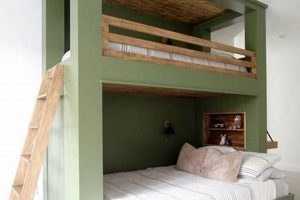
The act of constructing stacked sleeping arrangements from scratch, frequently employing readily available materials and plans, can be categorized as a home improvement endeavor. An example involves procuring lumber, fasteners, and tools to assemble a structure designed to accommodate two or more beds vertically.
Such projects offer potential cost savings compared to purchasing pre-fabricated furniture. Furthermore, completing a construction task of this nature can foster a sense of accomplishment and allow for customization to suit specific spatial needs and aesthetic preferences. Historically, self-sufficiency in furniture creation was a common practice, evolving alongside resource availability and technological advancements in woodworking.
The subsequent sections will delve into considerations for planning, material selection, safety protocols, and step-by-step construction techniques relevant to this particular type of project.
Construction Strategies for Elevated Sleeping Structures
The following represent key considerations to ensure the successful and safe completion of such a project.
Tip 1: Prioritize Structural Integrity: The frame must withstand significant weight and potential lateral forces. Utilize appropriate lumber dimensions and connection methods, such as mortise-and-tenon joints or metal fasteners with adequate shear strength.
Tip 2: Adhere to Safety Standards: Railings on the upper bunk must meet minimum height requirements to prevent falls. Ensure a secure ladder or staircase is implemented for safe access and egress.
Tip 3: Employ Precise Measurements: Accurate measurements are critical for a stable and aesthetically pleasing final product. Double-check all dimensions before cutting materials and assembling components.
Tip 4: Select Appropriate Materials: Opt for hardwoods like maple or oak for primary structural elements, as they offer superior strength and durability compared to softwoods. Softwoods may be suitable for non-load-bearing components.
Tip 5: Implement a Robust Fastening System: Screws and bolts should be appropriately sized and spaced to distribute weight evenly and prevent loosening over time. Consider using locking washers or threadlocker compounds for increased security.
Tip 6: Apply a Durable Finish: A protective finish, such as paint or varnish, will safeguard the wood from moisture and wear, prolonging the lifespan of the structure. Ensure the finish is non-toxic and child-safe if the structure is intended for children.
Tip 7: Consult Local Building Codes: Certain jurisdictions may have specific regulations regarding the construction of elevated sleeping platforms. Adherence to these codes is essential for legal compliance and safety assurance.
Successful execution hinges on careful planning, precise craftsmanship, and diligent adherence to safety protocols. The result can offer a functional and aesthetically pleasing solution for space optimization.
The subsequent section will address common challenges encountered during construction and provide troubleshooting strategies.
1. Planning

Effective planning serves as the foundation for the success of constructing stacked sleeping structures. The absence of a comprehensive plan can lead to material wastage, structural instability, and compromised safety. This phase necessitates a thorough assessment of available space, intended users, and compliance with relevant building codes. A meticulously crafted blueprint, outlining dimensions, materials, and construction sequence, is paramount. For instance, prematurely purchasing inadequate lumber due to insufficient planning can result in structural failure under anticipated weight loads.
Planning also dictates the selection of appropriate joinery methods and fastening hardware. Complex designs may necessitate advanced woodworking techniques, while simpler iterations may suffice with basic tools and materials. A detailed bill of materials, derived from the plan, enables efficient procurement and minimizes the risk of shortages or redundancies. Furthermore, a well-defined plan incorporates safety considerations, such as guardrail heights and ladder positioning, adhering to established safety standards. This foresight mitigates potential hazards and ensures the structure’s safe operation.
In summation, rigorous planning is integral to the successful construction of elevated sleeping arrangements. It serves to optimize resource utilization, enhance structural integrity, ensure safety compliance, and minimize potential setbacks. The investment in thorough planning is demonstrably justified by the enhanced quality, safety, and longevity of the final product.
2. Materials

Material selection constitutes a critical determinant in the structural integrity, longevity, and safety of stacked sleeping arrangements. The chosen components directly influence the load-bearing capacity, resistance to wear, and overall stability of the assembled structure.
- Lumber Selection
The type of wood used significantly impacts the structure’s strength and durability. Hardwoods, such as maple or oak, offer superior load-bearing capabilities compared to softwoods like pine. However, hardwoods are generally more expensive and require specialized tools for processing. Softwoods may be suitable for non-structural components, provided they meet minimum strength requirements. Proper grading and inspection of lumber are essential to identify and eliminate pieces with knots, cracks, or other defects that could compromise structural integrity.
- Fasteners and Hardware
Screws, bolts, and other fasteners are responsible for connecting individual components and maintaining the structure’s overall cohesion. The size, type, and spacing of fasteners must be carefully considered to ensure adequate holding power. High-quality fasteners made from durable materials, such as steel, are recommended. The use of appropriate washers and locknuts can further enhance joint stability and prevent loosening over time. Special attention should be paid to the shear strength and tensile strength ratings of fasteners, ensuring they are sufficient to withstand anticipated loads.
- Finishing Materials
Paints, varnishes, and other finishes serve to protect the wood from moisture, UV radiation, and physical wear. The choice of finish should be based on factors such as durability, ease of application, and aesthetic considerations. Non-toxic, low-VOC (volatile organic compound) finishes are preferable, particularly for structures intended for children. Proper surface preparation, including sanding and priming, is crucial for achieving a smooth and durable finish. The selected finish should also be compatible with the type of wood used and the intended use environment.
- Safety Components
Incorporating safety-related materials such as guardrails, ladder rungs, and non-slip surfaces enhances the overall safety of the structure. Guardrails should be constructed from sturdy materials and designed to prevent falls. Ladder rungs should be evenly spaced and provide a secure grip. Non-slip surfaces can be applied to ladder steps or the upper bunk platform to minimize the risk of slipping. These safety components should be integrated into the design and construction process, ensuring compliance with relevant safety standards and guidelines.
Therefore, a holistic approach to material selection, encompassing structural components, fasteners, finishes, and safety features, is indispensable for creating stacked sleeping arrangements that are safe, durable, and aesthetically pleasing. Compromising on material quality to reduce costs can lead to compromised structural integrity and increased risk of accidents. The investment in high-quality materials is ultimately justified by the enhanced safety, longevity, and overall value of the finished product.
3. Measurements

Accurate dimensional specification and execution are paramount to the structural integrity, safety, and aesthetic appeal of any stacked sleeping arrangement. Discrepancies in measurements can lead to instability, difficulty in assembly, and compromised safety standards. The application of precise measurements extends throughout the entire construction process, from initial planning to final assembly.
- Overall Dimensions and Space Planning
Precise measurements of the available space are crucial for determining the maximum permissible footprint. This includes not only floor area but also ceiling height, the position of windows and doors, and any obstructions. Inaccurate space planning can result in a structure that is too large for the intended location, obstructing pathways or impeding access to other furniture. Furthermore, the height of the structure must be carefully considered to ensure adequate headroom on both bunks and compliance with local building codes. An example of poor space planning would be constructing a structure too tall for a room, rendering the top bunk unusable.
- Component Lengths and Angles
The precise cutting of individual components, such as support posts, rails, and ladder rungs, is essential for ensuring a level and stable structure. Inaccurate lengths or angles can result in uneven weight distribution, leading to stress concentrations and potential failure points. For example, support posts that are not of equal length can cause the entire structure to lean, compromising its stability and increasing the risk of collapse. Similarly, improperly angled ladder rungs can make climbing difficult and dangerous. Precision in these areas directly translates to the safety and usability of the final product.
- Joinery Placement and Alignment
The accurate placement of joints, such as mortise and tenon or dowel joints, is crucial for creating strong and durable connections between components. Misaligned or poorly executed joints can significantly weaken the structure, reducing its load-bearing capacity and increasing the risk of failure. For example, a misaligned mortise and tenon joint can create stress concentrations, leading to cracking or splitting of the wood. Accurate alignment of joints also ensures that the structure is square and plumb, contributing to its overall aesthetic appeal.
- Guardrail and Ladder Dimensions
Compliance with safety standards requires precise adherence to specified dimensions for guardrails and ladders. Guardrails must be of sufficient height to prevent falls from the upper bunk, typically a minimum of 14 inches above the mattress. Ladder rungs must be evenly spaced and positioned to provide a safe and comfortable climbing experience. Inaccurate guardrail heights or poorly spaced ladder rungs can significantly increase the risk of falls and injuries. Strict adherence to these measurements is essential for ensuring the safety of the structure’s occupants.
In conclusion, meticulous attention to dimensional accuracy is an indispensable element in the successful construction of stacked sleeping arrangements. Precise measurements ensure structural integrity, enhance safety, and contribute to the overall aesthetic quality of the finished product. Failure to prioritize accuracy in measurements can lead to compromised safety and long-term structural problems.
4. Construction

The act of construction represents the core element in the realization of stacked sleeping arrangements. It is the tangible manifestation of planning, material selection, and precise measurements. A direct causal relationship exists: improper construction techniques will inevitably lead to a structurally unsound and potentially hazardous final product. The significance of proficient construction is amplified by the load-bearing demands inherent in vertically stacked beds and the potential for injury resulting from structural failure. Consider, for instance, the consequence of inadequate joint fabrication; a poorly executed mortise and tenon joint, lacking proper adhesion or dimensional accuracy, constitutes a critical weakness, predisposing the structure to collapse under normal usage.
The practical application of this understanding dictates a meticulous approach to each construction phase. Correct assembly order, the use of appropriate fastening techniques (e.g., pilot holes to prevent wood splitting when using screws), and the consistent application of safety protocols are essential. The successful integration of components, such as guardrails and ladders, within the overall structure demands strict adherence to design specifications and a thorough understanding of structural mechanics. Employing clamps during adhesive bonding or using jigs to ensure accurate drilling are illustrative examples of construction techniques that significantly enhance structural integrity and overall safety.
In essence, construction, in the context of creating vertically stacked beds, is more than simply assembling parts; it is the synthesis of design, materials, and skill into a functional and safe structure. Recognizing the pivotal role of competent construction methods is critical for achieving a desirable outcome. Challenges associated with complex joinery or unusual design elements can be addressed through careful planning, the use of appropriate tools, and a commitment to maintaining high standards of craftsmanship. The integration of these factors directly translates to the reliability and longevity of the assembled structure.
5. Safety

Safety is a paramount consideration in the self-directed construction of stacked sleeping arrangements. The inherent nature of elevated beds presents potential hazards that necessitate stringent adherence to safety protocols throughout the entire process, from planning to completion.
- Guardrail Integrity
Guardrails serve as the primary barrier against falls from the upper bunk. They must meet or exceed minimum height requirements specified by relevant safety standards. Secure attachment to the bed frame is crucial; inadequate fastening can result in guardrail failure under impact. Regular inspection of guardrails for damage or loosening is essential to maintain their protective function. An example of compromised guardrail integrity would be a railing constructed from insufficiently strong material, leading to breakage upon impact and subsequent injury.
- Ladder/Stairway Security
Access and egress to the upper bunk must be facilitated by a stable and secure ladder or stairway. Rung spacing must be uniform and appropriate for the intended user, preventing slips or falls. Proper attachment to the bed frame is vital, ensuring the ladder/stairway does not detach during use. Implementing non-slip surfaces on rungs or steps can further mitigate the risk of accidents. A poorly designed or attached ladder poses a significant safety risk, potentially leading to serious injuries.
- Structural Stability
The overall structural integrity of the bed is fundamental to preventing collapse or instability. Proper lumber selection, joint construction, and fastening techniques are critical for ensuring the structure can withstand anticipated loads. Regular inspection for signs of stress or damage, such as cracks or loose joints, is essential. An example of compromised structural stability could involve using inadequate lumber dimensions for the support posts, leading to buckling under the weight of occupants and bedding.
- Material Toxicity
Finishing materials, such as paints and varnishes, must be non-toxic and lead-free, particularly for structures intended for children. Exposure to toxic fumes or ingestion of lead-based paint can have severe health consequences. The use of water-based or low-VOC (volatile organic compound) finishes is recommended to minimize potential health risks. Careful selection of finishing materials is a crucial aspect of ensuring user safety.
These elements of safety are interwoven within the “building bunk beds diy” process, as there’s a direct responsibility on builder who chose building bunk beds diy project, and a commitment to safe building is indispensable, not only from immediate liability considerations but also from moral consideration.
6. Finishing

The application of a surface coating, referred to as finishing, represents a crucial final stage in the process of constructing stacked sleeping arrangements. This process transcends mere aesthetic enhancement, serving as a vital safeguard against environmental degradation and contributing significantly to the structure’s longevity and the safety of its users. The selection and application of the appropriate finishing material directly influence the resistance to moisture, ultraviolet radiation, and physical wear, thereby extending the lifespan of the wood. A lack of proper finishing can precipitate accelerated deterioration, leading to structural weaknesses and potential hazards. For example, an unfinished structure exposed to humidity is susceptible to warping, cracking, and the development of mold, compromising its integrity.
The functional importance of finishing extends beyond simple preservation. The application of a smooth, durable coating mitigates the risk of splinters and facilitates ease of cleaning, contributing to a safer and more hygienic sleeping environment. Furthermore, the choice of finishing material can impact the flammability of the wood. Certain fire-retardant coatings can significantly reduce the rate of flame spread, providing valuable time for evacuation in the event of a fire. Consider the scenario of a child’s bedroom where an unfinished structure is exposed to everyday wear and tear, potentially leading to splinters and an increased risk of accidental injury. Selecting appropriate, non-toxic finishes designed for children is paramount.
Ultimately, the finishing process is inextricably linked to the structural and functional performance of DIY-constructed stacked beds. The selection of appropriate materials and application techniques represents a critical investment in the long-term safety, durability, and aesthetic appeal of the final product. Neglecting this stage not only compromises the longevity of the structure but also introduces potential hazards that could be avoided through thoughtful consideration and diligent execution.
Frequently Asked Questions
The following addresses common inquiries related to the self-directed construction of vertically stacked beds. The information is intended to provide clarity and guidance for prospective builders.
Question 1: What is the minimum recommended ceiling height for accommodating a standard bunk bed?
A ceiling height of at least 8 feet is generally recommended to provide adequate headroom on both bunks. Lower ceilings may necessitate a reduced bed height, potentially compromising comfort.
Question 2: Which type of wood is best suited for constructing a durable frame?
Hardwoods, such as maple, oak, or birch, offer superior strength and resistance to wear compared to softwoods. However, softwoods like pine can be suitable for non-load-bearing components if properly treated.
Question 3: What safety features are essential for protecting occupants?
Essential safety features include guardrails on the upper bunk, a sturdy ladder or staircase with evenly spaced rungs, and a stable, level base. Adherence to established safety standards is paramount.
Question 4: How can structural integrity be ensured during assembly?
Utilizing appropriate joinery methods, such as mortise and tenon or robust metal fasteners, is crucial. Precise measurements and careful alignment of components are equally important.
Question 5: What type of finish is recommended for enhancing durability and safety?
Non-toxic, low-VOC paints or varnishes are preferable. These finishes protect the wood from moisture and wear while minimizing potential health risks.
Question 6: Is it necessary to consult local building codes before commencing construction?
Consulting local building codes is highly recommended to ensure compliance with regulations regarding the construction of elevated sleeping platforms. Adherence to these codes is essential for legal compliance and safety assurance.
Proper research, planning, and execution are essential to ensure the final product meets all required safety standards and serves its intended purpose effectively.
The subsequent section will provide resources for plans and material sourcing.
Conclusion
The preceding discourse has illuminated the multifaceted considerations inherent in building bunk beds diy. From initial planning and material selection to meticulous construction techniques and paramount safety precautions, each element contributes decisively to the final structure’s integrity, longevity, and user safety. A failure to address any of these aspects adequately introduces significant risks and compromises the overall viability of the undertaking. The information presented serves as a foundational guide for individuals considering such a project.
The informed application of these principles remains the sole determinant of a successful outcome. Prudence dictates a thorough evaluation of personal skills, resource availability, and adherence to all relevant building codes before embarking on this endeavor. The construction of sleeping structures necessitates a commitment to safety and precision; therefore, proceed with caution and a steadfast dedication to the principles outlined herein.