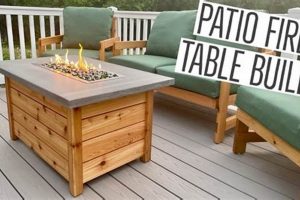
A self-constructed miniature fire feature, designed to be placed on a flat surface, allows for contained combustion. These projects commonly utilize materials such as concrete, metal containers, or repurposed vessels, combined with a fuel source like gel fuel or isopropyl alcohol, to generate a controlled flame. Such an item might feature prominently as a centerpiece or provide ambient warmth on an outdoor surface.
The appeal lies in its accessible creation and immediate gratification. These projects offer an opportunity for customization and creative expression, allowing individuals to tailor the design to their specific aesthetic preferences and spatial constraints. Furthermore, they can provide an economical alternative to commercially manufactured products, promoting resourcefulness and reducing consumption.
The following sections will delve into various construction methods, safety considerations, fuel options, and aesthetic design choices associated with creating a personalized fire feature. Information regarding appropriate materials selection and construction techniques will also be discussed.
Essential Construction and Usage Considerations
The following guidelines are critical for ensuring the safe and effective creation and operation of a miniature, self-made fire feature for placement on a flat surface. Adherence to these recommendations will mitigate potential hazards and optimize performance.
Tip 1: Material Selection Imperative: Employ non-combustible materials such as concrete, stone, or metal for the primary structure. Avoid plastics or wood, as these pose a significant fire risk.
Tip 2: Ventilation Assessment: Ensure adequate ventilation during operation. These devices are intended for outdoor use or well-ventilated spaces. Carbon monoxide poisoning is a potential hazard in enclosed environments.
Tip 3: Fuel Type Adherence: Utilize only fuels specifically designed for indoor or tabletop fire features, such as gel fuel or isopropyl alcohol of the appropriate concentration. Never use gasoline or other flammable liquids.
Tip 4: Stable Base Construction: Design a stable and level base to prevent accidental tipping. A wide base and a low center of gravity are crucial for stability.
Tip 5: Ignition Protocol: Use a long-handled lighter or match to ignite the fuel, maintaining a safe distance. Avoid leaning directly over the flame during ignition.
Tip 6: Extinguishing Procedures: Have a readily available fire extinguisher or damp cloth to smother the flame in case of emergency. Never use water to extinguish alcohol-based fires.
Tip 7: Surface Protection Measures: Place the device on a heat-resistant surface to protect the underlying table or countertop from heat damage. Ceramic tiles or metal sheets can provide adequate protection.
Tip 8: Supervision Requirement: Never leave a burning device unattended. Constant supervision is mandatory to prevent accidents or uncontrolled spread of the flame.
These guidelines emphasize the importance of responsible construction and operation, minimizing risks associated with open flames and promoting a safe and enjoyable experience. Careful attention to detail and adherence to safety protocols are paramount.
The following sections will provide detailed instructions on construction techniques, design variations, and aesthetic considerations, building upon the foundational principles outlined above.
1. Material Non-Combustibility

Material non-combustibility is a foundational safety requirement for the construction of any miniature fire feature intended for tabletop use. The selection of appropriate materials directly mitigates the risk of unintended fire spread and catastrophic failure of the device.
- Structural Integrity Preservation
The use of non-combustible materials ensures that the structural integrity of the fire pit remains intact during operation. Materials such as concrete, stone, and metal maintain their form and do not contribute to the fire, preventing collapse or deformation that could lead to fuel spillage and uncontrolled flame spread. For example, a fire pit constructed from untreated wood would rapidly ignite, compromising the containment and increasing the risk of a larger fire.
- Heat Resistance and Dissipation
Non-combustible materials exhibit superior heat resistance, allowing them to withstand the elevated temperatures generated by the burning fuel. They also often possess favorable heat dissipation properties, preventing the build-up of excessive heat that could damage surrounding surfaces or cause burns. Concrete, for instance, absorbs and distributes heat effectively, reducing the risk of localized hot spots. Conversely, flammable materials will ignite upon reaching their ignition temperature.
- Fume and Emission Reduction
Combustible materials, when heated, release harmful fumes and emissions that can pose a health hazard. Non-combustible alternatives eliminate this risk, ensuring that the only emissions are those produced by the fuel itself. This is particularly important in semi-enclosed or indoor environments where ventilation may be limited. The use of materials like treated wood will release toxins into the surrounding air.
- Longevity and Durability
Non-combustible materials exhibit greater durability and longevity when exposed to heat and flames. They are resistant to degradation, warping, and charring, ensuring that the fire pit maintains its structural integrity and aesthetic appeal over time. This reduces the need for frequent replacement and minimizes the long-term cost of ownership. A structure made of flammable materials will likely need to be replaced within a short period of time due to burning and structural damage
In summary, the adherence to non-combustible material selection is critical for safety, durability, and environmental considerations in tabletop fire feature construction. The careful choice of materials is inextricably linked to the successful and responsible implementation of such a project.
2. Fuel Source Appropriateness

Fuel source appropriateness is a critical determinant of the safety, functionality, and overall success of any self-constructed tabletop fire feature. The choice of fuel directly influences flame characteristics, heat output, combustion byproducts, and potential hazards. Inappropriate fuel selection can lead to uncontrolled fires, explosions, the release of toxic fumes, and property damage, thereby negating the intended aesthetic and recreational benefits. For instance, attempting to use gasoline within a small, enclosed unit would create an immediate and catastrophic fire hazard due to its volatility and rapid combustion rate, in contrast to the controlled burn offered by prescribed fuels.
Suitable fuels for tabletop fire features are typically limited to those specifically designed for contained combustion, such as gel fuel and isopropyl alcohol of high purity (typically 70% or greater). Gel fuel offers ease of use, predictable burn times, and often contains additives to enhance flame visibility. Isopropyl alcohol, while more economical, requires careful handling due to its flammability and the potential for invisible flames, necessitating the addition of suitable colorants. The volume of fuel must also be carefully considered in relation to the container size to prevent overfilling and potential spillage. The use of materials such as wood, charcoal, or other solid fuels is unsuitable and dangerous within the confines of a tabletop unit due to their unpredictable combustion patterns, high smoke output, and the generation of embers.
In summary, fuel source appropriateness is not merely a supplementary consideration but an integral component of the design and operation of a self-constructed tabletop fire feature. Careful selection and handling of the fuel is paramount for ensuring safety, preventing accidents, and realizing the intended aesthetic and functional benefits. The consequences of neglecting this aspect can be severe, underscoring the need for adherence to established safety guidelines and the use of only designated fuels. The safety measures discussed further down in this article become even more crucial given the limited fuel options.
3. Structural Stability
Structural stability is an indispensable attribute of any self-constructed tabletop fire feature. It directly impacts safety, longevity, and overall performance. A compromised structure presents immediate hazards, increasing the risk of fuel spillage, uncontrolled fires, and potential injury. The connection lies in the fundamental requirement for the fire pit to remain intact and upright during operation, resisting the forces exerted by heat, gravity, and accidental contact. Without adequate structural integrity, the containment of the fire is jeopardized, leading to potential property damage and personal harm.
The relationship between structural stability and material selection is also critical. A design employing non-combustible materials such as concrete or metal must still consider the physical properties of those materials to ensure long-term stability. For example, a concrete fire pit lacking proper reinforcement may develop cracks due to thermal expansion and contraction, ultimately leading to structural failure. Similarly, a metal fire pit constructed with inadequate welding or thin-gauge materials may buckle or deform under the intense heat. The base of the structure requires particular attention, as it must provide a stable and level platform to prevent tipping. The weight distribution of the fire pit and its fuel load must be carefully considered to ensure a low center of gravity and minimize the risk of accidental displacement.
In conclusion, structural stability is not merely a desirable feature but a fundamental prerequisite for the safe and reliable operation of any self-constructed tabletop fire feature. The failure to address this aspect adequately can have severe consequences, highlighting the importance of careful design, material selection, and construction techniques. The integration of safety features, such as a stable base and appropriate material reinforcement, is essential to mitigate the inherent risks associated with open flames and contained combustion. All of the previously discussed tips should be considered to ensure that every aspect of the project is carried out correctly, as the success of one element depends on the success of the previous.
4. Controlled Ventilation

The integration of controlled ventilation is a crucial safety and performance consideration in the design and operation of a self-constructed tabletop fire feature. While intuitively one might think of ventilation as primarily an outdoor concern, in the context of a small, potentially enclosed space, it becomes paramount for maintaining air quality and preventing the accumulation of hazardous combustion byproducts.
- Carbon Monoxide Mitigation
Incomplete combustion of fuels, such as isopropyl alcohol, can produce carbon monoxide (CO), an odorless and colorless gas that poses a significant health risk. Adequate ventilation facilitates the dispersal of CO, preventing it from reaching dangerous concentrations within the immediate vicinity of the fire feature. The implementation of proper ventilation reduces the potential for CO poisoning, ensuring a safer environment for users. Without sufficient airflow, even small amounts of CO can accumulate rapidly, particularly in partially enclosed spaces.
- Oxygen Replenishment for Combustion
Combustion requires a continuous supply of oxygen. An appropriately ventilated environment ensures that the fire feature receives an adequate oxygen supply, promoting complete and efficient fuel combustion. Inadequate oxygen levels can lead to incomplete combustion, resulting in reduced heat output, increased smoke production, and the formation of additional pollutants. The balance between airflow and fuel supply is crucial for optimizing the burning process and minimizing undesirable byproducts. Restricted oxygen availability may cause the fire to smolder or extinguish prematurely.
- Heat Dissipation Management
Ventilation contributes to the dissipation of heat generated by the fire feature, preventing the build-up of excessive temperatures in the surrounding area. This is particularly important for tabletop installations, where the close proximity of flammable materials and surfaces necessitates effective heat management. Adequate airflow helps to regulate the temperature of the fire feature’s components, preventing overheating and potential damage. Without sufficient heat dissipation, the surrounding area may become uncomfortably hot, and the risk of burns increases.
- Prevention of Soot and Smoke Buildup
Poor ventilation can lead to the accumulation of soot and smoke around the fire feature, particularly when using fuels that produce particulate matter during combustion. This buildup can stain surrounding surfaces, reduce visibility, and create an unpleasant odor. Adequate airflow helps to carry away soot and smoke particles, preventing their deposition and maintaining a cleaner environment. Regular cleaning and maintenance of the fire feature and its surroundings are also essential for preventing soot buildup. The use of cleaner-burning fuels can also contribute to minimizing smoke production.
These multifaceted aspects underscore the importance of integrating controlled ventilation into the design considerations of a tabletop fire feature. Prioritizing ventilation not only enhances safety by mitigating carbon monoxide risks, but it also optimizes fuel combustion, manages heat dissipation, and prevents the buildup of unwanted byproducts. Careful consideration of these factors is paramount for creating a functional and aesthetically pleasing fire feature that operates safely and efficiently within its intended environment.
5. Extinguishing Contingency
The incorporation of an “Extinguishing Contingency” represents a critical safety measure in the construction and operation of any miniature, self-constructed fire element intended for tabletop placement. The inherent risks associated with open flames necessitate the presence of readily available and appropriate extinguishing methods to mitigate potential hazards and prevent escalation into uncontrolled fire events.
- Immediate Flame Suppression
The primary function of an “Extinguishing Contingency” is to enable the immediate suppression of flames in the event of an accidental spill, malfunction, or unexpected event. This necessitates the presence of readily accessible extinguishing agents, such as a fire extinguisher rated for Class B fires (flammable liquids), a fire blanket, or a damp cloth. The response time is paramount; the quicker the intervention, the less likely the fire is to spread and cause damage or injury. For instance, a small spill of gel fuel igniting outside the intended container requires immediate and decisive action to prevent it from spreading to nearby flammable materials.
- Appropriate Extinguishing Agent Selection
The effectiveness of an “Extinguishing Contingency” is directly dependent on the selection of an appropriate extinguishing agent for the fuel source in use. Water is generally ineffective and potentially dangerous for extinguishing flammable liquid fires, as it can spread the burning liquid. Class B fire extinguishers, designed for flammable liquids, are the preferred option. Alternatively, smothering the flames with a fire blanket or a damp cloth can effectively cut off the oxygen supply and extinguish the fire. The selection of the extinguishing agent should be based on the type of fuel used in the tabletop fire element and the potential hazards associated with its combustion. A fire blanket must be large enough to completely cover the burning area to ensure oxygen deprivation.
- Accessibility and Proximity
The placement and accessibility of the “Extinguishing Contingency” are crucial factors in its effectiveness. Extinguishing agents should be located within close proximity to the tabletop fire element, ensuring that they can be quickly accessed in an emergency. The agents should be clearly visible and free from obstructions, enabling a swift and unimpeded response. Furthermore, all users of the fire element should be familiar with the location and operation of the extinguishing agents, ensuring that they can effectively deploy them in the event of a fire. For instance, a fire extinguisher stored in a locked cabinet or a fire blanket tucked away in a drawer is effectively useless in an emergency situation.
- Regular Inspection and Maintenance
An “Extinguishing Contingency” requires regular inspection and maintenance to ensure its continued effectiveness. Fire extinguishers should be inspected periodically to verify that they are fully charged and in good working order. Fire blankets and damp cloths should be checked for damage or deterioration. Expired fire extinguishers should be replaced promptly. Regular maintenance ensures that the extinguishing agents are ready for immediate use in the event of an emergency, providing a critical layer of protection against potential fire hazards. A neglected or malfunctioning extinguishing agent is no better than having no extinguishing agent at all.
The integration of these facets into a comprehensive “Extinguishing Contingency” is paramount for mitigating the risks associated with tabletop fire features. A well-planned and maintained contingency can effectively prevent minor incidents from escalating into major fire events, ensuring the safety of users and the protection of property. The absence of such a contingency represents a significant and unacceptable risk.
Frequently Asked Questions
The following section addresses common inquiries regarding the construction and usage of self-assembled miniature fire features intended for tabletop use. The information provided is designed to promote safety and informed decision-making.
Question 1: What are the fundamental safety precautions when constructing a tabletop fire pit?
Construction should prioritize non-combustible materials like concrete or metal. Adequate ventilation is mandatory to prevent carbon monoxide buildup. An appropriate extinguishing method must be readily available. The unit must possess a stable base to prevent tipping.
Question 2: What fuels are deemed safe for use in a tabletop fire pit?
Gel fuel and high-purity isopropyl alcohol (70% or greater) are the typically recommended fuels. Gasoline, kerosene, and other volatile substances are strictly prohibited due to their inherent dangers.
Question 3: Is indoor use of a tabletop fire pit permissible?
Indoor use is strongly discouraged unless the space is exceptionally well-ventilated. Carbon monoxide poisoning is a significant risk in enclosed environments. Outdoor use is the preferred and safer option.
Question 4: How should a tabletop fire pit be extinguished in case of emergency?
A Class B fire extinguisher, a fire blanket, or a damp cloth can be used to smother the flames. Water should not be used on alcohol-based fires, as it can spread the burning liquid.
Question 5: What measures should be taken to protect the tabletop surface from heat damage?
The fire pit should be placed on a heat-resistant surface, such as ceramic tiles or a metal sheet, to prevent heat from transferring to the underlying table or countertop.
Question 6: Is it safe to leave a tabletop fire pit unattended while burning?
Under no circumstances should a burning tabletop fire pit be left unattended. Constant supervision is mandatory to prevent accidents and ensure prompt response to any unforeseen events.
Adherence to these precautions is crucial for mitigating the risks associated with open flames and promoting a safe and enjoyable experience. Prioritization of safety is paramount in all aspects of construction and operation.
The following section will provide a summary of key takeaways and concluding remarks.
Conclusion
The preceding analysis of the “diy table top fire pit” concept has elucidated critical aspects pertaining to safety, construction, and responsible operation. The importance of material non-combustibility, appropriate fuel selection, structural stability, controlled ventilation, and a comprehensive extinguishing contingency cannot be overstated. These elements are inextricably linked and must be meticulously considered to mitigate the inherent risks associated with contained combustion.
The information presented serves as a foundation for informed decision-making. Potential constructors should meticulously evaluate their capabilities and resources before embarking on such a project. While the allure of a personalized fire feature is undeniable, responsible execution is paramount. Failure to adhere to established safety guidelines can have severe consequences, underscoring the need for diligence and a commitment to prioritizing safety above all else.