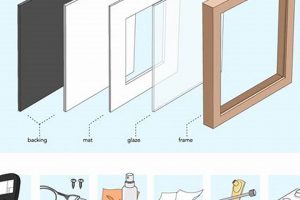
Constructing a decorative border for photographs utilizing rigid paper-based material represents a common crafting activity. This approach facilitates the inexpensive creation of customized enclosures for images, often employed in home decor or as personalized gifts. For example, a child might create a colorful surround for a school portrait using corrugated material and decorative elements.
The importance of this practice lies in its accessibility and resourcefulness. It offers a sustainable method for displaying visual memories, minimizing waste by repurposing readily available materials. Historically, using paper and board to create frames has been a longstanding tradition, evolving from basic utilitarian function to a form of artistic expression.
The subsequent discussion will delve into the selection of appropriate materials, various construction techniques, and design considerations for producing aesthetically pleasing and structurally sound photograph enclosures from recycled board stock.
Crafting Sturdy and Stylish Photo Holders
The following guidance assists in maximizing the potential of inexpensive materials when creating custom picture surrounds. Adherence to these principles promotes both durability and visual appeal.
Tip 1: Material Selection. Opt for dense, rigid varieties. Corrugated styles offer inherent strength, while heavier weight stock boards provide a smoother surface for decoration.
Tip 2: Precise Cutting. Employ a sharp utility knife or a specialized mat cutter. Inaccurate cuts compromise the structural integrity and aesthetic presentation.
Tip 3: Secure Adhesion. Utilize a high-quality adhesive suitable for paper products. Insufficient bonding agents result in separation and delamination over time. Consider acid-free options for archival purposes.
Tip 4: Reinforce Corners. The corners are points of stress. Reinforcing these areas with additional board or corner protectors extends the lifespan of the enclosure.
Tip 5: Surface Preparation. Prior to applying decorative finishes, ensure the surface is clean and free from debris. A smooth, even surface enhances the application and appearance of paints, papers, or fabrics.
Tip 6: Consider Backing and Support. Implement a rigid backing board to maintain the image’s flatness. A hinged stand or hanging hardware facilitates display.
Tip 7: Size Appropriately. Measure the photograph precisely. A holder that is too large or too small detracts from the overall presentation.
By implementing these strategies, one can generate visually appealing and structurally sound enclosures from basic materials, maximizing aesthetic impact and product longevity.
Subsequent sections will address advanced decorative techniques and alternative construction methodologies for creating refined and unique photo displays.
1. Material Rigidity

Material rigidity is a foundational attribute when constructing photograph displays from paper-based materials. It directly influences structural stability, longevity, and the overall aesthetic presentation.
- Structural Integrity
A frame’s ability to maintain its shape and resist deformation under stress is directly proportional to the rigidity of the employed material. A less rigid substance, such as thin poster board, will exhibit noticeable bending or warping, particularly when supporting a heavier photograph. Conversely, denser options like corrugated cardboard or chipboard offer greater resistance to these forces, ensuring the picture remains securely and attractively housed. For example, using thin card stock might result in a frame that bends easily, especially when displaying a larger photograph. This, in turn, diminishes the visual appeal and structural integrity of the enclosure.
- Resistance to Environmental Factors
Environmental conditions, such as humidity and temperature fluctuations, can significantly impact less rigid materials. These changes can cause warping, bending, and ultimately, structural failure. Higher rigidity offers a degree of protection against these factors, preserving the frame’s shape and extending its lifespan. For instance, a photograph support crafted from standard corrugated board is less susceptible to bending or warping in humid conditions than a frame made from thin poster board.
- Ease of Handling and Construction
Materials with high rigidity simplify the cutting, shaping, and assembly processes. The substantial nature of rigid matter provides a more stable surface for cutting tools, resulting in cleaner lines and more accurate dimensions. This enhanced precision contributes to a superior finished product. Consider the relative ease of cutting a straight line through thick cardboard compared to the difficulty of maintaining accuracy with flexible paper. The former offers better control, leading to more professional-looking edges and corners.
- Suitability for Decorative Embellishments
The inherent stability of rigid substrates makes them ideal for incorporating decorative elements. Paints, papers, fabrics, and other embellishments adhere more effectively to a firm surface. The rigidity also prevents the underlying material from warping or buckling under the weight of applied decorations. For example, applying heavy layers of paint or textured materials to flimsy construction paper is likely to cause buckling, while using a rigid cardboard base ensures a smooth and stable surface for these embellishments.
In summary, the selection of sufficiently rigid board stock is paramount to ensure the structural soundness, environmental resistance, ease of construction, and decorative potential of photograph displays crafted from recycled materials.
2. Cutting Precision

The dimensional accuracy of components within a self-assembled photographic border fabricated from paper-based materials is intrinsically linked to its structural integrity and visual presentation. Errors in linear measurement or angular alignment during the cutting phase directly propagate to the assembled product, compromising its overall quality. For instance, deviations from perpendicularity in the corner miters of a rectangular enclosure will result in visible gaps or overlaps, detracting from the aesthetic appeal. Similarly, inconsistent dimensions among the individual segments lead to a frame that is not uniformly rectangular or square, creating a distorted appearance. Therefore, meticulous attention to detail during the cutting process is paramount for a successful outcome.
The practical significance of accurate cutting extends beyond mere aesthetics. Precise dimensions are essential for ensuring that the photograph fits snugly within the enclosure, preventing slippage or exposure of the edges. Furthermore, proper alignment of the constituent parts contributes to the overall stability of the construction. A poorly cut frame is more susceptible to warping, breakage, or separation of the adhesive bonds over time. Real-world examples include using a dull blade or an unstable cutting surface; both can lead to ragged edges and inaccurate measurements, which in turn undermine the structural soundness of the constructed surround. Consistent and accurate cutting techniques, conversely, promote longevity and enhance the professional appearance of the finished product.
In conclusion, dimensional exactitude during the cutting phase is a critical determinant of the final quality of a photo display constructed from paper-based materials. While the materials themselves may be inexpensive and readily available, the level of precision applied in their preparation dictates the professional quality and long-term durability of the resulting frame. Challenges include maintaining sharp cutting implements, using accurate measuring tools, and practicing consistent cutting techniques. Adherence to these principles yields enhanced aesthetic and structural results.
3. Adhesive Strength

Adhesive strength represents a critical factor in the successful fabrication of photograph displays using paper-based materials. The integrity of the bond between constituent elements directly influences the structural stability and longevity of the final product.
- Structural Integrity and Load Bearing
The adhesive must withstand the shear and tensile forces exerted on the frame’s joints. Weak bonding agents result in delamination or separation, particularly at stress points like corners. Examples include frames that disassemble under their own weight or after minor impacts. A strong adhesive ensures the frame maintains its form and can support the photograph without collapsing.
- Environmental Resistance and Long-Term Durability
Adhesives should resist degradation from environmental factors such as humidity, temperature fluctuations, and ultraviolet (UV) exposure. Breakdown of the adhesive leads to warping, peeling, or eventual failure of the joints. For instance, water-based glues may weaken in humid conditions, while some adhesives become brittle with prolonged UV exposure. Durable adhesives maintain their bonding properties over time, extending the frame’s lifespan.
- Material Compatibility and Bond Formation
The selected adhesive must be chemically compatible with the paper-based materials used in construction. Incompatible adhesives may exhibit poor adhesion, discoloration, or even damage to the materials. For example, some solvent-based adhesives can dissolve certain types of coatings or inks. Effective adhesives form a strong, lasting bond without adversely affecting the structural or aesthetic properties of the frame’s components.
- Application Characteristics and Ease of Use
The adhesive’s viscosity, drying time, and application method impact the ease and precision of the assembly process. An adhesive that is too thin may run or seep, while one that is too thick may be difficult to spread evenly. Fast-drying adhesives require quick assembly, while slow-drying adhesives allow for adjustments. User-friendly adhesives streamline the construction process and promote accurate alignment of the frame’s elements.
The properties of an adhesive directly influence the structural integrity, environmental resistance, material compatibility, and ease of construction. A frame’s performance and useful life depend upon selecting appropriate adhesives and employing proper bonding techniques during assembly.
4. Corner Reinforcement

Corner reinforcement directly addresses a critical vulnerability in photograph displays fabricated from paper-based materials. The corners of a frame are subjected to concentrated stress from handling, gravity, and environmental factors. Absent reinforcement, these areas are prone to bending, crushing, or separation, leading to structural failure and aesthetic degradation. The relatively low tensile strength and susceptibility to folding characteristic of cardstock and corrugated board necessitate bolstering the corners to distribute stress and maintain structural integrity. For example, a frame constructed without reinforcement might exhibit a visible crease or tear at a corner after only minimal handling, rendering the display unstable and visually unappealing. Corner reinforcement increases the overall lifespan and visual appeal of this form of display.
Effective corner reinforcement techniques range from simple to elaborate. Applying additional layers of the same board stock, strategically placed to overlap the corner joint, represents a basic approach. More advanced methods involve incorporating specialized corner protectors constructed from rigid plastic, metal, or wood. These protectors provide a durable shield against impact and compression forces. Regardless of the chosen method, the objective remains consistent: to increase the resistance of the corner to deformation and separation. As an illustration, consider a photograph holder where the corners are reinforced with triangular pieces of thick cardstock glued to the interior surfaces. This simple addition significantly increases the frame’s ability to withstand accidental bumps or drops, preserving its structural integrity.
In summation, reinforcing the corners is an indispensable step in the fabrication of durable and aesthetically pleasing photograph displays using paper-based materials. This practice mitigates the inherent weaknesses of these materials, extending the frame’s lifespan and preserving its visual appeal. Challenges in corner reinforcement often involve selecting appropriate materials and application techniques that are both effective and visually harmonious with the overall design. Proper reinforcement enhances the structural integrity and the perceived quality.
5. Decorative Technique

The application of ornamentation to paper-based photograph displays represents a crucial element in enhancing their aesthetic value and conveying a desired style or theme. The selection and execution of decorative techniques transform a functional enclosure into a personalized art object.
- Surface Embellishment and Texture
Surface embellishment involves the application of materials that alter the visual and tactile properties of the frame’s surface. Examples include painting, decoupage, applying textured paper, or incorporating found objects. A frame adorned with layers of acrylic paint in varying shades creates depth and visual interest, while adhering small shells or beads produces a tactile surface. These techniques allow for extensive customization to match specific decor or to reflect the subject of the photograph.
- Color Palette and Contrast
The selection of colors and the interplay of contrast are fundamental to visual impact. A monochromatic color scheme evokes a sense of harmony and sophistication, while contrasting colors create a dynamic and attention-grabbing effect. For instance, a frame with a bold red border around a black and white photograph generates a striking visual contrast, drawing the viewer’s eye to the image. Judicious use of color enhances the visual appeal and directs focus.
- Pattern and Motif Integration
The incorporation of patterns and motifs adds visual complexity and reinforces a specific theme. Geometric patterns, floral designs, or abstract motifs can be applied through stenciling, stamping, or hand-painting. A frame decorated with a repeating floral pattern complements a photograph of a garden scene, creating a cohesive and visually pleasing composition. Strategic use of patterns can further the narrative or emotional impact of the display.
- Personalization and Customization
Personalization involves incorporating unique elements that reflect the individual’s style or the photograph’s significance. This may include hand-lettering, adding names or dates, or incorporating personal mementos. A frame adorned with handwritten quotes or personalized messages transforms a mass-produced item into a cherished keepsake. Personalized elements imbue the display with sentimental value and make it a unique expression of individual identity.
The range of decorative techniques applicable to paper-based photograph displays is extensive, limited only by the imagination and skill of the creator. The careful selection and skillful execution of these techniques elevates a simple structural element into a personalized work of art, enhancing the presentation and appreciation of the enclosed photograph.
Frequently Asked Questions
The following addresses common inquiries regarding the construction and utilization of photographic enclosures fabricated from rigid paper-based materials. Clarity on these aspects facilitates optimal results.
Question 1: What types of cardboard are most suitable for photo enclosures?
Corrugated cardboard offers inherent strength and structural stability, making it appropriate for larger frames or those requiring significant durability. Chipboard provides a smoother surface for decorative finishes and is well-suited for smaller frames or those with intricate designs. The selection is contingent upon size, desired aesthetic, and structural requirements.
Question 2: What tools are essential for accurate cutting and assembly?
A sharp utility knife or mat cutter is crucial for precise cuts. A metal ruler or straight edge provides guidance for accurate lines. A cutting mat protects work surfaces. High-quality adhesive is necessary for secure bonding. Corner clamps or weights assist in maintaining alignment during the drying process.
Question 3: How can the corners of cardboard frames be reinforced to prevent damage?
Applying additional layers of cardboard to the interior corner joints strengthens these vulnerable areas. Corner protectors made from plastic, metal, or wood offer superior impact resistance. Fabric or paper tape can be used to reinforce the exterior corners and conceal raw edges. Reinforcement selection depends on intended use and aesthetic preferences.
Question 4: What adhesives are recommended for bonding cardboard photo frames?
Acid-free PVA glue provides a strong, permanent bond without damaging photographs or the frame itself. Hot glue offers a rapid set time, but its rigidity may make it unsuitable for certain applications. Double-sided adhesive tape facilitates quick and clean assembly. Consider adhesive properties when bonding dissimilar materials.
Question 5: How can the surface of cardboard photo frames be prepared for decorative finishes?
Remove any dust, debris, or loose fibers from the surface. Apply a primer or sealant to create a smooth, uniform base for paint or other decorative materials. Sanding lightly improves adhesion and reduces imperfections. Proper surface preparation optimizes the appearance and longevity of decorative finishes.
Question 6: Are there considerations for displaying framed photos to prevent damage to the photograph?
Utilize acid-free backing boards to protect the photograph from contact with potentially harmful materials. Avoid direct sunlight or extreme temperature fluctuations. Handle the framed photograph with clean hands to prevent smudging or fingerprints. Protective measures ensure the photograph remains pristine over time.
In summary, careful material selection, precise cutting techniques, effective reinforcement strategies, appropriate adhesive choices, thorough surface preparation, and mindful display practices are essential for creating durable and aesthetically pleasing photographic enclosures.
The subsequent section will explore alternative materials and advanced design concepts.
Conclusion
The preceding discussion has elucidated various facets of constructing photographic enclosures from rigid paper-based materials. Critical aspects, including material selection, precise cutting, adhesive strength, corner reinforcement, and decorative techniques, have been examined to underscore their impact on structural integrity and aesthetic presentation. These considerations collectively inform the successful creation of durable and visually appealing displays.
Recognizing the inherent limitations and potential of paper-based resources fosters resourcefulness and personalized expression. The principles outlined provide a foundation for informed decision-making. Continued exploration of innovative design and material integration will undoubtedly yield novel approaches. The thoughtful application of these techniques elevates the functional object to a medium for artistic expression and preservation of visual memories.