Enhancing a current sleeping platform through the application of a solid wood sheet, typically utilizing do-it-yourself methods, constitutes a practical and cost-effective solution. This project involves adding a level surface to an existing bed frame using materials procured and assembled by the individual, as opposed to purchasing a new bed or box spring. For example, if a bed frame lacks adequate support for a memory foam mattress, affixing a sheet of sturdy material provides the necessary foundation.
This approach yields several advantages. It extends the lifespan of existing furniture, preventing unnecessary waste and reducing expenses associated with complete replacement. Furthermore, it allows for customization to accommodate specific mattress types or desired bed heights. Historically, resourceful individuals have employed similar techniques to adapt furniture to changing needs and resource constraints.
The subsequent discussion will delve into the essential aspects of selecting appropriate materials, outlining the construction process, and offering practical tips for achieving a professional and structurally sound result. Considerations regarding safety, ventilation, and aesthetic enhancements will also be addressed.
Essential Considerations for Bed Frame Enhancement
Successful implementation of a plywood top for an existing bed frame necessitates careful planning and execution. The following guidelines provide essential advice for a durable and functional upgrade.
Tip 1: Material Selection: Prioritize high-quality plywood with sufficient thickness to support the intended weight. Consider hardwood options like birch or maple for increased durability and reduced warping. Avoid low-grade materials prone to splintering or deformation.
Tip 2: Precise Measurements: Accurately measure the interior dimensions of the bed frame. Ensure the plywood sheet fits snugly within the frame without excessive gaps. Subtract a small allowance (approximately 1/8 inch) to facilitate easy insertion and prevent binding.
Tip 3: Adequate Ventilation: Drilled ventilation holes in the plywood surface are recommended, especially when using memory foam mattresses. This promotes airflow and prevents moisture buildup, which can lead to mold and mildew growth.
Tip 4: Secure Attachment: Employ appropriate fastening methods to secure the plywood to the existing frame. Screws are generally preferable to nails for enhanced stability. Consider using wood glue in conjunction with screws for added strength and to minimize movement.
Tip 5: Edge Treatment: Address the exposed edges of the plywood to prevent splintering and improve aesthetics. Sanding the edges smooth and applying edge banding or trim are effective solutions.
Tip 6: Surface Finishing: Sealing or painting the plywood surface can protect it from moisture and stains. Choose a low-VOC (volatile organic compound) finish to minimize off-gassing and maintain indoor air quality.
Tip 7: Weight Distribution: For larger beds, consider adding additional support beams beneath the plywood to distribute weight evenly and prevent sagging. These beams should be securely attached to both the plywood and the existing frame.
Adhering to these guidelines enhances the structural integrity, longevity, and comfort of the enhanced bed frame, ensuring a worthwhile and lasting improvement.
The subsequent sections will provide further details on troubleshooting common issues and ensuring a safe and successful project outcome.
1. Material Selection

The selection of plywood directly governs the success of any endeavor to enhance an existing bed frame. Plywood serves as the foundational element providing support and stability to the mattress. Inadequate selection, such as opting for thin or low-grade material, can lead to structural failure, manifested as sagging or complete collapse under weight. For instance, if lightweight plywood is used beneath a heavy memory foam mattress, it will likely deflect, rendering the bed uncomfortable and potentially unsafe.
Conversely, choosing appropriately strong and thick plywood ensures the bed frame’s capacity to bear the intended load. Hardwood plywood, such as birch or maple, offers enhanced durability and resistance to warping compared to softwood alternatives. This robustness translates directly into extended lifespan and improved sleeping comfort. Proper material selection includes consideration of plywood grade, thickness, and the presence of formaldehyde, with low-emission options contributing to better indoor air quality. For example, using a -inch thick sheet of hardwood plywood can significantly improve the support and stability of an older metal bed frame.
Therefore, Material Selection is not merely a preliminary step; it is an integral determinant of the overall quality, safety, and longevity of the upgraded bed. Challenges may arise in balancing cost considerations with desired performance, but prioritizing quality materials ultimately yields a more satisfying and durable outcome. Understanding the interplay between material properties and structural requirements is paramount for a successful enhancement.
2. Accurate Measurement

Precise dimensions are paramount to the successful integration of a plywood top onto an existing bed frame. Deviations from accurate measurement can compromise the structural integrity, aesthetics, and overall functionality of the modified bed. Thoroughness in this preliminary stage directly correlates with the project’s final outcome.
- Internal Frame Dimensions
The interior dimensions of the bed frame must be ascertained with precision. Errors at this stage can lead to a plywood top that is either too large, requiring trimming and potentially compromising its structural integrity, or too small, resulting in instability and movement within the frame. For example, if the internal dimensions are underestimated by even half an inch, the plywood may shift during use, creating noise and discomfort.
- Accounting for Obstructions
Existing bed frames may incorporate internal structures or hardware that impede a flush fit. Accurate measurement must account for these obstructions, such as corner brackets or support beams. Failure to do so can result in the plywood top not seating correctly, requiring modifications or rendering it unusable. A bed frame with protruding bolt heads, for instance, necessitates either countersinking the bolts or incorporating corresponding recesses into the plywood sheet.
- Plywood Thickness Considerations
The thickness of the plywood itself influences the final fit within the frame. While the primary measurement focuses on the horizontal dimensions, neglecting the plywood’s vertical thickness can lead to unforeseen issues. A thicker sheet may create a raised profile relative to the frame, while a thinner sheet may necessitate shimming to achieve a level surface. For example, using a plywood sheet that is significantly thicker than anticipated may prevent proper mattress placement.
- Squareness and Alignment
Beyond linear dimensions, ensuring the bed frame is square is crucial. Out-of-square frames necessitate adjustments to the plywood cut to compensate, preventing gaps or overlaps. Failing to verify squareness can result in a visually unappealing and structurally unsound modification. A frame that is even slightly trapezoidal will require a custom-cut plywood top to maintain proper support and appearance.
The implications of inaccurate measurement extend beyond mere inconvenience. A poorly fitting plywood top compromises the support system for the mattress, potentially leading to premature wear and tear. Moreover, instability resulting from dimensional errors poses a safety hazard. Therefore, meticulous attention to measurement is an indispensable aspect of any upgrade project involving plywood and an existing bed frame.
3. Secure Attachment

The method of affixing a plywood top to an existing bed frame directly influences the structural integrity and longevity of the upgrade. Improper attachment can result in instability, noise, and ultimately, failure of the modification. Therefore, selecting appropriate fastening techniques and executing them meticulously is paramount.
- Screws vs. Nails
Screws offer a superior hold compared to nails due to their threaded design, providing greater resistance to pull-out forces. In the context of this upgrade, screws are the preferred method for securing the plywood to the bed frame. Nails, while faster to install, are more prone to loosening over time due to vibrations and weight fluctuations. For example, if nails are used and the bed is frequently moved, the plywood will likely detach, rendering the upgrade ineffective.
- Pilot Holes and Countersinking
Drilling pilot holes before inserting screws is crucial, especially when working with hardwood frames. Pilot holes prevent the wood from splitting and ensure the screw threads grip properly. Countersinking the screw heads creates a flush surface, preventing the plywood from snagging on bedding. An attempt to drive screws directly into a hardwood frame without pilot holes will likely result in cracked wood and a weakened connection.
- Adhesive Application
The application of wood glue in conjunction with screws significantly enhances the bond between the plywood and the bed frame. Wood glue creates a chemical bond that provides additional strength and minimizes movement, reducing the likelihood of squeaking or loosening over time. For instance, applying a bead of wood glue along the frame before attaching the plywood with screws creates a far more rigid and durable connection than screws alone.
- Attachment Point Density
The number and spacing of attachment points are critical factors. Insufficient attachment points will lead to uneven weight distribution and potential sagging of the plywood. A higher density of screws, spaced evenly across the frame, provides more consistent support and prevents localized stress. A large bed with only a few screws at the corners is prone to bowing in the center, demonstrating the importance of adequate attachment point density.
These considerations highlight that secure attachment is not simply about fastening the plywood to the frame, but about understanding the underlying principles of structural mechanics and material properties. A well-executed attachment strategy ensures that the upgraded bed frame provides reliable support and comfort for years to come.
4. Adequate Support

Adequate support is a foundational requirement for the successful implementation of a plywood top on an existing bed frame. The installation of a plywood sheet without proper consideration for weight distribution and reinforcement can lead to structural compromise, premature material fatigue, and ultimately, failure of the bed frame modification. The plywood serves as a load-bearing surface, and its capacity to withstand the imposed weight is directly contingent upon the underlying support structure. For instance, a thin plywood sheet placed atop a bed frame with widely spaced slats will exhibit significant deflection under the weight of a mattress and occupants, potentially leading to cracking, sagging, or even collapse. The provision of adequate support ensures even weight distribution, preventing localized stress concentrations and maintaining the integrity of both the plywood and the original frame.
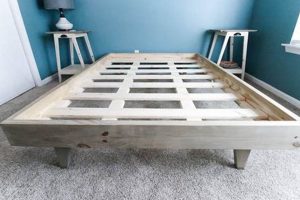
Practical implementation involves assessing the existing bed frame’s support system. If the frame features insufficient slats or inadequate cross-bracing, supplementary support structures should be introduced. These may include additional wooden or metal slats, centrally located support legs, or a complete grid of cross-beams. The spacing between supports should be determined based on the thickness of the plywood, the weight of the intended mattress, and the anticipated load. For example, a queen-sized bed frame with a -inch plywood top supporting a memory foam mattress may require additional support slats spaced no more than 12 inches apart to prevent sagging. Failure to implement these measures may result in an uncomfortable sleeping surface and accelerated degradation of the plywood top.
In summary, adequate support is not merely an optional addition but a critical component when enhancing a bed frame with a plywood top. Its absence compromises the structural integrity, longevity, and comfort of the modified bed. Careful assessment of the existing frame’s support capabilities, coupled with the strategic addition of supplementary structures, is essential for achieving a safe, durable, and functional outcome. A failure to prioritize this aspect undermines the entire project, rendering the plywood top a liability rather than an enhancement.
5. Edge Finishing

Edge finishing represents a crucial, often overlooked, aspect of enhancing an existing bed with a plywood top. The raw edges of plywood, when left untreated, present a significant risk of splintering, posing a potential hazard to users. Moreover, unfinished edges detract from the overall aesthetic, undermining the purpose of the modification. A well-executed edge finishing process mitigates these concerns, transforming a potentially rough and unsightly addition into a safe and visually appealing component of the bed frame.
Several methods exist for achieving a professional edge finish. Sanding smooths the edges, eliminating sharp corners and reducing the likelihood of splintering. Edge banding, typically a thin strip of veneer or plastic, adheres to the plywood edge, creating a clean and durable surface. Alternatively, applying trim, such as quarter-round molding, provides a decorative element while simultaneously protecting the edge. The choice of method depends on factors such as desired aesthetic, budget, and skill level. For example, a simple sanding and sealing process may suffice for a utilitarian bed frame, while a more elaborate edge banding or trim application is appropriate for a higher-end design. Failure to address the edges can result in snagged bedding, scratched skin, and a visually unrefined appearance, diminishing the user experience.
In conclusion, edge finishing is not merely an optional step but an integral part of a comprehensive bed frame upgrade. It directly impacts the safety, durability, and aesthetic appeal of the modified bed. Prioritizing this aspect elevates the project from a purely functional modification to a refined and long-lasting improvement. Overlooking edge finishing negates the time and effort invested in the overall project, resulting in a compromised and potentially hazardous outcome.
6. Ventilation
The implementation of a solid plywood top on an existing bed frame necessitates careful consideration of ventilation. A solid surface restricts airflow, potentially leading to moisture accumulation beneath the mattress. This trapped moisture creates a conducive environment for the growth of mold and mildew, posing health risks to occupants and accelerating the degradation of the mattress itself. For instance, individuals residing in humid climates who enclose their bed frames with plywood without addressing ventilation concerns often observe visible mold growth on the underside of their mattresses within a relatively short timeframe. The absence of adequate airflow disrupts the natural evaporation of moisture, resulting in a damp and unhygienic sleeping environment. Ventilation, therefore, becomes an essential component of any “upgrade existing bed with plywood top diy” project to mitigate these risks and promote a healthy sleep environment.
Practical methods for addressing ventilation include drilling evenly spaced holes throughout the plywood surface. The size and spacing of these holes should be determined based on the size of the bed and the climate in which it is used. Larger beds and more humid environments necessitate a greater number and size of ventilation holes. Another approach involves incorporating gaps or spaces between the plywood sheet and the bed frame to allow for airflow. This can be achieved by using small wooden blocks or spacers to elevate the plywood slightly above the frame. Choosing a breathable mattress material, such as latex or open-cell memory foam, also contributes to improved ventilation. Conversely, neglecting ventilation can lead to a mattress becoming waterlogged, fostering dust mite infestations, and emitting unpleasant odors.
In summary, ventilation is an indispensable consideration when undertaking an “upgrade existing bed with plywood top diy” project. Its inclusion mitigates the risk of moisture accumulation, mold growth, and mattress degradation, fostering a healthier and more hygienic sleeping environment. Failure to address ventilation undermines the benefits of the upgrade, potentially leading to adverse health outcomes and necessitating premature mattress replacement. Therefore, incorporating appropriate ventilation measures is paramount for ensuring a successful and sustainable bed frame modification.
Frequently Asked Questions
The following addresses common inquiries concerning the implementation of a plywood top on existing bed frames. Information provided aims to clarify key considerations and dispel potential misconceptions.
Question 1: What plywood thickness is appropriate for bed support?
The optimal plywood thickness varies based on bed size, mattress type, and anticipated load. Generally, -inch plywood is suitable for twin beds, while queen and king sizes necessitate -inch or thicker material. Hardwood plywood offers increased rigidity compared to softwood varieties.
Question 2: Is ventilation necessary when using a plywood bed top?
Ventilation is strongly recommended, particularly in humid environments or when using memory foam mattresses. The absence of airflow can trap moisture, fostering mold growth. Drilling ventilation holes or incorporating spacers promotes air circulation.
Question 3: How does the type of existing bed frame influence the plywood upgrade?
The existing frame’s construction dictates the required support structure. Frames with widely spaced slats require additional support beams beneath the plywood. Metal frames may necessitate modifications to facilitate secure attachment.
Question 4: What are the potential safety considerations?
Splintering from unfinished plywood edges poses a hazard. Sanding and edge banding are essential. Furthermore, ensure the upgraded bed frame can safely support the weight of the mattress and occupants to prevent collapse.
Question 5: How can squeaking be minimized in a plywood bed top installation?
Squeaking often arises from friction between the plywood and the bed frame. Applying wood glue to contact surfaces during installation minimizes movement. Ensuring a snug fit and using felt pads can also reduce noise.
Question 6: Does the finish applied to the plywood affect indoor air quality?
Certain finishes emit volatile organic compounds (VOCs), which can negatively impact indoor air quality. Selecting low-VOC or zero-VOC finishes is advisable to minimize off-gassing and maintain a healthy environment.
Careful consideration of these factors contributes to a successful and safe bed frame enhancement.
The subsequent section will explore troubleshooting common challenges encountered during the upgrade process.
Concluding Remarks
This exploration of “upgrade existing bed with plywood top diy” has detailed essential considerations, ranging from material selection and accurate measurement to secure attachment, adequate support, edge finishing, and ventilation. Each element directly influences the structural integrity, safety, and longevity of the modified bed frame. Prioritizing these factors ensures a stable and comfortable sleeping platform.
The decision to reinforce an existing bed frame with a plywood top represents a commitment to resourcefulness and customization. By adhering to established best practices, individuals can create a durable and personalized sleep environment. This undertaking warrants careful planning and execution to ensure a successful and long-lasting result.