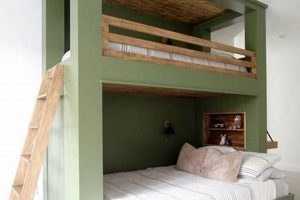
The concept involves elevated sleeping platforms constructed within a limited area, typically in a residence, by the occupant or a hired individual rather than purchasing a pre-fabricated unit. A standard illustration would be building a wooden frame to support a mattress several feet above the floor, utilizing the space beneath for a desk, storage, or seating.
This approach maximizes vertical space, creating additional functional zones in compact living spaces. Historically, such constructions provided essential solutions in densely populated urban areas or smaller dwellings, facilitating efficient space utilization. These projects can lead to cost savings compared to purchasing pre-made furniture and allow for customized designs tailored to specific room dimensions and individual requirements. The ability to personalize the design, material choices, and incorporated features contributes significantly to the value proposition.
The subsequent sections will delve into practical construction techniques, safety considerations, design variations suitable for various room configurations, and material selection for creating these space-saving structures.
Construction Pointers
The following guidelines offer advice for executing a successful project. Careful consideration of these points contributes to a structurally sound and safe finished product.
Tip 1: Structural Integrity Assessment: Prior to commencement, evaluate the load-bearing capacity of the floor and wall structures. A structural engineer’s consultation may be necessary for older buildings or uncertain conditions to ensure compliance with safety regulations.
Tip 2: Precise Measurement and Planning: Accurate room dimensions are paramount. Draft detailed plans outlining dimensions, material quantities, and component joinery methods. Digital modeling can aid in visualizing the final structure within the space.
Tip 3: Material Selection based on Durability: Opt for high-quality lumber, such as kiln-dried hardwood or engineered wood products. Ensure materials are free from defects, such as knots or warping, that can compromise structural integrity.
Tip 4: Secure Fastening Techniques: Employ robust fastening methods, including screws, bolts, and appropriate jointing techniques (e.g., mortise and tenon, half-lap joints). Reinforce connections with metal brackets or plates where necessary.
Tip 5: Ladder or Stairway Design Considerations: Design safe and accessible access points. Ladders should feature angled rungs for improved grip, while stairways require consistent rise and run dimensions to minimize trip hazards. Handrails are mandatory for stairways and recommended for ladders.
Tip 6: Safety Railing Height and Spacing: Install safety railings along the perimeter of the sleeping platform to prevent falls. Railings should meet or exceed local building code requirements for height and spacing to restrict passage.
Tip 7: Adequate Headroom Evaluation: Ensure sufficient vertical clearance between the mattress and the ceiling for comfortable movement. A minimum of 24 inches is generally recommended.
Tip 8: Regulatory Compliance Verification: Research and adhere to all applicable local building codes and safety regulations. Permit acquisition may be required, depending on the scope of the project and jurisdictional requirements.
Adhering to these principles yields a structurally sound and secure elevated sleeping area, maximizing usable square footage while prioritizing resident safety. Diligence in these areas significantly impacts the longevity and functionality of the finished build.
The next section will cover various creative design adaptations and aesthetic considerations applicable for different interior styles and spatial constraints.
1. Space Optimization
Space optimization is fundamental to the successful implementation of elevated sleeping platforms in confined residential settings. The core objective of such projects is to reclaim floor area by vertically relocating the bed, thereby freeing up space for other functional purposes. This cause-and-effect relationship highlights the inherent value of such design strategies. The effective use of the vertical dimension becomes the primary means of expanding usable area without increasing the physical footprint of the room. A common illustration is positioning a desk, a seating area, or storage solutions directly underneath the lofted bed. This leverages previously unusable vertical space, creating a multi-functional zone. The absence of space optimization negates the primary benefit of elevated sleeping arrangements, rendering them impractical for small rooms.
The optimization strategy extends beyond simply freeing floor space. Careful consideration must be given to the layout of the new zones created. For instance, if a desk is placed underneath, adequate lighting and ventilation must be ensured. If storage is implemented, the accessibility and organization of those storage units require planning. Examples of advanced optimization include integrating the ladder or stairs into the storage design, further minimizing space consumption. Another optimization strategy is to design a murphy-bed style loft bed, in which the bed can be folded away when not in use, revealing even more space.
In summary, space optimization is not merely a desirable attribute but a critical component of elevated sleeping platform designs for small rooms. The effectiveness of such a design hinges upon the ability to reclaim and efficiently utilize vertical space. Challenges in implementation include ensuring adequate headroom, proper weight distribution, and integrating various functionalities without compromising structural integrity or aesthetic appeal. The ability to overcome these difficulties translates directly into a more livable and functional small-room environment.
2. Structural Stability
Structural stability is a non-negotiable requirement for elevated sleeping platforms in any context, and particularly so for DIY constructions intended for small rooms. The potential consequences of structural failure range from property damage to serious personal injury. Therefore, the design, material selection, and construction methods must prioritize stability as the paramount consideration. An inadequately supported sleeping platform poses an immediate and significant risk to occupants, directly negating any benefits gained from space optimization. The cause-and-effect relationship is direct: compromised structural integrity inevitably leads to unsafe conditions.
Achieving adequate structural stability necessitates a thorough understanding of load-bearing principles. The weight of the mattress, occupants, and any stored items underneath must be distributed effectively across the supporting structure. Examples of robust structural design include using appropriately sized lumber (e.g., kiln-dried hardwood) for the frame, employing secure joinery techniques (e.g., mortise and tenon, bolted connections), and incorporating strategically placed support beams or posts. The integration of metal brackets and reinforcing plates at critical stress points further enhances structural integrity. A specific example would be using a minimum lumber dimension of 4×4 inches for the main support posts, and ensuring that all connections are secured with both screws and bolts, in a design intended to support two adults. The absence of such design considerations represents a critical deficiency.
In conclusion, the successful implementation of elevated sleeping areas hinges critically on ensuring robust structural integrity. The effort invested in proper design, material selection, and construction methods directly correlates with the safety and longevity of the structure. Overlooking structural stability in pursuit of cost savings or aesthetic considerations is a hazardous error that can have severe repercussions. Adherence to sound engineering principles and building codes is essential for mitigating risks and guaranteeing a secure living environment.
3. Ladder Accessibility
Ladder accessibility represents a crucial design element in the context of elevated sleeping platforms for small rooms. Given the limited spatial footprint, the means of accessing the lofted bed directly impacts usability, safety, and overall design efficiency. The access solution must be carefully integrated to avoid impeding movement or consuming excessive space within the room.
- Angle and Inclination
The angle of the ladder significantly influences ease of use. Steeper angles minimize floor space occupied but increase the difficulty of ascent and descent, posing a greater risk of falls. Shallower angles, while easier to navigate, consume more valuable square footage. An optimal angle strikes a balance between these competing demands. For example, a near-vertical ladder might be suitable for occasional use by agile individuals, while a gentler slope is preferable for daily access or users with mobility limitations.
- Rung Design and Spacing
The design and spacing of ladder rungs affect grip and stability. Rungs that are too narrow or spaced too far apart can lead to discomfort and increase the likelihood of slipping. Conversely, overly wide rungs or closely spaced rungs can be awkward to negotiate. Contoured rungs or those with non-slip surfaces provide improved grip. Consistent and appropriate rung spacing promotes a natural and comfortable climbing rhythm.
- Ladder Placement and Clearance
The placement of the ladder within the room dictates traffic flow and available space for other activities. A poorly positioned ladder can obstruct doorways, windows, or furniture placement. Adequate clearance around the ladder’s base and top is essential for safe maneuvering. For instance, positioning the ladder near a corner or wall can provide added support and stability. Ensuring sufficient headroom above the ladder’s top rung prevents head injuries during ascent and descent.
- Alternative Access Solutions
In situations where space permits, alternative access solutions, such as compact staircases, offer enhanced safety and comfort compared to traditional ladders. While staircases consume more floor space, they provide a more stable and natural climbing experience, particularly beneficial for frequent users or those with physical limitations. Another alternative, albeit more complex, is the incorporation of fold-away or sliding ladders that can be stowed when not in use, maximizing space efficiency.
In conclusion, the design and implementation of ladder accessibility within elevated sleeping platforms for small rooms require careful consideration of multiple factors. The optimal solution balances space efficiency, ease of use, and safety. Trade-offs between these competing demands are inevitable, and the final design must reflect a thoughtful assessment of the user’s needs and the constraints of the available space. The selection and integration of the access solution are crucial determinants of the overall success and practicality of the loft bed design.
4. Storage Integration
The integration of storage solutions is a vital component of effectively employing elevated sleeping platforms within constricted living quarters. This practice directly enhances the functionality of the available area. The efficient management of belongings significantly contributes to optimizing space utilization. The subsequent points outline critical facets of incorporating storage into these structures.
- Under-Bed Storage Systems
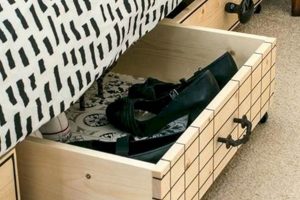
The space beneath the elevated sleeping surface provides an ideal location for integrating various storage systems. Common examples include drawers, shelving units, and enclosed cabinets. Implementing these systems requires careful planning to ensure accessibility and avoid obstructing movement. Real-world applications show custom-built drawer systems designed to house clothing or shelving tailored for books and personal items. The implications of these systems for small rooms are substantial, as they minimize the need for separate storage furniture, thereby maximizing floor space.
- Integrated Staircase Storage
In instances where a staircase is used to access the lofted bed, the staircase structure can be dual-purposed to provide concealed storage. Individual steps can be designed as drawers or lift-up compartments, suitable for storing shoes, accessories, or smaller items. This integration necessitates careful structural engineering to maintain the staircase’s stability and load-bearing capacity. This configuration proves especially valuable where every square inch of space must be maximized.
- Wall-Mounted Storage Adjacent to Loft Bed
Utilizing the wall space adjacent to the lofted bed for storage is a logical extension of space optimization. Wall-mounted shelves, cabinets, or pegboards can provide easily accessible storage for frequently used items. This approach minimizes clutter on the floor and allows for customized storage configurations tailored to specific needs. Consider, for instance, mounting a small bookshelf within easy reach of the bed for nighttime reading materials. The integration of such wall storage further enhances the livability of the small room.
- Multi-Functional Furniture Incorporation
The area beneath the loft bed can be further optimized by incorporating multi-functional furniture. Examples include desks with integrated drawers, seating areas with built-in storage benches, or fold-down tables that can be stowed away when not in use. This approach combines storage with other essential functions, maximizing the utility of the limited space. A desk with integrated shelving, for example, can serve as both a workspace and a storage solution for books, stationery, and other office supplies. This synergistic combination amplifies the value proposition of the elevated sleeping platform.
These integrated storage solutions are intrinsically linked to the successful implementation of elevated sleeping platforms within smaller dwellings. The capacity to efficiently store belongings without sacrificing floor space contributes significantly to the practicality and comfort of such designs. Strategic planning and creative implementation are crucial for realizing the full potential of these space-saving configurations.
5. Customization Options
Customization options are intrinsically linked to the effectiveness of do-it-yourself elevated sleeping platforms in compact living spaces. The ability to tailor the design to specific spatial constraints and individual needs significantly amplifies the value proposition of such projects. The inherent flexibility afforded by DIY construction allows for the creation of bespoke solutions that would be unattainable through mass-produced furniture. The impact of customization is direct: designs can be precisely adapted to maximize space utilization and address specific functional requirements. For instance, a room with an unusually low ceiling necessitates a lower platform height, which can be readily accommodated through personalized design modifications.
Consideration of ladder placement, integrated storage solutions, and under-bed workspace configurations exemplify practical areas for customization. Ladder placement can be optimized to avoid obstructing doorways or windows, maximizing available wall space. The integration of storage can be tailored to accommodate specific items, such as books, clothing, or equipment, contributing to a clutter-free environment. The area beneath the sleeping platform can be transformed into a personalized workspace, complete with custom-built desks, shelving units, and lighting arrangements. Each of these customizations directly addresses specific functional needs while optimizing the use of available area. Without customization, the design may be unable to satisfy the specific characteristics of small rooms which includes but not limited to, low ceilings, minimal square-footage, asymmetrical layout, and existing fixtures.
In summary, customization is a cornerstone of successful DIY elevated sleeping platform projects in smaller dwellings. This adaptability allows for a tailored design that maximizes usable space, addresses individual functional needs, and seamlessly integrates with the existing room layout. The ability to personalize the design, materials, and incorporated features transforms a generic sleeping platform into a bespoke living solution optimized for the specific constraints of the limited space. Potential challenges can include design complexity and the requirement for advanced skills, but careful planning and iterative adjustments during the building process can lead to highly rewarding results. Without customization, the efficiency and usability of the platform will be severely limited.
6. Safety Features
Safety features constitute an indispensable element within do-it-yourself elevated sleeping platform configurations, particularly when tailored for compact residential spaces. The inherent elevation associated with these structures introduces potential risks necessitating proactive mitigation strategies. The absence of adequate safety provisions elevates the likelihood of falls, injuries, and structural instability. Therefore, prioritizing safety features becomes a direct determinant of the project’s overall success and the well-being of occupants. For example, a poorly constructed railing or an unstable ladder can negate any benefits derived from space optimization, rendering the entire endeavor counterproductive and potentially hazardous. The direct cause-and-effect relationship underscores the critical role of safety considerations.
Practical examples of safety features include the installation of sturdy guardrails around the perimeter of the sleeping platform, designed to prevent accidental falls during sleep or movement. These guardrails must adhere to minimum height requirements stipulated by building codes to effectively restrain occupants. Furthermore, the access ladder or staircase must be engineered for stability and ease of use, incorporating non-slip surfaces, secure handrails, and appropriate step spacing. Weight limitations for the structure as a whole must be calculated and clearly posted to prevent overloading, which could compromise structural integrity. Fire safety is also paramount, dictating the use of flame-retardant materials and readily accessible escape routes. Finally, a smoke detector should be mounted in close proximity to the sleeping area to alert occupants in case of fire emergencies.
In conclusion, the integration of comprehensive safety measures is not merely an optional addendum, but an essential prerequisite for do-it-yourself elevated sleeping arrangements in compact dwellings. The commitment to prioritizing safety directly translates into a secure living environment, minimizing risks and maximizing the benefits of space optimization. Challenges may arise in balancing safety requirements with aesthetic design preferences or budget constraints, but compromise on safety should not be considered an option. Diligence in adhering to building codes, incorporating robust safety features, and maintaining ongoing inspection and upkeep ultimately safeguards the occupants’ well-being.
7. Ventilation Considerations
Ventilation considerations directly impact the suitability of elevated sleeping platforms within restricted residential environments. Compact rooms frequently suffer from compromised air circulation, which is exacerbated by the construction of a loft bed. Elevated positions tend to trap warm air, creating a microclimate with elevated temperatures and humidity levels. Inadequate ventilation can lead to discomfort, promote the growth of mold and mildew, and negatively impact sleep quality. A poorly ventilated loft bed, in essence, can negate many of the spatial benefits by creating an uninhabitable sleeping environment. For example, a loft bed constructed in a small room with limited window access will require supplementary ventilation strategies to ensure occupant comfort. The connection is a direct cause-and-effect relationship: poor planning for air circulation results in a substandard living condition.
Implementation of effective ventilation strategies necessitates a multi-faceted approach. Proper placement of the loft bed in relation to existing windows and ventilation ducts becomes crucial. The installation of a ceiling fan or strategically positioned oscillating fans can significantly improve air circulation. Furthermore, material selection for the loft bed itself should prioritize breathability; for instance, opting for open-slat mattress supports instead of a solid platform. In specific instances, the integration of small, dedicated ventilation systems might prove necessary, particularly in rooms lacking natural airflow. The design should also minimize obstruction of existing ventilation pathways within the room to avoid creating stagnant air pockets.
In summary, appropriate ventilation strategies are essential for successful elevated sleeping platform installations in confined spaces. The impact of compromised air circulation ranges from decreased occupant comfort to potential health hazards. Therefore, integrating thoughtful ventilation design from the outset constitutes a critical aspect of project planning, maximizing both the usability and habitability of the resulting living space. The challenges faced in achieving proper airflow must be addressed proactively to fully realize the benefits of elevated sleeping arrangements in small rooms.
Frequently Asked Questions
The following section addresses commonly raised inquiries pertaining to the design, construction, and implementation of elevated sleeping platforms within confined residential spaces.
Question 1: What are the primary benefits of utilizing elevated sleeping platforms in small rooms?
The principal advantage resides in the optimization of vertical space. By elevating the sleeping area, the floor space beneath is freed for alternative uses, such as storage, work areas, or recreational zones. This strategy allows for enhanced functionality within a limited area.
Question 2: Are there specific building codes or regulations that must be considered before constructing a DIY loft bed?
Local building codes and safety regulations must be adhered to. These regulations may stipulate minimum headroom clearances, railing heights, and structural load-bearing requirements. Consultation with local building authorities is advisable prior to commencement of construction.
Question 3: What materials are most suitable for constructing a structurally sound and safe DIY loft bed?
Kiln-dried hardwood lumber, such as oak or maple, or engineered wood products, like plywood or laminated veneer lumber (LVL), are recommended. These materials offer sufficient strength and stability to support the weight of occupants and belongings. All materials should be free from defects that could compromise structural integrity.
Question 4: How can ventilation be effectively managed in a lofted sleeping area within a small room?
Optimizing ventilation involves strategic placement of the loft bed in relation to windows and ventilation ducts. The incorporation of fans, both ceiling-mounted and portable, can improve air circulation. The use of breathable mattress platforms and materials further contributes to maintaining comfortable air quality.
Question 5: What are the most critical safety considerations when designing and building a DIY loft bed?
Prioritizing safety necessitates the installation of sturdy guardrails around the sleeping platform perimeter, secure access via a well-designed ladder or staircase, and adherence to weight limitations. Smoke detectors and fire-retardant materials are also essential safety measures.
Question 6: What are some creative storage solutions that can be integrated into a DIY loft bed design?
Storage options include under-bed drawers or shelving units, integrated storage within the staircase structure (if applicable), and wall-mounted shelves or cabinets adjacent to the sleeping area. Multi-functional furniture, such as desks with built-in storage, can further optimize space utilization.
In summary, effective utilization of elevated sleeping platforms in small rooms requires careful attention to building codes, material selection, safety considerations, ventilation management, and integrated storage solutions. Adherence to these guidelines ensures a functional and secure living environment.
The following section will discuss the aesthetic considerations when integrating these structures into various interior design schemes.
Conclusion
The preceding analysis has explored the intricacies of employing diy loft bed ideas for small rooms. Successful implementation necessitates careful consideration of structural integrity, space optimization, ladder accessibility, storage integration, and essential safety features. Strategic design and material selection are crucial for maximizing the functionality and safety of elevated sleeping platforms within confined residential spaces.
The application of these principles can significantly enhance living conditions in small homes. Continued adherence to building codes and prioritizing occupant safety are paramount. The potential for creating efficient, personalized living spaces makes the effort worthwhile, promoting a more functional and comfortable environment in small rooms.