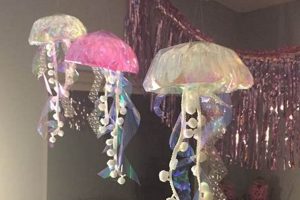
Creating homemade, aquatic-themed ornamentation replicating marine invertebrates involves a multifaceted crafting process. This activity generally includes the use of materials such as paper lanterns, plastic bags, ribbons, and LED lights to simulate the appearance of gelatinous sea creatures in a decorative format. For instance, one might construct the bell-shaped body using a white paper lantern and then affix translucent plastic strips to mimic trailing tentacles.
The appeal of this type of craft lies in its customizable nature, low cost, and suitability for various events and locations. It can transform spaces for parties, add an element of whimsy to childrens rooms, or serve as an engaging activity to foster creativity and environmental awareness regarding ocean life. Historically, handcrafted items have held significance in cultural expressions and celebrations, offering a personal touch that mass-produced decorations often lack.
Therefore, the following sections will explore diverse approaches to crafting these marine-inspired ornaments, focusing on different materials, techniques, and customization options to achieve varied aesthetic results. Attention will also be paid to safety considerations and resourcefulness in material selection.
Tips for Jellyfish-Inspired Ornamentation
Optimal creation of marine invertebrate decorations necessitates careful planning and execution. The following suggestions provide guidance for achieving visually appealing and structurally sound results.
Tip 1: Material Selection: Opt for lightweight materials for the bell structure, such as paper lanterns or repurposed plastic containers. This ensures ease of suspension and reduces the risk of collapse. For the tentacles, consider using iridescent cellophane or thin strips of plastic bags to simulate the natural translucence of jellyfish.
Tip 2: Color Harmony: Employ a cohesive color palette. A combination of blues, greens, purples, and whites effectively replicates the oceanic environment. Consider incorporating subtle gradients or ombre effects on the tentacles to enhance visual depth.
Tip 3: Illumination Integration: Incorporate LED lights to mimic bioluminescence. Battery-operated string lights or submersible LEDs can be strategically placed within the bell structure to create a captivating glow. Ensure the lights are waterproof if the ornaments are intended for outdoor use.
Tip 4: Tentacle Attachment: Securely attach the tentacles to the bell using durable adhesives such as hot glue or strong tape. Distribute the tentacles evenly around the circumference to maintain balance and prevent uneven weight distribution.
Tip 5: Suspension System: Employ a robust suspension system. Transparent fishing line or thin wire is discreet and capable of supporting the weight of the decoration. Reinforce the attachment point to the bell to prevent detachment during suspension.
Tip 6: Structural Reinforcement: If using delicate materials, reinforce the bell structure with internal supports, such as wire frames or cardboard inserts. This prevents collapsing and maintains the desired shape.
Tip 7: Safety Considerations: Exercise caution when using heat-generating tools such as hot glue guns. Ensure proper ventilation and supervision, especially when involving children in the crafting process. Avoid using sharp or pointed materials that could pose a safety hazard.
Adhering to these recommendations will improve both the aesthetic appeal and structural integrity of these handcrafted marine invertebrate decorations, resulting in visually stunning and durable ornamentation.
Moving forward, the subsequent segments of this article will delve into specific design ideas and alternative material choices for constructing these engaging decorations.
1. Material Selection

The success of aquatic invertebrate-themed decorative projects is inextricably linked to material selection. The chosen materials directly influence the aesthetic appearance, durability, and overall feasibility of the design. For instance, utilizing lightweight, translucent materials such as iridescent cellophane or thin plastic sheeting for the tentacles effectively mimics the diaphanous nature of actual jellyfish. Conversely, employing heavier or opaque materials would compromise the desired visual effect. The selection of a paper lantern versus a sturdier, potentially heavier, plastic sphere for the bell structure necessitates a corresponding adjustment in the suspension method, potentially requiring stronger, less visually appealing support.
The impact extends beyond mere aesthetics. The longevity of the decoration is directly proportional to the quality and resilience of the chosen materials. Substandard adhesives or easily torn fabrics will result in premature degradation, particularly if exposed to environmental factors such as humidity or direct sunlight. Moreover, the selection process must account for safety considerations. Opting for non-toxic paints and flame-retardant materials is crucial, especially if the decoration is intended for use in a child’s room or at events with open flames. Consider the practical application; an outdoor display demands weather-resistant materials, while an indoor setting allows for a broader range of more delicate options.
In summary, material selection is not merely a preliminary step but a foundational element dictating the outcome of creating gelatinous sea creature-inspired embellishments. Careful consideration of aesthetic properties, structural integrity, safety standards, and intended use is paramount. A well-informed material selection process minimizes potential complications, maximizes longevity, and ultimately contributes to a more compelling and successful final product. Failure to prioritize this stage can lead to aesthetically disappointing and structurally unsound results.
2. Structural Integrity

The longevity and aesthetic appeal of handcrafted jellyfish-themed decorations are contingent upon their structural soundness. Poor structural design compromises the intended visual representation and reduces the lifespan of the decoration. For example, if the paper lantern forming the bell is inadequately reinforced, it may collapse under its own weight, particularly when embellished with additional materials simulating tentacles. Similarly, insecure attachment of the tentacles to the bell jeopardizes the overall design, potentially leading to detachment and a diminished aesthetic impact. The selection of inappropriate adhesives or inadequate suspension methods exacerbates these vulnerabilities, increasing the risk of premature failure.
The impact of compromised structural integrity extends beyond aesthetic considerations. Decorations designed for outdoor use require robust construction to withstand environmental factors such as wind and moisture. Inadequate construction in such conditions results in rapid deterioration and potential safety hazards, especially if the decoration detaches from its suspension point and falls. Furthermore, the structural design must account for the weight distribution of the components. Uneven distribution places undue stress on specific areas, increasing the likelihood of tears, breaks, or overall deformation. A meticulously planned framework, coupled with appropriate material selection, mitigates these risks and ensures that the decoration retains its intended form and function over an extended period.
In summary, structural integrity is a non-negotiable aspect of crafting these marine-inspired ornaments. Its importance stems from its direct influence on the durability, aesthetic consistency, and overall safety of the final product. Addressing structural challenges through thoughtful design and construction techniques is vital for realizing a successful and enduring display, contributing to the desired atmosphere without posing potential risks. The absence of such consideration results in a decoration that is both visually flawed and prone to rapid deterioration, negating the intended artistic expression.
3. Illumination Methods

The integration of illumination significantly enhances the visual appeal of handcrafted jellyfish-themed decorations, simulating the bioluminescent properties often associated with these marine organisms. The selection of appropriate illumination methods is crucial for achieving a realistic and captivating effect. This element transforms a static decoration into a dynamic and engaging visual display, contributing significantly to the overall ambiance.
- LED String Lights
Employing battery-operated LED string lights allows for the creation of a subtle, diffused glow within the jellyfish bell. The low heat output of LEDs mitigates the risk of damaging delicate materials. These lights can be strategically positioned to emulate bioluminescent patterns. For example, blue or green LEDs create a realistic marine effect, while color-changing LEDs provide a dynamic, eye-catching display. These lighting systems are readily available and easy to incorporate into various designs, offering a practical solution for adding luminosity.
- Submersible LED Lights
Submersible LEDs, typically used in aquariums or floral arrangements, offer a waterproof option for illuminating jellyfish decorations. This is particularly useful for ornaments intended for outdoor use or display near water features. These lights are available in various colors and can be controlled remotely, allowing for adjustments to brightness and color schemes. Their robust construction and waterproof design ensure reliable performance in diverse environments. As an example, the lights can be placed inside the bell and set to a slow fade for a realistic ocean effect.
- Fiber Optic Cables
Fiber optic cables provide a method for creating pinpoint light sources, replicating the individual bioluminescent spots often found on jellyfish. These cables can be threaded through the tentacles, creating a delicate and ethereal effect. The light source for the fiber optics can be remotely located, simplifying the wiring and reducing the heat generated within the decoration. Fiber optic illumination provides a high level of control over light intensity and distribution, enabling the creation of intricate and realistic lighting patterns. For instance, if one wants to create a stunning effect with multiple jellyfish, they can be set them to different lights.
The selection of illumination methods must align with the overall design aesthetic and the intended use of the jellyfish decorations. The strategic application of these techniques transforms simple craft projects into visually striking displays, effectively capturing the allure and mystery of marine bioluminescence. The ability to customize the intensity, color, and pattern of the illumination allows for the creation of unique and personalized decorations, elevating their visual impact and enhancing the overall ambiance of the display.
4. Tentacle Design

The construction of tentacles constitutes a critical element in crafting marine invertebrate-inspired decorations, directly influencing the realism and aesthetic appeal. Careful attention to detail in tentacle design elevates the decoration from a simple craft project to a more convincing representation of its biological counterpart.
- Material Selection for Movement
The choice of material impacts the tentacle’s movement and visual texture. Lightweight, pliable materials like plastic sheeting, crepe paper streamers, or thin ribbons mimic the natural undulation of jellyfish tentacles in water currents. The material’s inherent flexibility allows it to respond to air currents, imbuing the decoration with a sense of lifelike motion. In contrast, stiffer materials lack this dynamic quality, resulting in a static and less engaging appearance. For instance, the use of iridescent cellophane strips reflects light, adding to the illusion of movement and mimicking the shimmering quality of some jellyfish species.
- Length and Quantity Variations
Accurate representation requires variations in tentacle length and quantity. Real jellyfish exhibit tentacles of varying lengths, some trailing far behind the bell, others shorter and more numerous. Mimicking this asymmetry in the decorative design enhances its realism. Uniform length and density create an artificial appearance, detracting from the overall effect. A design incorporating both long, flowing tentacles and shorter, more textured appendages more closely resembles the natural structure of a jellyfish. Also, The quantity of tentacles greatly influences its overall realism.
- Textural Differentiation
Introducing textural variations in tentacle design adds depth and visual interest. Smooth, glossy materials can be contrasted with rougher, more textured alternatives to simulate different types of jellyfish tentacles. For example, incorporating knotted sections or fringed edges creates a more complex and visually stimulating design. Utilizing materials with varying degrees of transparency further enhances the tentacle’s depth, allowing light to play across its surface in a more nuanced way.
- Attachment Method and Distribution
The method of attaching the tentacles to the bell and their distribution around its circumference significantly impact the decoration’s balance and visual harmony. Even distribution prevents the decoration from tilting or appearing lopsided. Secure attachment is crucial for preventing detachment, ensuring the decoration’s longevity. Strategically varying the tentacle density around the bell can create focal points and add visual interest, guiding the viewer’s eye and enhancing the overall composition. Also, consider using adhesives or a strong knot when attaching the tentacles.
In summation, effective tentacle design is an indispensable element in the creation of compelling marine invertebrate decorations. The careful consideration of material properties, length variations, textural diversity, and attachment techniques contributes to a more lifelike and aesthetically pleasing representation. By prioritizing these design aspects, craft projects transform into more sophisticated and visually captivating artistic expressions.
5. Suspension Technique

The method by which these simulated marine organisms are suspended significantly impacts their overall visual effect and structural stability. In the context of handcrafted jellyfish decorations, the suspension technique is not merely an afterthought but an integral design component, influencing how effectively the decoration mimics the natural buoyancy and ethereal quality of jellyfish in water. Improper suspension can detract from even the most meticulously crafted details, rendering the decoration unbalanced, visually unappealing, or prone to damage. For example, using a thick, opaque cord clashes with the delicate aesthetic, whereas an insufficient attachment point can lead to the decoration falling and potentially breaking. Clear fishing line, in contrast, virtually disappears, creating the illusion of the decoration floating in mid-air.
The choice of suspension material, knotting technique, and attachment point directly affect the load-bearing capacity and visual harmony of the decoration. A lightweight decoration constructed from paper lanterns and plastic streamers may be adequately supported by a single strand of thin fishing line, secured with a simple overhand knot. However, a heavier decoration incorporating LED lighting or denser materials necessitates a more robust suspension system. This may involve multiple strands of wire, reinforced attachment points using metal rings or grommets, and secure knots such as a bowline, designed to withstand significant tension without slipping. The placement of the attachment point is equally critical; a centralized point ensures balanced suspension, while an off-center point results in tilting and an unnatural appearance.
In conclusion, the suspension technique represents a critical, often overlooked aspect of crafting jellyfish-themed decorations. Its proper execution ensures both the aesthetic success and structural integrity of the finished product. Through careful selection of materials, secure knotting methods, and strategic placement of attachment points, the decoration can effectively simulate the graceful movement of a jellyfish in its natural environment, enhancing its overall visual impact. Conversely, a poorly executed suspension technique can undermine the entire project, resulting in a visually flawed and structurally unstable decoration.
Frequently Asked Questions Regarding Handcrafted Aquatic Invertebrate Decorations
The following section addresses common inquiries and misconceptions surrounding the creation and application of these marine-inspired embellishments. It aims to provide clear, concise answers to facilitate a successful crafting experience.
Question 1: What types of materials are best suited for creating the bell structure?
Lightweight and translucent materials such as paper lanterns, plastic bowls, or repurposed plastic bottles are recommended. These materials facilitate illumination and minimize the overall weight of the decoration.
Question 2: How can the tentacles be effectively secured to the bell structure?
Durable adhesives such as hot glue or industrial-strength tape are suitable. The adhesive must be compatible with the chosen materials. Ensure even distribution of the tentacles around the bell’s circumference to maintain balance.
Question 3: What are the optimal methods for incorporating illumination into this type of decoration?
Battery-operated LED string lights or submersible LEDs are generally preferred due to their low heat output and ease of integration. Secure the lights within the bell structure to prevent displacement.
Question 4: How can a realistic undulating motion be achieved for the tentacles?
Employ lightweight and pliable materials such as iridescent cellophane, thin plastic strips, or ribbons. Strategic layering and varying lengths of tentacles enhance the illusion of movement.
Question 5: What safety precautions should be observed during the construction process?
Exercise caution when using heat-generating tools such as hot glue guns. Ensure adequate ventilation when working with adhesives or paints. Avoid the use of sharp or hazardous materials.
Question 6: What is the recommended approach for suspending the completed jellyfish decoration?
Transparent fishing line or thin wire provides a discreet and secure suspension method. Reinforce the attachment point to the bell to prevent detachment during suspension.
In essence, successful creation involves careful material selection, secure assembly techniques, and a keen awareness of safety protocols. Attention to these details will enhance the overall aesthetic and longevity of the decoration.
The succeeding section transitions to advanced customization options and alternative design considerations for crafting these engaging marine-inspired ornaments.
Conclusion
This exploration of “jellyfish decorations diy” has outlined critical elements for successful construction. Emphasis was placed on material selection, structural integrity, illumination methods, tentacle design, and suspension techniques, all of which contribute to the final aesthetic and longevity of the decoration. Furthermore, common queries and safety considerations were addressed to provide comprehensive guidance.
The creation of these handcrafted ornaments represents more than a mere crafting activity; it offers an opportunity for creative expression and environmental awareness. By carefully applying the principles discussed, individuals can produce visually compelling and enduring representations of marine life, enhancing environments and fostering a deeper appreciation for the ocean’s delicate ecosystems. Continued innovation in materials and techniques will undoubtedly further refine the artistic possibilities within this domain.