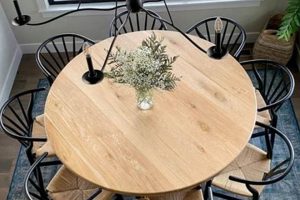
The construction of circular tabletops through do-it-yourself methods involves individuals creating a table with a round surface independently, typically using readily available materials and tools. For example, an individual might construct a tabletop from reclaimed wood, attaching it to a base made from repurposed metal pipes.
This approach to furniture creation offers several advantages. It provides a cost-effective alternative to purchasing commercially produced tables, enabling customization to specific dimensions and aesthetic preferences. Historically, individuals have engaged in furniture making for economic reasons and to express personal creativity, traditions that continue to resonate within the DIY movement.
The subsequent discussion will delve into the selection of appropriate materials, outlining practical construction techniques, and providing guidance on finishing methods to ensure a durable and visually appealing result.
Construction Guidance for Circular Tabletops
The following guidelines aim to provide insights into effective construction of circular tabletops using do-it-yourself methods. Careful adherence to these recommendations will contribute to a stable, aesthetically pleasing, and enduring final product.
Tip 1: Material Selection: Choose wood species based on durability and intended use. Hardwoods like oak or maple are suitable for high-traffic areas. Ensure the material is properly seasoned and free from defects to minimize warping.
Tip 2: Precise Measurement and Cutting: Accurate measurements are paramount. Employ a compass or trammel bar to mark the circular shape. Utilize a jigsaw or bandsaw for the initial cut, followed by sanding or routing to achieve a smooth, consistent edge.
Tip 3: Joint Selection and Execution: Select appropriate joining methods based on the wood thickness and anticipated load. Biscuit joints or dowels can enhance the strength of edge-to-edge connections. Ensure proper alignment during glue-up using clamps and cauls.
Tip 4: Surface Preparation: Thoroughly sand the surface to remove imperfections and create a smooth base for finishing. Start with a coarse grit sandpaper and gradually progress to finer grits for optimal results. Vacuum the surface to remove dust before applying any finish.
Tip 5: Finishing Application: Choose a finish appropriate for the intended use environment. Polyurethane offers durability and water resistance, while oil-based finishes provide a warm, natural appearance. Apply multiple thin coats, allowing each coat to dry completely before applying the next. Lightly sand between coats for a smoother finish.
Tip 6: Base Construction: The base design must complement the tabletop and provide adequate support. Consider factors such as height, stability, and style when selecting a base design. Use robust joinery techniques to ensure the base can withstand the weight of the tabletop.
Tip 7: Attachment Method: Securely attach the tabletop to the base using screws, bolts, or other appropriate fasteners. Countersink the fasteners and use wood filler to conceal them for a clean, professional appearance. Ensure the fasteners are of sufficient length to provide a strong, lasting connection.
By focusing on material integrity, precision, and appropriate finishing techniques, individuals can create circular tabletops that are both functional and visually appealing. These projects offer opportunities for skill development and customization that mass-produced alternatives cannot provide.
The subsequent sections will provide detailed instructions on specific design considerations and explore various decorative techniques that can further enhance the aesthetics of the finished project.
1. Material Selection

Material selection constitutes a foundational element in the construction of a circular tabletop via do-it-yourself methods. The choice of material directly influences the project’s durability, aesthetics, and overall suitability for its intended use.
- Wood Species and Structural Integrity
The selection of wood species significantly impacts the tabletop’s structural integrity. Hardwoods, such as oak or maple, exhibit greater resistance to dents and scratches, making them suitable for high-traffic areas or tables subject to frequent use. Softwoods, like pine or fir, are more susceptible to damage but offer cost savings. The chosen wood should be properly dried to prevent warping or cracking after construction.
- Sheet Materials and Stability
Alternatively, sheet materials like plywood or medium-density fiberboard (MDF) can be utilized. While these materials may lack the inherent aesthetic appeal of solid wood, they offer stability and resistance to warping, particularly for larger tabletops. Veneering or edge banding can be employed to enhance the visual appearance of sheet material constructions. Their consistent density facilitates even finishing application.
- Reclaimed Materials and Sustainability
The use of reclaimed materials, such as salvaged wood from old furniture or construction sites, aligns with sustainability principles. These materials often possess unique character and can add a distinctive element to the finished tabletop. However, reclaimed wood may require careful preparation, including cleaning, sanding, and the removal of nails or other debris, before it can be incorporated into the project. Sourcing locations include demolition sites and architectural salvage businesses.
- Material Cost and Project Scope
The cost of materials represents a significant factor in the overall project budget. The selection of materials should align with the available resources and the intended lifespan of the tabletop. Less expensive materials, while initially appealing, may require more frequent maintenance or replacement. The use of readily available or locally sourced materials can minimize transportation costs and reduce the project’s environmental impact.
The considered selection and preparation of construction materials are essential steps toward achieving a structurally sound, visually appealing, and functionally appropriate circular tabletop. These considerations are crucial for longevity and satisfaction with the finished project, and directly impact subsequent steps like base design and finishing applications.
2. Diameter determination

The determination of the diameter is a fundamental step in the construction of a circular tabletop using do-it-yourself methods. This measurement dictates the tabletop’s surface area and consequently, its seating capacity and overall utility within a given space. An incorrectly sized tabletop can render a room overcrowded or, conversely, appear disproportionately small, diminishing its intended functionality and aesthetic appeal. Therefore, careful consideration of spatial constraints and intended use is paramount during this initial stage. For instance, a small diameter table may suffice for an apartment nook, while a larger diameter is required for dining in a big house.
A practical approach to diameter determination involves first assessing the available space and the typical number of individuals the table is intended to accommodate. Industry standards suggest a minimum of 24 inches of table width per person for comfortable dining. Multiplying this figure by the intended number of diners provides a baseline for the minimum circumference, from which the diameter can be calculated. Additionally, consideration should be given to the placement of chairs and the need for adequate clearance around the table to ensure ease of movement. Failing to account for these factors can lead to a congested and impractical arrangement. Another use of table diameter may also use to put items at the center of the table.
In summary, the accurate determination of the diameter is not merely a technical measurement but a critical design decision with significant implications for the usability and aesthetic integration of a circular tabletop within its intended environment. Careful consideration of spatial context, seating requirements, and intended functionality is essential to ensure the finished project meets the user’s needs and enhances the overall space. Its impact ripples through every subsequent construction phase, affecting material requirements, structural support design, and final finishing touches.
3. Base stability

Base stability is a critical determinant of a circular tabletop’s functionality and longevity, especially within the context of do-it-yourself construction. An unstable base compromises safety and diminishes the usability of the surface. Factors contributing to this stability require careful consideration during design and construction.
- Geometric Design and Load Distribution
The geometric design of the base directly influences its ability to distribute weight evenly. A wide stance or a multi-leg design provides greater stability than a single, narrow pedestal. For example, a four-legged base spreads the load across a larger footprint, reducing the risk of tipping, particularly with heavier tabletop materials. The angle of the legs also contributes; splayed legs increase the base’s effective width. Mathematical calculations, such as determining the center of gravity, assist in optimizing base geometry for load distribution.
- Material Selection and Structural Integrity
The materials chosen for the base must possess adequate strength and rigidity to support the tabletop and any applied loads. Solid wood, metal, or reinforced polymers are commonly used. The dimensions of the base components, such as leg thickness or metal gauge, must be sufficient to prevent bending or buckling under pressure. Insufficient material strength leads to instability and potential failure. Engineering principles guide appropriate material selection and sizing for structural integrity.
- Joint Construction and Connection Strength
The methods used to join the base components significantly impact overall stability. Weak or poorly executed joints introduce points of failure. Mortise and tenon joints, dovetail joints, or welded connections provide robust and durable bonds. Screws, bolts, and adhesives can augment joint strength. Careful alignment and precise execution are essential to ensure secure and reliable connections. Inadequate joint strength jeopardizes the entire structure.
- Surface Contact and Floor Compatibility
The interface between the base and the floor influences stability, particularly on uneven surfaces. Leveling feet or adjustable glides compensate for minor floor irregularities, preventing wobbling. The material of the feet should also be compatible with the flooring to prevent scratching or damage. A broad, flat contact surface distributes weight effectively, minimizing pressure points and improving stability. Failure to address surface contact issues results in an unsteady and potentially hazardous tabletop.
In conclusion, achieving sufficient base stability for a do-it-yourself circular tabletop requires a holistic approach that considers geometric design, material properties, joint construction, and floor compatibility. Each element plays a crucial role in ensuring a safe, functional, and durable piece. Neglecting any of these factors compromises the overall stability and detracts from the tabletop’s value.
4. Edge finishing

Edge finishing represents a crucial process in the creation of a circular tabletop through do-it-yourself methods. This process directly impacts both the aesthetic appeal and the functional safety of the finished piece. The absence of proper edge finishing can result in sharp edges, splinters, or an uneven surface, posing a safety hazard and detracting from the overall quality of the tabletop. For instance, an unfinished edge on a wooden tabletop intended for dining may snag clothing or cause discomfort to users. Proper edge finishing mitigates these risks.
Various techniques are available for edge finishing, each offering distinct advantages and disadvantages. Sanding, using progressively finer grits of sandpaper, is a fundamental method for smoothing rough edges and removing imperfections. Routing, employing a specialized tool with various bit profiles, enables the creation of decorative edges or rounded profiles. Edge banding, involving the application of a thin strip of material (e.g., wood veneer, plastic) to conceal the raw edge of plywood or MDF, provides a clean and professional appearance. The selection of a specific technique depends on the material of the tabletop, the desired aesthetic, and the skill level of the individual undertaking the project. A poorly executed edge banding, for example, may result in a visible seam or peeling over time, undermining the overall quality.
In summary, edge finishing constitutes an indispensable step in the construction of a circular tabletop via DIY methods. It addresses both safety concerns and aesthetic considerations. A well-executed edge finish enhances the tactile experience, improves the visual appeal, and prolongs the lifespan of the tabletop. Neglecting this phase leads to a compromised product and ultimately diminishes the value of the entire undertaking. The challenges lie in selecting the appropriate method and executing it with precision, ensuring a harmonious integration of form and function.
5. Surface treatment

Surface treatment is a critical stage in the do-it-yourself construction of a circular tabletop. Its application directly influences the aesthetic qualities, durability, and overall resistance to wear and environmental factors of the finished product. The selection and proper application of a surface treatment can transform a raw material into a functional and visually appealing piece.
- Protective Coatings and Longevity
Protective coatings, such as polyurethane or varnish, enhance the longevity of a tabletop by creating a barrier against moisture, scratches, and stains. Polyurethane, for instance, forms a hard, durable film that resists abrasion and spills. Varnish offers similar protection but typically provides a glossier finish. These coatings extend the lifespan of the tabletop and reduce the need for frequent maintenance or refinishing.
- Aesthetic Enhancements and Visual Appeal
Surface treatments can significantly enhance the visual appeal of a circular tabletop. Stains alter the color of the wood, allowing for customization and matching to existing dcor. Paint provides a solid, opaque finish, offering versatility in color selection. Clear finishes, such as oil or wax, accentuate the natural grain and texture of the wood. The choice of finish directly impacts the tabletop’s aesthetic contribution to its surroundings.
- Preparation Techniques and Finish Quality
Proper preparation techniques are essential for achieving a high-quality surface finish. Sanding removes imperfections and creates a smooth base for the treatment. Cleaning ensures the surface is free from dust, dirt, and contaminants that could compromise adhesion. The application technique, whether brushing, spraying, or wiping, influences the uniformity and smoothness of the finish. Thorough preparation directly correlates with the final aesthetic and protective properties of the surface treatment.
- Specialized Finishes and Functionality
Specialized finishes cater to specific functional requirements. Heat-resistant coatings protect tabletops from hot dishes. Food-safe finishes ensure compatibility with surfaces used for dining. UV-resistant coatings prevent fading from sunlight exposure. These specialized treatments enhance the practicality and suitability of the tabletop for its intended purpose.
In summary, surface treatment plays a multifaceted role in the creation of a circular tabletop through do-it-yourself methods. It impacts durability, aesthetics, preparation, and functionality. Thoughtful selection and proper application of the chosen treatment ensures a finished product that is both visually appealing and well-suited for its intended use, adding value and longevity to the hand-crafted item.
6. Assembly technique

The success of a do-it-yourself circular tabletop project hinges significantly on the chosen assembly technique. The assembly technique dictates the structural integrity, longevity, and overall aesthetic of the finished piece. A flawed technique can compromise the table’s stability, leading to premature failure or an unsatisfactory appearance. The selection of an appropriate assembly method must consider the materials used, the intended load, and the desired aesthetic.
For example, when constructing a circular tabletop from multiple pieces of wood, techniques such as biscuit joining, dowel joining, or tongue-and-groove joinery may be employed. Each offers varying degrees of strength and complexity. Biscuit joints provide alignment and moderate strength, suitable for smaller tables. Dowel joints offer increased strength and require precise drilling. Tongue-and-groove joinery creates a robust connection, ideal for larger tabletops subject to heavier loads. Screws and adhesives typically augment these joints. The precise execution of these techniques, including proper alignment and clamping, directly impacts the final product’s durability and appearance. Another example is where the top assembled in the right technique to connect to the frame of the table.
In conclusion, assembly technique is an indispensable element in the construction of a circular tabletop via do-it-yourself methods. Careful selection and precise execution of the chosen technique are paramount to achieving a stable, aesthetically pleasing, and durable finished product. Challenges in assembly can arise from improper material preparation, inadequate tools, or a lack of experience. Overcoming these challenges requires meticulous planning, attention to detail, and a commitment to best practices in woodworking or metalworking, depending on the project’s materials. The final result reflects the quality of the assembly technique employed, directly influencing the table’s usefulness and lifespan.
Frequently Asked Questions
The following questions address common inquiries regarding the design, construction, and maintenance of circular tabletops created through do-it-yourself methods. These responses aim to provide clear and concise information to facilitate successful project outcomes.
Question 1: What is the minimum recommended diameter for a circular dining table intended to comfortably seat four adults?
The generally accepted minimum diameter is 48 inches. This allows approximately 24 inches of table space per person, providing adequate elbow room for dining. However, consider increasing the diameter to 54 or 60 inches for added comfort and serving space.
Question 2: Which wood species offers the best balance of cost-effectiveness and durability for a tabletop?
Poplar represents a suitable compromise. It is relatively inexpensive, readily available, and possesses sufficient hardness for general use. For higher durability, consider hardwoods like maple or oak, albeit at a higher cost.
Question 3: What is the most effective method for preventing a wooden circular tabletop from warping over time?
Ensuring the wood is properly seasoned and dried to a consistent moisture content prior to construction is paramount. Applying a moisture-resistant finish, such as polyurethane, to all surfaces (including the underside) helps to equalize moisture absorption and minimize warping. Furthermore, avoid placing the table in direct sunlight or areas with extreme temperature fluctuations.
Question 4: What joinery techniques are recommended for connecting multiple boards to create a larger circular tabletop?
Biscuit joints and dowel joints are commonly employed to enhance the strength and alignment of edge-to-edge connections. A combination of these techniques, along with a high-quality wood glue, provides a durable and aesthetically pleasing result. Proper clamping during the glue-up phase is critical to ensure a tight bond.
Question 5: How can a smooth, consistent finish be achieved on a circular tabletop constructed from plywood?
Thorough surface preparation is essential. Filling any voids or imperfections with wood filler, followed by extensive sanding with progressively finer grits of sandpaper, creates a smooth base for finishing. Applying multiple thin coats of primer and paint or varnish, with light sanding between coats, yields the best results.
Question 6: What considerations are important when designing a base for a circular tabletop to ensure adequate stability?
The base should have a wide stance and a low center of gravity to prevent tipping. A multi-legged design, with the legs splayed outwards, provides greater stability than a single pedestal. The material used for the base must be sufficiently strong to support the weight of the tabletop and any applied loads. Securing the tabletop to the base with robust fasteners is crucial.
These answers provide a foundation for understanding key aspects of DIY circular tabletop construction. However, specific project requirements may necessitate further research and adaptation of these principles.
The following section will explore advanced techniques for enhancing the aesthetics and functionality of do-it-yourself circular tabletops, including inlay work and integrated features.
Concluding Remarks on diy round table Construction
This exploration has detailed critical aspects of “diy round table” creation, from material selection and diameter determination to base stability, edge finishing, surface treatment, and assembly techniques. Mastery of these elements contributes directly to the production of durable, aesthetically pleasing, and functional circular tabletops.
The principles outlined herein serve as a foundation for successful independent construction. Continued refinement of these skills will allow for innovation and customization, fostering a deeper appreciation for craftsmanship and self-sufficiency in the realm of furniture design. The creation of a diy round table is a way of personal creativity.