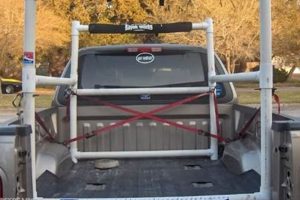
A do-it-yourself truck bed enclosure represents a project where individuals construct a covering for the cargo area of a pickup truck using self-sourced materials and personal labor. An example is building a frame from lumber and covering it with durable canvas to protect items within the truck bed from weather and theft.
Creating a customized truck bed protection system offers multiple advantages, including cost savings compared to purchasing a commercially manufactured unit, customization to specific needs and truck bed dimensions, and the satisfaction derived from a successful fabrication project. Historically, vehicle owners have adapted readily available materials to improve the functionality and security of their vehicles, and this type of project aligns with that tradition.
The subsequent discussion details various approaches, materials, and considerations inherent in constructing such a system, encompassing aspects from initial design and material selection to assembly and final installation on the vehicle.
Tips for Constructing a Do-It-Yourself Truck Bed Enclosure
Consider these guidelines to optimize the construction of a protective covering for a pickup truck bed, enhancing durability and functionality.
Tip 1: Material Selection: Prioritize weather-resistant materials, such as treated lumber for framing and heavy-duty tarpaulin or canvas for the cover. The selected materials must withstand exposure to sunlight, rain, and potential abrasion from transported items.
Tip 2: Precise Measurement: Obtain accurate dimensions of the truck bed to ensure a snug fit. Imprecise measurements can result in a loose or ill-fitting cover, compromising its protective capabilities and aesthetic appeal.
Tip 3: Sturdy Frame Construction: Utilize robust joinery techniques, such as screws and brackets, to assemble a rigid frame. A weak frame can collapse under load or during transit, negating the purpose of the enclosure.
Tip 4: Secure Attachment Points: Implement a reliable system for attaching the cover to the truck bed, employing methods like bungee cords, straps, or clamps. Inadequate attachment can lead to the cover detaching while driving, posing a safety hazard.
Tip 5: Weatherproofing: Seal seams and edges of the cover with waterproof tape or sealant to prevent water intrusion. Water damage can degrade transported items and compromise the structural integrity of the enclosure itself.
Tip 6: Consider Aerodynamics: Design the enclosure with a streamlined profile to minimize wind resistance. Excess drag can negatively affect fuel efficiency and increase wind noise.
Tip 7: Plan for Accessibility: Incorporate access points, such as flaps or zippers, to facilitate loading and unloading of cargo. Restricted access can hinder usability and diminish the overall value of the enclosure.
Following these recommendations will increase the likelihood of creating a durable, functional, and aesthetically pleasing truck bed covering.
The subsequent section examines design considerations and potential challenges associated with this project.
1. Durability
Durability, in the context of a do-it-yourself truck bed enclosure, fundamentally determines the lifespan and protective capabilities of the structure. The choice of materials and construction techniques directly impacts its ability to withstand external forces, environmental conditions, and the rigors of daily use. A lack of durability renders the enclosure susceptible to damage, potentially exposing cargo to the elements and diminishing its overall value. For example, using untreated wood for the frame will lead to rot and eventual structural failure, particularly in regions with high humidity or frequent precipitation. Conversely, employing treated lumber and reinforced joints enhances the enclosures resistance to weathering and physical stress, extending its service life.
The selection of covering material also significantly affects durability. Thin, inexpensive tarpaulins may tear easily under windy conditions or when subjected to abrasive contact with transported items. In contrast, heavy-duty canvas or reinforced vinyl provides superior resistance to tearing, abrasion, and UV degradation, thereby safeguarding the cargo and maintaining the enclosures integrity over time. The method of attachment likewise plays a crucial role. Weak or improperly secured fasteners can fail under stress, causing the cover to detach or allowing the frame to shift, which can compromise the entire structure and its protective function. Employing robust attachment hardware and techniques, such as bolts and reinforced straps, increases resistance to detachment and maintains the enclosure’s stability during transit.
Ultimately, prioritizing durability in the design and construction of a truck bed covering translates to a longer-lasting, more reliable protective solution. This consideration minimizes the need for frequent repairs or replacements, providing a more cost-effective and dependable way to secure and transport cargo. The challenges inherent in ensuring durability are multifaceted, requiring careful material selection, precise construction, and a thorough understanding of the environmental and operational stresses the enclosure will encounter. Addressing these factors ensures the creation of a high-quality, durable truck bed covering that provides long-term value and protection.
2. Weather Resistance
Weather resistance is a critical attribute of any do-it-yourself pickup bed cover, directly influencing its ability to protect cargo from environmental elements. An effective cover must mitigate the effects of precipitation, sunlight, and temperature fluctuations to preserve the transported goods and the cover itself.
- Material Selection for Water Protection
The choice of materials dictates the level of water resistance. Untreated fabrics readily absorb water, leading to potential damage of the cargo and material degradation, including mildew and rot. Selecting waterproof or water-resistant materials, such as coated canvas or durable tarpaulin, provides a barrier against rain and snow. Seam sealing further enhances this protection by preventing water penetration through stitching holes. The effectiveness of these materials is quantifiable by a hydrostatic head test, measuring the water pressure the fabric can withstand before leakage.
- UV Resistance and Material Longevity
Prolonged exposure to ultraviolet radiation from sunlight degrades many materials, causing them to become brittle and prone to cracking or tearing. This degradation compromises the cover’s structural integrity and protective capabilities. Choosing UV-resistant materials, such as those treated with UV inhibitors, extends the lifespan of the cover. Implementing UV-resistant coatings or films adds an extra layer of protection against sunlight, mitigating the damage and preserving the material’s strength and appearance.
- Temperature Fluctuation and Material Stability
Temperature changes cause materials to expand and contract. Extreme temperature fluctuations can lead to warping, cracking, or loosening of fasteners, compromising the cover’s fit and structural integrity. Selecting materials with low thermal expansion coefficients minimizes these effects. For instance, certain polymers exhibit greater dimensional stability across a range of temperatures compared to metals. Incorporating expansion joints or flexible connectors allows the cover to accommodate dimensional changes without inducing undue stress on the structure.
- Wind Resistance and Securement
High winds can exert significant force on a truck bed covering, potentially causing it to detach or tear. Securing the cover effectively is crucial for maintaining its integrity during windy conditions. Robust attachment points, such as reinforced grommets and durable straps, distribute wind loads evenly. Aerodynamic design considerations, such as a sloped profile, minimize wind resistance and reduce the likelihood of detachment. Properly tensioning the cover through adjustable straps or bungee cords prevents flapping and reduces the stress on attachment points.
Integrating these considerations regarding weather resistance into the design and construction of a truck bed enclosure results in a more durable, reliable, and protective covering. Attention to material selection, UV resistance, temperature stability, and securement methods ensures the cover effectively safeguards cargo and maintains its structural integrity over time, regardless of environmental conditions.
3. Cost-Effectiveness
Cost-effectiveness constitutes a primary motivation for individuals considering a do-it-yourself approach to constructing a pickup bed cover. The economic advantages stem from the potential to significantly reduce expenses compared to purchasing a commercially manufactured alternative. This reduction in expenditure warrants careful consideration of material selection, labor input, and long-term durability.
- Material Sourcing and Price Variance
The cost-effectiveness of constructing a truck bed covering is significantly influenced by the chosen materials and their respective prices. Commercially produced covers often involve markups associated with manufacturing, distribution, and retail. Sourcing materials independently allows for direct negotiation with suppliers, potentially securing lower prices. For instance, acquiring lumber from a local sawmill may prove more economical than purchasing pre-fabricated panels from a large home improvement retailer. Similarly, utilizing recycled or repurposed materials, such as reclaimed wood or salvaged tarpaulins, further diminishes material costs. Careful consideration must be given to the trade-off between material cost and durability; opting for the cheapest materials may compromise the longevity and protective capabilities of the cover, negating the initial cost savings.
- Labor Input and Skill Requirements
A critical component of assessing cost-effectiveness is the consideration of labor input. While a do-it-yourself project eliminates direct labor costs in the form of wages paid to a professional installer, it necessitates a significant time investment from the individual constructing the cover. This time commitment carries an opportunity cost, representing the value of alternative activities foregone. Furthermore, the level of skill required impacts both the time needed for completion and the potential for errors or rework. Complex designs or unfamiliar construction techniques may prolong the project, increasing the overall cost when considering the value of the time invested. Accurate evaluation of ones skills and available time is crucial for realistically assessing the economic viability of a do-it-yourself project.
- Long-Term Maintenance and Repair Costs
The initial cost savings associated with a do-it-yourself truck bed covering must be weighed against potential long-term maintenance and repair costs. Commercially manufactured covers often come with warranties that cover defects in materials or workmanship. In contrast, a self-constructed cover lacks such protection, placing the burden of repair expenses solely on the owner. The durability of the chosen materials and the quality of construction directly impact the frequency and cost of repairs. For instance, a cover constructed with inferior materials may require frequent patching or replacement, ultimately negating the initial cost savings. Careful attention to material selection and construction techniques minimizes the likelihood of premature failure and reduces long-term maintenance expenses.
- Tools and Equipment Costs
The construction of a do-it-yourself pickup bed cover may necessitate the acquisition of specific tools and equipment. The cost of these items must be factored into the overall cost analysis. Individuals who already possess the required tools realize a distinct economic advantage compared to those who must purchase or rent them. Furthermore, the quality and type of tools influence the efficiency of the construction process and the quality of the finished product. Utilizing appropriate tools ensures accurate cuts, secure fasteners, and a professional-looking finish. The decision to invest in high-quality tools depends on the frequency with which they will be used for other projects. However, neglecting to account for tool and equipment costs can significantly distort the perceived cost-effectiveness of the project.
In summary, evaluating the cost-effectiveness of a do-it-yourself truck bed covering necessitates a comprehensive analysis encompassing material sourcing, labor input, long-term maintenance, and tool acquisition. A thorough assessment of these factors enables individuals to make informed decisions regarding the economic viability of constructing their own truck bed protection system, balancing initial cost savings with long-term durability and performance.
4. Customization
Customization forms a pivotal element in the consideration of a do-it-yourself truck bed cover, offering a significant advantage over pre-fabricated, commercially available options. The capacity to tailor the cover’s design, materials, and functionality to specific requirements and preferences directly influences its utility and overall value. This adaptability stems from the inherent flexibility of the construction process, enabling individuals to address particular cargo needs, aesthetic preferences, and truck bed dimensions with a degree of precision unattainable through standardized products. For instance, an individual who frequently transports oversized equipment could design a cover with increased height clearance or integrated tie-down points strategically positioned to secure such items. Conversely, a user prioritizing discreet storage could opt for a low-profile design with concealed access panels.
The significance of customization extends beyond mere aesthetic considerations, directly impacting the practical application of the truck bed cover. The integration of specialized features, such as lockable compartments for secure tool storage, integrated lighting systems for enhanced visibility at night, or solar panels for powering auxiliary devices, demonstrates the potential to transform the cover into a multifunctional platform. Moreover, customization allows for the adaptation of the cover to unique truck bed configurations, accommodating variations in bed length, width, and the presence of pre-existing accessories, such as bed liners or tonneau covers. This adaptability is particularly relevant for older or less common truck models where finding compatible aftermarket covers may prove challenging or impossible. The ability to select materials that align with specific environmental conditions, such as heavy-duty canvas for regions with frequent rainfall or UV-resistant polymers for areas with intense sunlight, further underscores the importance of customization in ensuring the long-term durability and performance of the cover.
In conclusion, the profound connection between customization and the construction of a truck bed cover lies in the capacity to create a solution that precisely meets individual needs and preferences. This adaptability enhances its practical utility, ensuring that the cover not only provides protection from the elements but also optimizes the functionality of the truck bed for specific tasks and applications. The challenges inherent in customization involve a greater initial investment of time and effort compared to purchasing a pre-made cover, requiring careful planning, precise execution, and a thorough understanding of the desired features and functionalities. However, the resulting product, tailored to specific needs, offers a level of satisfaction and utility that cannot be replicated by off-the-shelf solutions.
5. Security
A primary function of a pickup bed cover, whether commercially manufactured or a do-it-yourself project, centers on enhancing the security of items stored within the truck bed. The installation of any type of cover inherently provides a visual deterrent to opportunistic theft by concealing the contents from immediate view. This basic level of security is amplified through specific design choices and the incorporation of security-focused features. For example, a canvas cover secured only with bungee cords offers minimal resistance to forced entry, whereas a solid frame construction with a locking mechanism significantly increases the difficulty for unauthorized access. The effectiveness of the security measures implemented directly correlates to the perceived risk and the likelihood of a potential thief targeting the vehicle.
Further augmenting the security aspect involves the selection of robust materials and tamper-resistant hardware. Replacing standard screws with security screws, which require specialized tools for removal, increases the time and effort required for forced entry. The addition of internal reinforcement, such as steel mesh integrated within the cover’s structure, adds a physical barrier against cutting or puncturing. Consider the hypothetical scenario of a contractor storing power tools in the truck bed overnight. A flimsy cover easily compromised provides little protection. A reinforced cover with a robust locking system, conversely, offers a significant deterrent, potentially redirecting a thief to a less secure target. The integration of an alarm system connected to the cover further enhances security, triggering an audible alert upon attempted unauthorized access, thereby increasing the risk of detection and apprehension.
In conclusion, the security provided by a truck bed cover is not an inherent attribute but rather a carefully considered design element. The effectiveness of the security hinges on a combination of visual deterrence, material strength, and the implementation of robust locking mechanisms and anti-tampering measures. The challenges lie in balancing security enhancements with cost considerations and ease of use. A heavily fortified cover may deter theft but also prove cumbersome to operate. The ultimate goal is to achieve a level of security commensurate with the perceived risk and the value of the items being protected, thereby creating a secure and functional truck bed enclosure.
6. Ease of Installation
The constructability of a self-made truck bed enclosure depends significantly on the ease of installation. A design requiring extensive specialized tools, complex assembly procedures, or a high degree of mechanical aptitude diminishes the feasibility for many individuals. A direct correlation exists between installation complexity and the likelihood of project completion. An excessively complicated design may deter potential builders, negating the cost savings and customization benefits associated with a do-it-yourself approach. For example, a cover design that requires welding or intricate woodworking techniques represents a significant barrier to entry for those lacking the necessary skills or equipment. Conversely, a design utilizing readily available materials and straightforward assembly methods, such as bolting pre-cut lumber sections together, substantially increases the accessibility of the project.
The importance of simplified installation extends beyond mere project completion. The structural integrity and functionality of the cover often depend on the accuracy of the installation. Misalignment or improper fastening due to a complicated installation process compromises the weather resistance and security provided by the cover. A scenario involving a frame that is not square, for example, results in gaps that allow water intrusion and reduce the overall stability. The integration of modular components and pre-drilled holes simplifies the assembly process and minimizes the potential for errors, thereby enhancing the structural soundness and long-term performance of the DIY cover. Moreover, a design that prioritizes ease of installation translates to reduced construction time, a factor that contributes to the overall cost-effectiveness of the project when considering the value of time invested.
In conclusion, ease of installation is not merely a convenience but a crucial factor determining the success and overall value of a self-made truck bed enclosure. Simplifying the construction process enhances accessibility for a wider range of individuals, improves the accuracy of the installation, and reduces both construction time and the likelihood of errors. Designs that prioritize straightforward assembly methods and readily available materials ultimately contribute to a more functional, durable, and cost-effective truck bed covering. The challenges lie in balancing design complexity with installation simplicity, ensuring that customization options do not compromise the ease with which the cover can be constructed and installed.
Frequently Asked Questions
The following section addresses common inquiries regarding the construction and implementation of self-made pickup truck bed enclosures. The objective is to provide clear and concise answers to facilitate informed decision-making.
Question 1: What is the typical lifespan of a self-constructed truck bed cover?
The lifespan of a do-it-yourself truck bed cover depends significantly on the materials utilized and the quality of construction. Covers built with weather-resistant materials and robust joinery can last for several years, potentially exceeding the lifespan of cheaper commercial alternatives. However, covers constructed with inferior materials may require frequent repairs or replacement.
Question 2: Does a self-made truck bed cover offer adequate protection against theft?
The level of theft protection afforded by a do-it-yourself truck bed cover varies depending on the design and security features implemented. A simple canvas cover provides minimal security, while a reinforced cover with a locking mechanism offers a greater deterrent. The effectiveness of the security measures implemented directly correlates with the difficulty of forced entry.
Question 3: Is it possible to create a waterproof truck bed cover without specialized equipment?
Achieving complete waterproof integrity without specialized equipment presents a challenge. However, utilizing waterproof materials, sealing seams with appropriate sealant, and incorporating drainage features minimizes water intrusion. Regular maintenance and inspection are necessary to identify and address potential leaks.
Question 4: What are the primary cost factors associated with building a truck bed enclosure?
The primary cost factors include the cost of materials, such as lumber, fabric, and hardware, as well as the cost of tools and equipment required for construction. The time invested in the project also represents a significant cost factor, especially when considering the value of alternative activities.
Question 5: Can a self-made truck bed cover be easily removed and reinstalled?
The ease of removal and reinstallation depends on the design and attachment method. Covers secured with simple clamping mechanisms or straps offer greater ease of removal compared to those permanently bolted to the truck bed. The design should prioritize both security and ease of access for optimal utility.
Question 6: What are the potential legal implications of constructing a truck bed cover?
Potential legal implications are generally minimal, provided the cover adheres to all applicable vehicle regulations regarding height and width restrictions, as well as visibility requirements for taillights and license plates. Consultation with local authorities or a qualified legal professional is advisable to ensure compliance with all applicable laws.
In summation, constructing a truck bed cover involves weighing various factors, including durability, security, cost, and regulatory adherence. Thorough planning and execution contribute to a successful and functional outcome.
The next section details specific material recommendations for building a reliable truck bed enclosure.
Conclusion
The preceding discussion examined various facets of constructing a diy pickup bed cover, encompassing design considerations, material selection, security enhancements, and cost implications. Emphasis was placed on the crucial balance between customization, durability, and ease of installation to achieve a functional and economically viable result.
The viability of a self-made solution hinges upon a thorough assessment of individual needs and capabilities, weighed against the availability of commercial alternatives. Prudent planning and diligent execution are essential for realizing the potential benefits of a customized truck bed protection system. Continued exploration and refinement of these construction methods may further enhance their practicality and accessibility within the automotive sector.