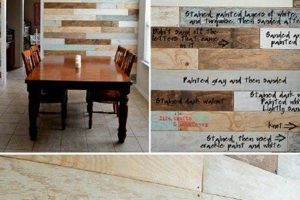
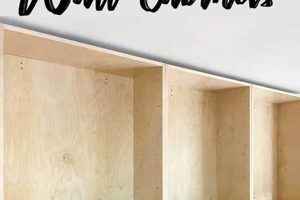
The term refers to the numerous creative and individual approaches to designing and constructing shelving units attached to a wall. These projects typically involve readily available materials and basic tools, allowing individuals to customize storage and display solutions to fit their specific needs and aesthetic preferences. An example would be crafting a shelf from reclaimed wood planks and metal brackets to achieve a rustic look.
Wall-mounted storage solutions offer several benefits, including maximizing space utilization, enhancing room decor, and providing organized storage options. Historically, wall-mounted shelving has evolved from simple, utilitarian structures to intricate designs incorporating diverse materials and styles. This evolution reflects changing aesthetic tastes and a growing emphasis on personalized home organization.
The subsequent sections will delve into various aspects of crafting these customized wall-mounted storage units. This will encompass material selection, design considerations, construction techniques, and safety precautions relevant to building durable and visually appealing structures.
Essential Construction Guidance
The following guidelines aim to enhance the durability, aesthetic appeal, and safety of self-assembled wall-mounted storage solutions.
Tip 1: Material Selection is Paramount. Opt for lumber grades appropriate for load-bearing applications. Solid hardwood or engineered wood composites offer increased stability and resistance to warping compared to softwood alternatives. Consider the weight of items intended for storage when selecting materials.
Tip 2: Precise Measurement and Marking are Critical. Prior to cutting any material, accurately measure and mark all dimensions. Employ a carpenter’s square to ensure right angles and consistent lines. Deviations from planned dimensions can compromise structural integrity and visual harmony.
Tip 3: Secure Wall Anchoring is Non-Negotiable. Match wall anchors to the substrate (drywall, plaster, brick, concrete). Employ stud finders to locate wall studs whenever possible, as anchoring directly to studs provides the most secure attachment point. For hollow walls, use appropriate expansion anchors rated to support the anticipated weight load.
Tip 4: Pre-Drilling Minimizes Wood Splitting. When attaching shelf components with screws, pre-drill pilot holes slightly smaller than the screw’s shank diameter. This technique reduces the likelihood of wood splitting, particularly when working with hardwoods or brittle materials.
Tip 5: Leveling Ensures Stability and Visual Appeal. Before permanently affixing shelves to the wall, utilize a bubble level to ensure horizontal alignment. Adjust as necessary to achieve a level surface, preventing items from sliding off and maintaining aesthetic consistency.
Tip 6: Edge Finishing Enhances Aesthetics and Safety. Sand all exposed edges and corners to eliminate sharp edges and splinters. Apply a sealant, stain, or paint to protect the wood and enhance its visual appeal. Consider using edge banding for a professional finish on plywood or particleboard.
Effective application of these recommendations will result in long-lasting, visually pleasing, and structurally sound wall-mounted storage solutions. Attention to detail throughout the construction process is essential for achieving optimal results.
The subsequent discourse will address specific design styles and advanced construction techniques to further refine the creation of customized wall storage.
1. Material Selection

Material selection constitutes a foundational element in the successful realization of customized storage solutions. The choice of materials directly impacts structural integrity, aesthetic characteristics, and overall longevity of the constructed unit. The selection process must therefore be deliberate and informed, considering both functional requirements and desired visual outcome.
- Wood Species and Grade
The selection of wood species influences both the strength and visual appeal of the structure. Hardwoods, such as oak or maple, offer superior load-bearing capacity and resistance to wear, making them suitable for shelves intended to support heavy objects. Softwoods, such as pine or fir, are more economical but may require reinforcement for heavier loads. The grade of lumber, indicated by markings denoting the presence of knots or imperfections, also affects structural integrity and aesthetic uniformity.
- Engineered Wood Products
Plywood, MDF (Medium-Density Fiberboard), and particleboard represent engineered alternatives to solid wood. These materials offer cost advantages and dimensional stability, minimizing warping and cracking. However, their load-bearing capacity may be lower than that of solid wood. Edge banding is often necessary to conceal exposed edges and enhance aesthetic appeal.
- Metal Components
Metal brackets, supports, and frames can provide both structural reinforcement and aesthetic contrast. Steel and aluminum are commonly used for their strength and durability. Powder coating or painting can protect metal components from corrosion and allow for customization of color and finish. The gauge (thickness) of the metal is a critical factor in determining its load-bearing capacity.
- Fasteners and Adhesives
Screws, nails, and adhesives play a critical role in joining materials. The type and size of fastener must be appropriate for the materials being joined and the anticipated load. Wood screws are designed for use with wood, while metal screws are intended for metal components. Construction adhesives can provide additional strength and prevent movement between joined surfaces.
The interplay between material choice and construction technique directly influences the success of a custom project. Selecting materials with appropriate strength characteristics and employing proper fastening methods ensures a stable and visually harmonious structure that meets intended storage needs.
2. Structural Integrity
Structural integrity, defined as the ability of a shelf to withstand applied loads without failure, represents a paramount consideration in the context of self-assembled wall-mounted storage solutions. Proper design and execution are critical to ensure safe and reliable performance.
- Load Capacity Assessment
Accurate estimation of the anticipated load is fundamental. This involves considering the weight of the shelving material itself, as well as the weight of items to be stored. Overestimation is preferable to underestimation. Load distribution also plays a significant role; evenly distributing weight across the shelf surface minimizes stress concentrations and reduces the risk of failure. For example, a shelf intended to hold books requires a significantly higher load capacity than one designed for lightweight decorative items.
- Material Properties and Selection
The inherent strength and stiffness of the chosen materials directly influence structural performance. Solid wood, engineered wood products, and metal components exhibit varying degrees of resistance to bending, deflection, and shear forces. Hardwoods generally offer superior load-bearing capacity compared to softwoods. Engineered wood products, such as plywood, provide dimensional stability and resistance to warping. The selection of appropriate materials, coupled with an understanding of their mechanical properties, is crucial for achieving adequate structural integrity.
- Fastener Selection and Placement
The type, size, and placement of fasteners (screws, bolts, anchors) significantly impact the stability and strength of the assembled unit. Fasteners must be appropriately sized to withstand the tensile and shear forces generated by the applied load. Proper installation techniques, including pre-drilling pilot holes and ensuring adequate thread engagement, are essential. The density and spacing of fasteners should be determined based on the material properties and anticipated load. Using insufficient fasteners or improper installation techniques can lead to premature failure.
- Wall Anchoring Techniques
The method of anchoring the shelf to the wall is a critical aspect of structural integrity. Wall anchors must be compatible with the wall substrate (drywall, plaster, concrete) and rated to support the anticipated load. Locating and utilizing wall studs provides the most secure attachment point. When studs are not accessible, appropriate expansion anchors designed for hollow walls must be employed. Failure to adequately anchor the shelf to the wall can result in catastrophic failure, posing a significant safety risk.
These interconnected elements highlight the necessity for diligent planning and execution in constructing wall-mounted storage solutions. A thorough understanding of load capacity, material properties, fastener mechanics, and wall anchoring techniques is essential for ensuring the structural integrity and long-term performance of the finished product. This attention to detail transforms what might seem like simple structures into stable, reliable, and safe storage assets.
3. Aesthetic Harmony

Aesthetic harmony, within the context of self-assembled wall-mounted storage solutions, concerns the cohesive integration of these structures into the surrounding environment. It dictates how well a unit blends with or intentionally contrasts against existing architectural elements, furnishings, and decorative styles.
- Color Palette Cohesion
The selection of color, whether through paint, stain, or the inherent material hue, significantly influences visual integration. A palette that complements existing wall colors, furniture tones, or accent pieces promotes a unified aesthetic. Conversely, a contrasting color can establish a focal point, provided it aligns with the room’s overall design scheme. The implications of mismatched color palettes can result in visual dissonance, detracting from the overall appeal of the space.
- Material Consistency and Contrast
The use of materials that echo or deliberately diverge from existing elements contributes to aesthetic harmony. Employing the same type of wood as existing trim or furniture creates a sense of continuity. Alternatively, incorporating contrasting materials, such as metal or glass, can introduce visual interest and prevent monotony. However, the juxtaposition of materials requires careful consideration to ensure that it enhances rather than disrupts the visual balance.
- Form and Proportion Alignment
The shape and dimensions of shelves must align with the architectural characteristics of the room and the scale of existing furnishings. Shelves that are disproportionately large or small can appear out of place. Consider the room’s height, width, and depth when determining shelf dimensions. The style of the shelf, whether minimalist, rustic, or contemporary, should also complement the overall design theme of the space.
- Style and Decorative Integration
The incorporation of decorative elements, such as brackets, corbels, or integrated lighting, influences the aesthetic character of the shelving unit. These elements should harmonize with the overall style of the room. For example, ornate brackets may be appropriate for a Victorian-style setting, while minimalist brackets are better suited for a modern interior. Thoughtful consideration of these details contributes to a cohesive and visually appealing result.
Collectively, these facets underscore the importance of careful planning and execution in achieving aesthetic harmony within personalized storage solutions. Successful integration elevates the function of storage beyond mere utility, transforming the structure into a contributing element of the overall aesthetic experience. This synergy is achieved by integrating personalized units seamlessly into existing themes.
4. Spatial Optimization

The relationship between spatial optimization and self-assembled wall-mounted storage solutions is fundamentally one of cause and effect. Limited square footage necessitates efficient storage solutions; customized shelving provides a direct response. These units, when strategically designed and placed, maximize usable area by utilizing vertical space that would otherwise remain unoccupied. This optimization is particularly crucial in compact living environments, such as apartments or studios, where floor space is at a premium. Consider, for example, a narrow hallway transformed into a functional library through the installation of floor-to-ceiling shelves, thereby reclaiming previously underutilized space.
Spatial optimization is not merely a beneficial component of self-assembled wall-mounted storage; it is often the primary driving force behind its implementation. Individuals undertake these projects specifically to address storage constraints and enhance the functionality of their living spaces. A practical illustration of this is the creation of custom shelves above doorways or windows to accommodate infrequently used items, thereby freeing up valuable floor space. Furthermore, bespoke shelving can be tailored to fit awkward or irregular spaces, such as alcoves or corners, which are typically difficult to furnish with conventional storage units. This adaptability underscores the practical significance of understanding and applying spatial optimization principles in the design and construction of customized storage solutions.
In summary, the strategic integration of spatial optimization principles into the conception and execution of self-assembled wall storage projects yields significant benefits in terms of efficiency, functionality, and overall living space utilization. The effective use of vertical space and the adaptation of shelving to suit unconventional areas allows for the transformation of previously underutilized spaces into highly functional storage zones. The challenge lies in balancing the desire for maximum storage capacity with the need to maintain aesthetic coherence and accessibility, ensuring that optimized space remains both practical and visually appealing. These units address an element in increasing living density environments.
5. Secure Mounting

The practice of secure mounting constitutes a critical prerequisite for the successful implementation of self-assembled storage solutions. Failure to adequately secure wall shelves can result in structural collapse, potentially causing damage to property and physical harm to individuals. The connection between design and proper installation cannot be overstated; even the most aesthetically pleasing and structurally sound shelf will fail if not affixed correctly to the wall. For instance, consider a scenario where a homeowner constructs a bookshelf from solid hardwood but utilizes inadequate drywall anchors. The weight of the books, combined with the shelfs mass, can easily exceed the anchors load-bearing capacity, leading to the shelf detaching from the wall.
The significance of secure mounting extends beyond mere structural stability. It directly impacts the usability and longevity of the shelf. A wobbly or insecure shelf is impractical for storing valuable or fragile items. Furthermore, repeated stress on inadequate mounting points can gradually weaken the surrounding wall structure, necessitating costly repairs. The application of appropriate mounting techniques varies depending on wall type (drywall, plaster, concrete) and the anticipated load. Direct attachment to wall studs offers the strongest support, while specialized anchors are required for hollow walls. Selecting the appropriate fastener type and ensuring proper installation depth are essential elements of secure mounting practices.
In summary, the imperative for secure mounting transcends basic construction principles; it forms an integral component of responsible storage design and execution. A thorough understanding of wall types, anchor load ratings, and proper installation techniques is essential for ensuring the safety and longevity of these projects. Neglecting secure mounting protocols not only jeopardizes the structural integrity of the storage unit but also poses a potential safety hazard. A well-secured shelf, however, transforms from a decorative item into a functional asset, serving its intended purpose safely and reliably. The choice and implementation of specific anchoring techniques are a non-negotiable requirement for successful completion.
6. Functional Versatility

Functional versatility, in the context of self-assembled wall-mounted storage solutions, refers to the capacity of a shelving unit to adapt to a range of storage and display needs. It extends beyond static storage, encompassing modular designs, adjustable components, and multi-purpose configurations, enhancing the utility and longevity of structures.
- Adjustable Shelf Heights
Adjustable shelf heights represent a primary facet of functional versatility. This feature accommodates items of varying dimensions, maximizing storage efficiency and preventing wasted vertical space. Examples include shelving systems with pre-drilled holes allowing shelf repositioning, or designs incorporating removable support pegs. This adaptability ensures that the shelf can evolve alongside changing storage requirements, extending its useful lifespan.
- Modular Component Integration
The incorporation of modular components, such as drawers, cabinets, or display niches, enhances the functional repertoire of a shelving unit. These components can be added, removed, or rearranged to suit evolving storage needs and aesthetic preferences. Modular designs provide flexibility and allow for customization beyond basic shelving configurations. For example, a bookshelf can be transformed into a media center by integrating drawers for storing electronics and a cabinet for concealing cables.
- Multi-Purpose Configurations
Multi-purpose configurations enable a shelving unit to serve multiple functions within a given space. A wall-mounted shelf can double as a desk surface, a headboard, or a room divider. These configurations maximize space utilization and provide integrated solutions for compact living environments. A shelf positioned above a desk can provide storage for books and supplies, while simultaneously serving as a display area for artwork or personal items.
- Adaptable Material Selection
The utilization of materials conducive to modification and customization enhances functional versatility. Wood, for example, can be easily painted, stained, or cut to accommodate changing design preferences. Metal components can be powder-coated or modified to accommodate different load requirements or aesthetic styles. The choice of materials that readily adapt to evolving needs contributes to the long-term utility and versatility of a shelving unit.
Ultimately, the integration of functional versatility into self-assembled wall-mounted storage solutions transforms a simple storage unit into a dynamic and adaptable element within the living space. Adjustable components, modular designs, multi-purpose configurations, and adaptable materials collectively contribute to a structure that meets immediate storage needs while accommodating future requirements and stylistic evolution. This approach maximizes the value and longevity of personalized storage projects.
Frequently Asked Questions
The following questions address common concerns and misconceptions regarding the design, construction, and installation of personalized wall storage.
Question 1: What factors dictate the appropriate wall anchor selection for a wall-mounted shelf?
The selection of a suitable wall anchor is governed by two primary factors: the substrate composition (drywall, plaster, concrete, stud) and the anticipated weight load. Drywall and plaster require specialized expansion anchors designed to distribute weight, whereas concrete necessitates masonry anchors. Direct attachment to a wall stud provides the most secure connection.
Question 2: How does material selection affect the structural integrity of shelving?
Material selection exerts a direct influence on structural integrity. Hardwoods, such as oak and maple, offer greater load-bearing capacity compared to softwoods like pine. Engineered wood products, such as plywood, provide dimensional stability but may require edge banding for aesthetic purposes.
Question 3: What precautions mitigate the risk of shelf collapse due to overloading?
To mitigate the risk of shelf collapse, accurately assess the anticipated load, evenly distribute weight across the shelf surface, and select materials and fasteners rated to support the load. Adherence to weight capacity guidelines is crucial.
Question 4: What methods ensure accurate leveling during shelf installation?
Accurate leveling requires the use of a bubble level or laser level. Before permanently affixing the shelf, verify horizontal alignment. Shims can be employed to compensate for minor irregularities in the wall surface.
Question 5: How does finish application influence the longevity of wood shelving?
The application of a suitable finish, such as paint, stain, or sealant, protects the wood from moisture, UV radiation, and physical damage. This prolongs the lifespan of the shelving and preserves its aesthetic appearance.
Question 6: What design considerations maximize spatial efficiency in small living spaces?
To maximize spatial efficiency, design shelving units that utilize vertical space, incorporate adjustable shelf heights, and adapt to irregular wall configurations. Consider multi-purpose designs that integrate storage with other functions, such as desk surfaces or room dividers.
These responses underscore the importance of careful planning, material selection, and execution in the construction of self-assembled storage solutions. A thorough understanding of these principles contributes to the creation of safe, functional, and aesthetically pleasing storage units.
The subsequent section will elaborate on advanced design concepts.
diy wall shelf ideas
The preceding discourse examined the multifaceted nature of personalized storage solutions, emphasizing the crucial interplay between material selection, structural integrity, aesthetic harmony, spatial optimization, secure mounting, and functional versatility. Each element, when meticulously considered and executed, contributes to the creation of storage units that are not only functional but also aesthetically integrated into the living space.
The application of these principles will facilitate the transformation of ordinary spaces into organized, visually appealing environments. While the potential for creative customization is extensive, adherence to fundamental structural and safety guidelines is paramount. Further exploration of innovative designs and advanced construction techniques is encouraged to maximize the potential of personalized wall-mounted storage solutions.