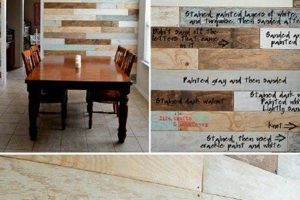
The endeavor of installing a decorative surface composed of lumber sections directly onto an interior partition via a do-it-yourself approach represents a popular method for altering the aesthetic of a room. For instance, a homeowner might select shiplap boards, adhere them to a bedroom wall, and subsequently apply paint to achieve a rustic appearance.
This activity offers a blend of cost-effectiveness and personalized design expression. Throughout history, wall paneling has served as both a functional element, providing insulation, and a decorative feature, adding visual texture and character to architectural spaces. The modern iteration allows individuals to customize their living environments without necessarily engaging professional contractors.
Subsequent discussion will address the various wood types suitable for such projects, the required tools and materials, the step-by-step installation process, and essential safety considerations. Furthermore, different design styles and finishing techniques will be examined to assist in achieving a desired aesthetic.
Essential Considerations for Decorative Lumber Partition Installation
The subsequent guidelines aim to optimize the success and longevity of applying wood-based surfacing to existing interior walls using a do-it-yourself methodology.
Tip 1: Material Acclimation: Prior to installation, lumber should be stored within the room where it will be applied for a minimum of 72 hours. This allows the material to adjust to the ambient temperature and humidity, minimizing subsequent warping or cracking.
Tip 2: Surface Preparation: The existing wall surface must be clean, dry, and structurally sound. Repair any imperfections, such as holes or cracks, and ensure a level plane to facilitate proper adhesion of the lumber elements.
Tip 3: Accurate Measurement and Planning: Precise measurements are crucial for efficient material utilization and a visually appealing outcome. Develop a detailed plan outlining the placement of each element, accounting for obstacles such as outlets or light switches.
Tip 4: Secure Attachment Method: Select appropriate fasteners (nails, screws, or adhesive) based on the lumber type, wall material, and desired permanence. Pilot holes may be necessary to prevent splitting of the lumber during fastening.
Tip 5: Consistent Spacing: When using individual boards or planks, maintain uniform spacing between elements to create a visually consistent design. Spacers or shims can assist in achieving this precision.
Tip 6: Precise Cuts: Accurate cuts are essential for achieving seamless transitions and professional finish. Employ a miter saw or circular saw with a fine-tooth blade for clean, precise cuts.
Tip 7: Protective Finishing: Apply a sealant, stain, or paint to the installed lumber to protect it from moisture, UV damage, and wear. Ensure proper ventilation during the application process.
Adhering to these best practices ensures a durable, aesthetically pleasing interior improvement.
Following sections will cover potential design ideas and troubleshooting common issues.
1. Material Selection

The selection of appropriate materials directly influences the aesthetic, longevity, and ease of execution for any do-it-yourself interior surfacing endeavor. The intended visual style dictates the type of lumber employed, be it hardwood, softwood, reclaimed wood, or manufactured composite. Each material possesses unique characteristics that impact workability, cost, and environmental sustainability. For example, using reclaimed wood yields a rustic, aged appearance, but may require extensive preparation to ensure uniformity and structural integrity. Conversely, pre-finished composite panels offer ease of installation and consistent aesthetics, but might lack the unique character of natural wood.
Improper material selection can lead to premature deterioration, warping, or structural instability of the wall surface. Softwoods, such as pine, are generally more cost-effective but may be susceptible to dents and scratches in high-traffic areas. Hardwoods, such as oak or maple, offer superior durability but demand specialized tools and techniques for proper cutting and installation. The dimensional stability of the chosen material is critical, as significant expansion or contraction can compromise the integrity of the overall design. A poorly chosen adhesive can also lead to panel separation and visual defects.
In conclusion, the successful implementation of a lumber surfacing project hinges on informed material choices. Factors such as the desired aesthetic, budget constraints, and intended use of the room should guide the selection process. Careful consideration of wood species, panel type, and adhesive properties will ensure a durable, aesthetically pleasing, and long-lasting modification to the interior space.
2. Surface Preparation

Surface preparation constitutes a critical phase within the process of installing decorative lumber surfaces onto interior partitions. The integrity and aesthetic longevity of the modification depend significantly on the condition of the underlying substrate.
- Cleaning and Degreasing
The removal of dirt, dust, grease, and other contaminants ensures proper adhesion of adhesives or fasteners. Residue inhibits bonding, potentially leading to panel separation or instability. For instance, walls previously painted with glossy finishes require thorough degreasing to facilitate adequate adhesion.
- Repairing Imperfections
Addressing cracks, holes, or uneven surfaces creates a uniform plane for lumber attachment. Failure to rectify such imperfections results in uneven panels and a compromised aesthetic. Spackling compounds or patching materials are commonly employed to fill voids and level surfaces.
- Priming
Application of a primer enhances adhesion, seals porous surfaces, and provides a consistent base for subsequent finishes. Priming is particularly important when applying lumber directly to drywall, as it prevents the drywall paper from absorbing moisture from adhesives, potentially weakening the bond.
- Leveling and Flattening
Ensuring a level and flat surface guarantees consistent lumber alignment. Variations in wall flatness are exacerbated by the addition of decorative elements, resulting in visible inconsistencies and a less professional appearance. Shims or furring strips can be employed to correct minor deviations in flatness.
These facets of surface preparation are integral to the successful execution of decorative lumber surfacing projects. Neglecting these preparatory steps compromises the structural integrity and visual appeal of the finished installation. The time and effort invested in thorough surface preparation yields significant returns in terms of long-term durability and aesthetic satisfaction.
3. Accurate Measurement

Accurate measurement is paramount in the successful execution of decorative lumber partition installation. The precise determination of dimensions directly impacts material usage, aesthetic alignment, and overall structural integrity.
- Room Dimension Assessment
The initial step involves meticulously measuring the width, height, and depth of the space where the wood surface is to be installed. These measurements form the basis for calculating the required quantity of lumber and determining the layout. Failure to accurately assess room dimensions can lead to material shortages, misaligned patterns, and structural deficiencies.
- Obstacle Accommodation
Existing architectural features, such as electrical outlets, light switches, windows, and door frames, necessitate precise measurement and planning. These elements must be carefully incorporated into the design to ensure a seamless and functional installation. Inaccurate measurement of these features can result in improperly sized lumber sections, creating gaps, obstructions, or safety hazards.
- Material Calculation and Minimization of Waste
Precise measurement enables accurate calculation of lumber requirements, minimizing material waste and associated costs. By carefully considering the dimensions of individual boards or panels and the overall coverage area, individuals can optimize material usage and reduce environmental impact. Imprecise measurements lead to overestimation of material needs, resulting in unnecessary expenses and disposal challenges.
- Alignment and Leveling Precision
Accurate measurements are essential for ensuring horizontal and vertical alignment of the wood surface. Maintaining consistent dimensions and spacing between lumber elements contributes to a visually appealing and professional finish. Inaccurate measurements result in crooked lines, uneven surfaces, and an overall lack of aesthetic harmony.
In conclusion, accurate measurement is a non-negotiable aspect of decorative lumber partition installation. Its influence spans material efficiency, obstacle integration, cost control, and aesthetic quality. Diligence in measurement activities directly correlates with the successful realization of a visually pleasing and structurally sound interior modification.
4. Secure Attachment

The stability and longevity of any decorative lumber partition installation are fundamentally contingent upon secure attachment of the lumber elements to the underlying wall structure. Inadequate attachment methods invariably lead to panel separation, warping, or eventual structural failure of the installed surface. The choice of attachment methodwhether nails, screws, adhesives, or a combination thereofmust correspond directly to the type of lumber employed, the composition of the existing wall, and the anticipated environmental conditions. For instance, utilizing lightweight adhesive alone on a heavy hardwood panel adhered to a painted drywall surface is unlikely to provide sufficient long-term support. Conversely, excessive use of large fasteners on thin paneling may result in splitting or cosmetic damage. A real-world example is a failure to adequately secure shiplap boards to furring strips on an uneven wall, resulting in bowed boards and visible gaps within a short time.
The specific application significantly influences the importance of secure attachment. High-traffic areas or rooms subject to temperature and humidity fluctuations demand more robust attachment strategies than low-use spaces with stable environmental conditions. Kitchens and bathrooms, for example, often require moisture-resistant adhesives and corrosion-resistant fasteners to prevent degradation and maintain structural integrity over time. Furthermore, adherence to building codes and safety regulations necessitates the selection of appropriate attachment methods that can withstand specified load-bearing requirements. Failure to comply with these regulations may result in structural hazards and legal ramifications. Considerations regarding accessibility for future maintenance or repairs should also inform the attachment strategy.
In summation, secure attachment is an indispensable component of successful decorative lumber partition installations. Sound judgment regarding material compatibility, environmental factors, and regulatory requirements is crucial for ensuring the durability, safety, and aesthetic longevity of the modified surface. Challenges such as unforeseen wall irregularities or material inconsistencies necessitate adaptable attachment strategies and diligent monitoring throughout the installation process. The investment in appropriate attachment methods yields substantial returns in terms of reduced maintenance, extended lifespan, and enhanced structural performance.
5. Precise Cutting

In the context of lumber panel installations executed via do-it-yourself methods, the act of precise cutting represents a critical determinant of the final aesthetic and structural integrity. The correlation is causal: inaccurate cuts necessitate corrections, potentially leading to material waste, visible seams, and an overall diminished appearance. The ability to produce clean, dimensionally accurate cuts facilitates seamless transitions between individual panels and ensures a professional-grade finish. As an example, the successful installation of a herringbone pattern relies entirely on the consistent and accurate mitering of each individual piece.
The selection of cutting tools directly impacts the achievable level of precision. A miter saw, equipped with a sharp, fine-tooth blade, permits the creation of accurate angled cuts crucial for complex patterns and corner installations. Conversely, using a dull circular saw risks splintering and inaccurate cuts, ultimately compromising the visual appeal and structural soundness of the wall surface. Furthermore, the application of proper measuring techniques and the use of guides or jigs contribute significantly to cutting accuracy. Misalignment during cutting, even by a fraction of an inch, accumulates over multiple panels, resulting in substantial deviations from the intended design.
In summary, precise cutting stands as a foundational element within the domain of self-executed lumber panel projects. Its influence extends from material efficiency and aesthetic quality to the long-term structural stability of the installed surface. The combination of appropriate tools, refined techniques, and meticulous attention to detail is essential for achieving optimal outcomes and realizing the intended visual design. Difficulties arising from uneven wall surfaces or complex angles demand heightened cutting precision and may require advanced techniques to mitigate their effects, further emphasizing the connection between competent cutting and a successful project.
6. Consistent Spacing
Consistent spacing, when integrated into the practice of decorative lumber surface installation, directly impacts the visual uniformity and overall aesthetic appeal. Consistent spacing, achieved via DIY methods, constitutes a factor in achieving the desired outcome. Precise and uniform gaps between individual lumber elements contribute to a polished appearance, reflecting attention to detail and craftsmanship.
- Visual Harmony and Pattern Definition
Uniform spacing establishes a visual rhythm and defines the pattern of the wall surface. Regular intervals create a sense of order, preventing visual clutter and enhancing the intended design. For example, evenly spaced shiplap boards produce a clean, modern aesthetic, whereas irregular gaps can appear haphazard and detract from the intended visual effect.
- Material Expansion and Contraction Accommodation
Consistent spacing allows for the natural expansion and contraction of lumber due to changes in temperature and humidity. Adequate gaps prevent buckling or warping of the wall surface, ensuring long-term structural integrity. The absence of sufficient spacing can result in panels pressing against each other, causing deformation and potential detachment.
- Ease of Installation and Adjustment
Maintaining consistent spacing simplifies the installation process, allowing for efficient alignment and adjustment of individual lumber elements. Uniform gaps serve as a visual guide, ensuring that each piece is positioned correctly. Inconsistent spacing complicates the installation, requiring frequent adjustments and potentially leading to misalignment and increased project duration.
- Professional Appearance and Perceived Quality
Uniform spacing contributes to a professional appearance and enhances the perceived quality of the installation. Consistent gaps demonstrate attention to detail and craftsmanship, elevating the overall aesthetic. Inconsistent spacing creates a visual distraction, detracting from the intended design and diminishing the perceived quality of the project.
The adherence to consistent spacing is a significant element in decorative lumber surface implementation. Precise execution impacts aesthetic results, material behavior over time, and ease of installation. Diligence in this area results in a visually appealing and structurally stable wall finish.
7. Protective Finishing

Protective finishing constitutes a crucial phase within the process of decorative lumber surface installation, serving as a means of safeguarding the installed materials against various forms of degradation and ensuring the longevity of the modification.
- Moisture Resistance
The application of sealants, varnishes, or paints provides a barrier against moisture penetration, preventing warping, swelling, and fungal growth. Untreated wood is susceptible to moisture damage, particularly in environments with high humidity or temperature fluctuations. For instance, in a bathroom setting, a water-resistant finish prevents moisture from seeping into the lumber, maintaining its structural integrity and aesthetic appearance.
- Ultraviolet (UV) Protection
Exposure to ultraviolet radiation can cause discoloration, fading, and weakening of the wood fibers. Protective coatings containing UV inhibitors mitigate these effects, preserving the color and structural integrity of the lumber over time. Without UV protection, panels exposed to sunlight may exhibit fading or yellowing, diminishing their visual appeal and potentially compromising their structural properties.
- Abrasion and Impact Resistance
Protective finishes enhance the lumber’s resistance to scratches, dents, and other forms of physical damage. Durable coatings create a protective layer that absorbs impact, preventing superficial blemishes and maintaining the surface’s pristine condition. In high-traffic areas, such as hallways or living rooms, abrasion-resistant finishes are essential for preserving the aesthetic quality of the lumber over extended periods.
- Ease of Maintenance and Cleaning
Protective coatings facilitate cleaning and maintenance by creating a smooth, non-porous surface that resists staining and dirt accumulation. Treated surfaces can be easily wiped clean, minimizing the effort required to maintain their appearance. Untreated lumber is more susceptible to staining and requires more intensive cleaning methods, potentially damaging the wood fibers.
These facets highlight the importance of protective finishing in lumber surface installations. The selection and application of appropriate coatings are essential for ensuring the long-term durability, aesthetic appeal, and ease of maintenance of the modified surface. Addressing these considerations ensures a high-quality final product.
Frequently Asked Questions Regarding Decorative Lumber Partitioning
The following addresses common inquiries concerning the installation of decorative lumber partitions using do-it-yourself methods. The information provided is intended to offer clarity and guidance on best practices and potential challenges.
Question 1: What is the optimal thickness for lumber used in decorative wall installations?
The selection of lumber thickness is dependent on the intended aesthetic and the structural requirements. Generally, a thickness of 1/2 inch to 3/4 inch is suitable for decorative purposes, providing adequate rigidity without adding excessive weight. Thicker lumber may be necessary for structural applications or to achieve a specific visual effect.
Question 2: What are the essential tools required for such installations?
Essential tools include a measuring tape, level, miter saw or circular saw, nail gun or screw gun, stud finder, safety glasses, and a dust mask. Additional tools, such as a jigsaw or router, may be necessary for intricate cuts or edge detailing.
Question 3: How should one address uneven wall surfaces prior to lumber installation?
Uneven wall surfaces should be addressed using shims or furring strips to create a level plane. Furring strips are typically installed horizontally at regular intervals to provide a consistent base for the lumber panels. Shims can be used to correct minor imperfections and ensure proper alignment.
Question 4: What type of adhesive is recommended for attaching lumber to drywall?
A construction-grade adhesive specifically formulated for bonding wood to drywall is recommended. The adhesive should be applied in a consistent pattern to ensure uniform adhesion. Additional mechanical fasteners, such as nails or screws, may be necessary for added security.
Question 5: How can one minimize visible nail holes or screw heads in the finished installation?
Nail holes or screw heads can be concealed using wood filler or putty that matches the color of the lumber. The filler should be applied sparingly and sanded smooth after drying. Alternatively, a countersinking technique can be employed to recess the screw heads below the surface of the wood.
Question 6: What safety precautions should be observed during lumber partition installation?
Safety precautions include wearing safety glasses to protect against flying debris, using a dust mask to prevent inhalation of wood dust, and following all manufacturer’s instructions for power tools and adhesives. Proper ventilation is essential when working with solvents or finishes.
The information above underscores the necessity for careful planning, precise execution, and adherence to safety protocols when undertaking a do-it-yourself lumber partition project. By addressing these common questions, individuals can enhance their understanding and improve the likelihood of a successful installation.
The upcoming section will explore potential design concepts for decorative lumber partitions.
Concluding Remarks on Decorative Lumber Partition Installations
This exploration has elucidated the diverse facets inherent to decorative lumber partition installation achieved through do-it-yourself methods. Emphasis has been placed on material selection, surface preparation, secure attachment techniques, precision cutting methodologies, consistent spacing protocols, and the imperative of protective finishing. The synthesis of these elements dictates the ultimate aesthetic quality, structural integrity, and sustained longevity of the modified interior space. The considerations outlined serve as a framework for informed decision-making, promoting efficient resource utilization and mitigating potential complications.
Mastery of these techniques empowers individuals to transform interior spaces through personalized design interventions. Continued adherence to best practices, coupled with rigorous attention to detail, will undoubtedly contribute to the successful implementation of visually appealing and enduring decorative lumber surfaces, thereby enhancing the overall architectural character of the built environment. Further research and experimentation within this domain are encouraged to advance the possibilities of lumber applications in interior design.