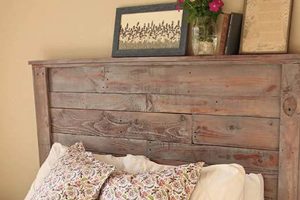
A self-constructed bed frame, designed to support a queen-sized mattress, constitutes a platform bed created through do-it-yourself methods. These projects generally eliminate the need for a box spring, providing direct support to the mattress. The result is often a lower profile bed with an emphasis on simple construction techniques using readily available materials.
Engaging in such a project can yield several benefits. Economically, constructing a bed frame independently can reduce costs compared to purchasing a pre-made option. Further, this allows for customization tailored to specific needs and aesthetic preferences. Historically, self-sufficiency in furniture construction has been a common practice, evolving with available materials and design trends.
The following discussion explores key elements in creating a queen-sized mattress support, from material selection and design considerations to the construction process and finishing techniques. Emphasis will be placed on accessible methodologies suitable for individuals with varying levels of carpentry experience.
Construction Guidance for a Queen Mattress Platform
The following guidance provides essential information for the successful execution of a self-built queen mattress platform. Proper planning and execution are crucial to ensure structural integrity and desired aesthetics.
Tip 1: Material Selection is Paramount: Opt for hardwoods like oak or maple for enhanced durability and longevity. Alternatively, construction-grade plywood can provide a cost-effective and structurally sound base. Ensure that lumber is straight, free from knots, and properly dried to minimize warping.
Tip 2: Accurate Measurements are Indispensable: Precisely measure the queen mattress dimensions to ensure a snug fit within the platform. Account for potential variations in mattress size and incorporate a slight tolerance to prevent overly tight constraints.
Tip 3: Prioritize Structural Integrity: Employ robust joinery techniques, such as mortise and tenon joints, or reinforced screw connections with wood glue. Reinforce corners with metal brackets for added stability and prevent racking.
Tip 4: Plan for Adequate Support: Incorporate sufficient support slats, spaced appropriately, to evenly distribute the mattress weight and prevent sagging. Consider using a center support beam for increased reinforcement, particularly for heavier mattresses.
Tip 5: Smooth Surface Finishing is Essential: Thoroughly sand all surfaces to eliminate splinters and sharp edges. Apply a suitable finish, such as sealant, stain, or paint, to protect the wood and enhance the aesthetic appeal. Ensure adequate ventilation during finishing to avoid hazardous fumes.
Tip 6: Headboard Integration Considerations: If a headboard attachment is desired, plan for appropriate mounting points during the construction phase. Ensure the headboard mounting system is compatible with the platform’s design and weight capacity.
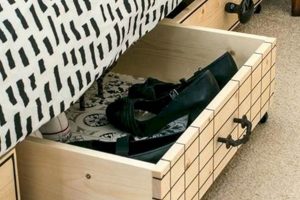
Tip 7: Consider Under-bed Storage: Incorporate features such as drawers or open shelving to maximize space utilization. Careful planning of this under-bed storage is crucial for a queen mattress platform.
Adherence to these guidelines will contribute to a structurally sound and aesthetically pleasing queen mattress platform. Careful consideration of material selection, measurements, and joinery techniques are vital for project success.
With these fundamental principles established, the ensuing sections will address specific design choices and variations in construction methods.
1. Frame dimensions

Accurate determination of frame dimensions is paramount when undertaking the construction of a queen-sized mattress support. These measurements directly dictate the fit and functionality of the completed bed structure, influencing both aesthetic appeal and structural stability.
- Mattress Accommodation
The primary function of the frame is to securely and accurately accommodate the queen mattress. Deviations from specified mattress dimensions can result in either an overly tight fit, hindering placement and removal, or an excessively loose fit, leading to mattress movement and premature wear. Standard queen mattress dimensions are 60 inches in width and 80 inches in length; however, variations between manufacturers necessitate precise measurement prior to frame construction.
- Headboard and Footboard Integration
Planned incorporation of a headboard or footboard into the structure requires precise dimensional planning. The frame must be sized to allow secure attachment of these components, considering both their thickness and overall dimensions. Failure to account for these factors may result in misalignment, structural instability, or aesthetic inconsistencies.
- Overall Footprint Considerations
Frame dimensions dictate the overall footprint of the bed within the bedroom. Careful consideration must be given to available space and room layout to ensure adequate clearance for movement and furniture placement. An oversized frame can impede traffic flow and detract from the room’s usability.
- Support Structure Integration
Internal support structures, such as slats or solid platforms, necessitate dimensional accuracy to ensure proper weight distribution and prevent mattress sagging. The spacing and placement of these supports must align with mattress manufacturer recommendations and account for the intended load-bearing capacity of the bed.
The interrelationship between these dimensional aspects and the success of the bed construction is undeniable. Precise measurements, meticulous planning, and accurate execution in relation to these points are crucial for a stable, functional, and visually pleasing finished product. A well-dimensioned frame ensures the proper support and presentation of the queen mattress, thereby enhancing the overall sleeping experience.
2. Material strength

Material strength represents a critical determinant in the successful construction of any structurally sound bed frame. Specifically, regarding queen-sized platforms, the material’s ability to withstand significant static and dynamic loads directly impacts the bed’s longevity, stability, and overall safety. Insufficient material strength can lead to premature structural failure, manifested as sagging slats, joint separation, or even complete collapse, thereby compromising the bed’s primary function and potentially causing injury.
Consider, for example, a platform constructed from low-density softwood. While such material may be initially appealing due to its lower cost and ease of workability, its inherent lack of rigidity renders it unsuitable for supporting the weight of a queen mattress and occupants. Over time, the wood fibers will compress under sustained pressure, resulting in a noticeable dip in the mattress surface and an increased risk of structural compromise. Conversely, utilizing high-density hardwoods, such as oak or maple, or engineered wood products like plywood, provides substantially greater load-bearing capacity and resistance to deformation. These materials distribute weight more effectively and maintain their structural integrity over prolonged periods of use. The selection of appropriate fasteners, such as screws or bolts, is equally crucial to complement the material strength of the frame components. Using undersized or low-quality fasteners can negate the benefits of a robust material, as the joints will become points of weakness prone to failure.
In summation, material strength is not merely an aesthetic consideration but a fundamental requirement for a functional and reliable queen platform bed. Careful selection of materials and appropriate fasteners, coupled with sound construction techniques, guarantees a bed frame capable of safely and effectively supporting its intended load, providing years of dependable service. Neglecting this critical aspect can result in compromised structural integrity and potential safety hazards, ultimately undermining the entire endeavor.
3. Slat spacing

Slat spacing constitutes a crucial design element influencing both the support and longevity of a self-constructed queen-sized mattress platform. The distance between individual slats directly affects weight distribution and ventilation, thereby impacting mattress performance and lifespan. Insufficient support, resulting from excessive spacing, can lead to mattress sagging and premature wear, while inadequate airflow, due to overly tight spacing, may contribute to moisture accumulation and the growth of mold or mildew. The optimal spacing depends on factors such as mattress type, slat material, and anticipated weight load. For example, memory foam mattresses, known for conforming to the body’s contours, generally require closer slat spacing to prevent excessive sinking between supports. Conversely, innerspring mattresses, possessing inherent structural rigidity, may tolerate slightly wider spacing without compromising support. Real-life examples demonstrate that platforms with improperly spaced slats often exhibit visible mattress deformation and accelerated wear patterns, ultimately necessitating premature replacement.
Practical application of this understanding involves careful calculation and precise execution during the construction process. A common guideline suggests a maximum spacing of 2-3 inches for memory foam mattresses and up to 4 inches for innerspring models. Reinforcing the slats with a central support beam can further mitigate sagging, particularly for heavier individuals or couples. Furthermore, the slat material itself plays a significant role. Hardwoods, such as oak or maple, offer greater strength and resistance to bending compared to softwoods, allowing for slightly wider spacing without compromising support. The connection method between the slats and the frame is also critical; securely fastened slats prevent movement and maintain consistent spacing over time. Ignoring these considerations can result in a platform that fails to adequately support the mattress, leading to discomfort and diminished mattress lifespan. Proper measurement and consistent application of the chosen spacing are crucial for realizing a successful outcome.
In summary, appropriate slat spacing is a non-negotiable aspect of platform construction. It directly influences mattress support, ventilation, and longevity. While specific dimensions may vary based on mattress type and other factors, a thorough understanding of these principles enables the construction of a durable and comfortable sleeping platform. Challenges often arise from inaccurate measurements or inconsistent execution, highlighting the importance of meticulous planning and precise craftsmanship. Failing to address these elements compromises the bed’s structural integrity and diminishes its overall value.
4. Joint robustness
The structural integrity of any self-constructed queen-sized mattress platform is fundamentally contingent upon the robustness of its joints. These connections, where different frame members unite, bear the brunt of both static and dynamic forces exerted by the mattress and occupants. Inferior joint construction precipitates premature failure, manifesting as wobbling, creaking, or, in extreme cases, complete structural collapse. A primary example is the corner joint, typically connecting the side rails to the headboard and footboard. A weak corner joint allows racking, distorting the entire frame and leading to uneven weight distribution, accelerating wear on both the bed and the mattress. Conversely, employing durable joinery techniques, such as mortise and tenon, or reinforced screw connections with wood glue, creates a stable and long-lasting frame capable of withstanding considerable stress.
Practical application involves the careful selection of appropriate joinery methods commensurate with the load-bearing requirements of a queen-sized platform. Simple butt joints, relying solely on screws or nails, often prove inadequate for sustained use, particularly with heavier mattresses or multiple occupants. Reinforcement techniques, such as adding metal brackets or strategically placed support blocks, can enhance the strength of weaker joint configurations. Furthermore, the quality of materials used in the joints significantly impacts their overall robustness. Employing high-quality wood glue, specifically formulated for structural applications, ensures a strong and durable bond between frame members. Similarly, using adequately sized and hardened screws or bolts prevents stripping and loosening over time. Real-world examples showcase the disparity between well-constructed and poorly constructed joints. A platform bed utilizing well-executed mortise and tenon joints, coupled with high-quality wood glue and appropriate fasteners, can easily withstand years of regular use without exhibiting any signs of structural degradation. In contrast, a platform bed relying on poorly executed butt joints and substandard fasteners will likely exhibit instability and require frequent repairs, ultimately compromising its functionality and lifespan.
In conclusion, joint robustness is not merely an ancillary consideration in the construction of a queen-sized platform bed; it is an indispensable element that directly determines the bed’s structural integrity and longevity. A comprehensive understanding of joinery techniques, coupled with the careful selection of appropriate materials and fasteners, enables the creation of a stable, durable, and reliable sleeping platform. While challenges may arise in mastering complex joinery methods, the investment in time and effort yields significant returns in terms of enhanced structural performance and extended lifespan. A robustly joined bed frame provides a secure and comfortable sleeping surface, eliminating the risk of premature failure and ensuring years of dependable service.
5. Finish durability
The longevity and aesthetic appeal of a self-constructed queen platform bed are inextricably linked to the durability of the chosen finish. The finish acts as a protective barrier against environmental factors, including moisture, abrasion, and ultraviolet radiation, all of which can degrade the underlying wood over time. Consider a platform bed constructed from pine and finished with a single coat of inexpensive varnish. Within a year, the surface might exhibit scratches, water rings, and discoloration, detracting from the bed’s appearance and potentially compromising the wood’s structural integrity. Conversely, a bed finished with multiple coats of a high-quality polyurethane or a catalyzed varnish will demonstrate superior resistance to wear and tear, maintaining its aesthetic appeal and protective function for an extended period. The selection and application of a durable finish are, therefore, not merely cosmetic concerns but essential components of ensuring the long-term viability of the platform bed.
Practical application of this understanding involves careful consideration of the intended usage environment and the properties of different finishing products. A bed located in a humid climate necessitates a finish with exceptional moisture resistance to prevent warping, swelling, or the growth of mold and mildew. In such cases, marine-grade varnishes or epoxy coatings may be warranted. For beds subjected to frequent contact or abrasion, finishes with high abrasion resistance, such as polyurethane or lacquer, provide greater protection against scratches and scuffs. Proper surface preparation is equally crucial; thorough sanding and cleaning ensure optimal adhesion of the finish, maximizing its durability. The application method also plays a significant role; multiple thin coats, applied according to the manufacturer’s instructions, typically yield a more durable and aesthetically pleasing result than a single thick coat. Furthermore, periodic maintenance, such as cleaning and reapplication of a topcoat, can significantly extend the lifespan of the finish and preserve the bed’s overall appearance. A platform bed in a child’s room is subject to entirely different wear patterns than one in a guest bedroom, therefore select finish durability according to situation.
In conclusion, finish durability is a pivotal consideration in the construction of a self-made queen platform bed. Its impact extends beyond mere aesthetics, influencing the bed’s structural integrity and overall lifespan. Challenges may arise in selecting the appropriate finish and mastering proper application techniques, but the investment in knowledge and effort yields substantial returns in terms of enhanced durability, longevity, and aesthetic appeal. A well-finished platform bed represents not only a functional piece of furniture but also a testament to the craftsmanship and attention to detail invested in its creation. Understanding the link between finish durability and structural integrity is key in the project.
Frequently Asked Questions
The following addresses common inquiries and misconceptions surrounding the construction of a queen-sized mattress support through do-it-yourself methods. These responses are designed to provide clarity and guidance for prospective builders.
Question 1: What is the minimum recommended thickness for lumber used in a queen-sized bed frame?
The minimum recommended lumber thickness for structural components, such as side rails and support legs, is 1.5 inches (nominal 2-inch lumber). This provides sufficient strength to support the weight of the mattress and occupants. Slat thickness can be slightly less, typically 0.75 inches (nominal 1-inch lumber), provided they are adequately spaced and supported.
Question 2: What is the appropriate slat spacing to prevent mattress sagging?
The recommended slat spacing is dependent on the mattress type. For memory foam mattresses, a maximum spacing of 2-3 inches is advised. For innerspring mattresses, a maximum spacing of 4 inches is generally acceptable. Closer spacing provides increased support and minimizes the risk of sagging.
Question 3: Are metal brackets necessary for reinforcing corner joints?
While not strictly necessary, metal brackets significantly enhance the strength and stability of corner joints, particularly for frames subjected to heavy use. The brackets provide additional resistance against racking and prevent joint separation over time. They are highly recommended for ensuring long-term durability.
Question 4: Which type of wood glue offers the best performance for bed frame construction?
Polyurethane-based wood glues and PVA (polyvinyl acetate) glues designed for exterior use provide superior strength and moisture resistance compared to standard PVA glues. These glues form a durable bond that withstands the stresses of bed frame use and environmental fluctuations.
Question 5: What safety precautions should be observed when working with power tools?
Adherence to standard safety practices is crucial. These include wearing safety glasses to protect against flying debris, using hearing protection to minimize noise exposure, and ensuring proper ventilation when working with solvents or finishes. All power tools should be operated according to the manufacturer’s instructions.
Question 6: How can squeaking be prevented in a newly constructed bed frame?
Squeaking often results from friction between frame members. To prevent this, ensure all joints are tightly secured and lubricate potential friction points with beeswax or paraffin wax. Applying felt pads to areas where the frame contacts the floor can also reduce noise transmission.
These answers provide fundamental insights into building considerations. Diligent planning and careful execution are key to a lasting build.
The subsequent discussion will explore various design approaches, offering inspiration and guidance for crafting a personalized mattress platform.
DIY Queen Platform Bed
This exploration of the self-constructed queen-sized mattress support has underscored the importance of material selection, precise measurements, robust joinery, adequate support, and durable finishing. Each element contributes significantly to the structural integrity, longevity, and aesthetic appeal of the completed bed frame. Addressing these considerations ensures a functional and enduring sleeping platform.
The decision to undertake such a project demands careful assessment of skills, resources, and commitment. Success hinges on meticulous planning and execution, yielding a customized piece of furniture tailored to individual needs and preferences. The resulting platform not only provides a stable foundation for rest but also embodies the satisfaction derived from self-sufficiency and personalized creation.