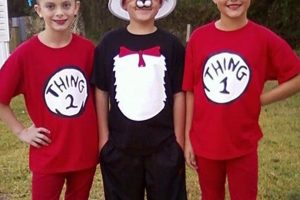
Creating character representations of Lock, Shock, and Barrel from The Nightmare Before Christmas through self-made apparel is a popular activity. This involves crafting outfits and accessories designed to resemble the distinct appearances of these characters. Examples include constructing Shock’s witch-like dress, Lock’s devil costume, and Barrel’s skeleton-themed attire utilizing materials such as fabric, paint, and craft supplies.
The practice offers individuals an opportunity for creative expression and cost savings compared to purchasing pre-made ensembles. Historically, homemade costumes have served as an accessible and personalized alternative for celebrations such as Halloween and themed parties. The appeal of crafting character-specific attire lies in the unique interpretation and individual artistry involved.
The following sections will detail material selection, construction techniques, and styling considerations for successful character renditions. Guidance on achieving accurate representations through makeup and prop creation will also be provided.
Tips for DIY Lock, Shock, and Barrel Costumes
Achieving accurate and recognizable representations of Lock, Shock, and Barrel requires attention to detail and a strategic approach to crafting.
Tip 1: Character Research is Paramount: Thoroughly study the character designs. Pay close attention to color palettes, silhouettes, and distinguishing features. Refer to film stills and character models for accuracy.
Tip 2: Prioritize Fabric Selection: Choose fabrics that accurately reflect the texture and drape of the characters’ clothing. Velvet or velour can mimic the richness of Lock’s devil suit, while lightweight cotton or linen is suitable for Shock’s dress. Stiff fabrics are ideal for maintaining Barrel’s rigid shape.
Tip 3: Pattern Adaptation is Crucial: Adapt existing sewing patterns to match the unique shapes and proportions of each costume. Modify sleeves, hemlines, and collars to achieve the desired silhouette. Consider drafting custom patterns for complex elements like Barrels round body.
Tip 4: Emphasize Detail with Appliqus and Embellishments: Add character-specific details through appliqus, embroidery, or painted designs. Replicate patterns and textures from the original costumes to enhance authenticity. Stencil techniques can ensure accurate and repeatable designs.
Tip 5: Makeup Application Should Be Methodical: Apply makeup strategically to emphasize the characters distinctive facial features. Use contrasting colors to highlight bone structure, and consider special effects makeup for aging or adding texture. Research makeup tutorials from sources specializing in theatrical makeup for proper application techniques.
Tip 6: Prop Construction Enhances Character Rendition: Craft props that complement the costumes and reflect the characters’ personalities. Lock’s pitchfork, Shock’s cauldron spoon, and Barrel’s lollipop add visual interest and improve overall recognition. Employ durable materials and secure construction methods for longevity.
Tip 7: Proportion and Scale Considerations: Maintain accurate proportions relative to body size to avoid distortion of the characters appearance. Oversized elements, when appropriate, should be carefully balanced to maintain visual harmony and not impede mobility.
Diligent planning and execution are key to producing successful and recognizable character recreations. By focusing on accurate details and thoughtful construction, individuals can create visually impressive and authentic representations.
The following sections will delve into specific techniques for crafting individual costume elements, providing detailed instructions and material recommendations.
1. Design Accuracy

Design accuracy is a critical determinant in the success of representations from The Nightmare Before Christmas through homemade outfits. A failure to accurately reproduce key visual elements results in costumes that are either unrecognisable or perceived as substandard. The correlation between design accuracy and visual impact is demonstrably strong. For instance, omitting Shock’s distinctive pointed hat or Lock’s prominent horns immediately diminishes the costume’s authenticity.
Achieving design accuracy requires meticulous attention to detail, including precise color matching, accurate reproduction of patterns and textures, and faithful adherence to character silhouettes. This often necessitates careful research, detailed pattern drafting, and precise execution of sewing or crafting techniques. Utilizing reference images and character models is essential. Furthermore, the degree of accuracy directly impacts the audience’s perception. A meticulously crafted costume that adheres closely to the original design generates a more positive response than one that deviates significantly.
In summary, design accuracy is paramount to the successful creation of Lock, Shock, and Barrel character representations. Prioritizing research, employing precise techniques, and attending to fine details are essential steps. Compromising design accuracy diminishes the overall impact and recognizability of the ensemble. The pursuit of accuracy, while demanding, yields a demonstrably superior outcome.
2. Material Suitability

Material suitability exerts a direct influence on the aesthetic appeal, durability, and overall success of self-constructed Lock, Shock, and Barrel character apparel. Inappropriate material selection can compromise the visual accuracy, reduce the costume’s lifespan, and negatively affect the wearer’s comfort. A prime example is choosing a heavy, inflexible fabric for Shock’s dress. This can result in a distorted silhouette, restrict movement, and detract from the costume’s visual fidelity. Conversely, selecting lightweight, breathable fabric ensures a more accurate drape and increases the wearer’s comfort. Similarly, utilizing rigid materials for Barrel’s round body is essential for maintaining its characteristic shape.
The practical significance of understanding material suitability lies in its ability to minimize material waste, reduce construction time, and improve the final product’s overall quality. For instance, selecting fabrics that are easy to sew and manipulate streamlines the construction process and prevents frustration. Furthermore, considering the specific properties of each material, such as its colorfastness and resistance to tearing, ensures that the costume remains visually appealing and structurally sound over time. The ability to properly identify and source ideal material impacts project outcomes.
In conclusion, material suitability is inextricably linked to the successful fabrication of Lock, Shock, and Barrel-themed attire. Careful consideration of factors such
as texture, weight, drape, and durability is paramount. By prioritizing material suitability, creators can enhance the visual accuracy, improve the wearer’s experience, and maximize the longevity of the costumes. The deliberate selection of adequate materials improves project effectiveness.
3. Construction Techniques

The successful realization of self-made Lock, Shock, and Barrel character apparel hinges critically on the application of appropriate construction techniques. These techniques encompass a range of skills, from pattern drafting and fabric cutting to sewing, gluing, and painting. The causal relationship is clear: inadequate construction techniques directly lead to poorly executed costumes, diminishing their resemblance to the source material. For instance, inaccurate pattern drafting results in ill-fitting garments, while shoddy sewing undermines structural integrity.
Construction techniques form an integral component of the overall creative effort. Examples abound: accurately replicating Shock’s pointed hat requires precise pattern drafting and meticulous sewing to maintain its distinctive shape. Barrel’s round body necessitates the use of shaping techniques, such as creating a wireframe structure or employing padded construction. Lock’s devil suit demands careful attention to seam placement and finishing to achieve a polished appearance. The practical significance of understanding these techniques lies in the ability to translate a design concept into a tangible and visually compelling costume. Improper sewing might cause the costume to tear when performing. Rigidity for prop construction ensures durability.
In summary, proficient construction techniques are essential for achieving visually accurate and structurally sound Lock, Shock, and Barrel costumes. Prioritizing skill development and employing appropriate methods are crucial. The inherent challenges of costuming, such as achieving complex shapes or replicating intricate details, can be overcome through dedicated learning and the application of suitable construction principles. Mastery in these areas directly correlates to the finished product and the recognition of the project goal.
4. Budget constraints

Budget constraints represent a significant determinant in the creation of homemade Lock, Shock, and Barrel character attire. The financial resources available directly influence material choices, construction methods, and the overall level of detail achievable. A limited budget necessitates resourceful approaches, often involving the utilization of recycled materials, thrift store finds, and simplified construction techniques. For instance, rather than purchasing expensive fabrics, individuals might repurpose existing clothing or opt for less costly alternatives. This can manifest in the use of felt instead of velvet for Locks devil suit or cardboard instead of specialized foam for Barrels rounded body. The practical consequence of this limitation can be a reduction in visual accuracy or overall durability. However, it simultaneously fosters creativity and ingenuity in problem-solving.
A restricted budget requires a prioritized approach to resource allocation. The most visually critical elements of each costume are often prioritized, while less prominent details are simplified or omitted. For example, achieving Shocks signature witch hat may take precedence over intricate detailing on her dress. Similarly, focusing on Barrels overall shape may supersede efforts to perfectly replicate the pattern on his skeleton costume. The process of cost reduction extends to construction techniques. Elaborate sewing methods might be replaced by simpler gluing or stapling for non-critical areas. Pre-made components, such as masks or gloves, can be substituted for labor-intensive, hand-crafted versions. The challenge lies in balancing cost savings with maintaining a reasonable level of character accuracy and costume integrity.
In conclusion, budget constraints exert a pervasive influence on the process of creating self-made Lock, Shock, and Barrel apparel. Resourcefulness, prioritization, and creative problem-solving become essential skills. While financial limitations may compromise certain aspects of the final product, they simultaneously encourage innovation and provide an opportunity to demonstrate craftsmanship within defined parameters. The success in the project depends on how the available resources are distributed.
5. Time investment
The creation of self-made Lock, Shock, and Barrel character apparel from The Nightmare Before Christmas necessitates a substantial time investment. The magnitude of this commitment directly impacts the quality, accuracy, and complexity of the finished product. A cursory effort typically yields a less refined result, whereas a more prolonged and dedicated approach allows for greater attention to detail, resulting in a more visually compelling and authentic representation. For example, creating Barrels rounded body requires significantly more time than a standard garment construction, due to its unique shape and structural requirements. Similarly, replicating the intricate patterns on Shocks dress demands considerable time for either hand-painting, fabric printing, or careful applique work.
The time required is further influenced by the creators skill level and familiarity with relevant crafting techniques. Novice sewers may spend significantly more time on basic tasks, such as pattern cutting and seam finishing, than experienced individuals. Moreover, the complexity of the design and the desired level of accuracy contribute directly to the overall time commitment. A faithful recreation of the character costumes, with all their distinctive details, will necessitate a more extensive time investment than a simplified or stylized interpretation. Sourcing materials, troubleshooting construction challenges, and conducting iterative adjustments also add significantly to the required time. The effect of time translates directly into costume design.
In summary, the correlation between time investment and the successful fabrication of Lock, Shock, and Barrel costumes is undeniable. A realistic assessment of the time required, coupled with efficient project management, is essential for achieving a satisfactory outcome. While shortcuts may be tempting, they often result in compromises in quality and accuracy. The conscientious allocation of time, commensurate with the complexity of the design and the desired level of detail, is paramount to the success of these costuming projects. Effective time-management techniques and a solid timeline planning are key for such projects.
6. Comfort level

The comfort level associated with self-constructed Lock, Shock, and Barrel character apparel is a significant determinant of the costume’s wearability and, consequently, its overall success. A costume that is aesthetically pleasing but physically uncomfortable is less likely to be worn for extended periods, diminishing its intended impact.
- Fabric Selection Impact
The choice of fabric directly influences comfort. Synthetic materials, while potentially cost-effective or visually appropriate, may lack breathability, leading to overheating and discomfort, particularly during prolonged wear or in warm environments. Natural fibers, such as cotton or linen, offer better ventilation and moisture absorption but may compromise the visual fidelity of certain elements, such as Lock’s devil suit. The trade-off between aesthetic accuracy and wearer comfort necessitates careful consideration.
- Construction Method Implications
Construction techniques also significantly affect comfort. Ill-fitting seams, rigid structures, or restrictive patterns can impede movement and cause chafing. Barrel’s rounded body, for example, requires careful design to ensure it does not restrict arm movement or create pressure points. Sewing techniques, such as flat-felled seams, can minimize friction and improve overall wearability. Proper sizing and fit are paramount to maintaining comfort.
- Accessibility and Mobility Restrictions
The design and construction of the costume may impact accessibility and mobility. Elaborate headgear, such as Shocks pointed hat, can obstruct vision or restrict head movement. Overly long or cumbersome garments can impede walking or other activities. The practicality of the costume in real-world situations, such as navigating crowds or participating in social events, must be considered to ensure the wearer’s comfort and safety.
- Layering and Environmental Factors
The intended wearing environment affects optimal layering and comfort. Costumes designed for outdoor events require additional consideration of weather conditions. Layering options should be incorporated to provide warmth in cold weather or ventilation in warm weather. The addition of breathable underlayers can improve comfort and prevent chafing, regardless of the outer garment’s material composition.
The interplay of fabric selection, construction methods, accessibility considerations, and environmental factors directly influences the comfort level of character renditions. A thoughtfully designed and carefully constructed costume prioritizes not only visual accuracy but also the wearer’s physical well-being, ultimately enhancing the overall experience.
7. Durability Required
The required durability of self-constructed Lock, Shock, and Barrel character apparel is a crucial factor influencing material selection, construction techniques, and overall cost-effectiveness. The intended use case dictates the necessary level of resilience, ranging from single-use costumes for a brief event to more robust garments intended for repeated wear and potential washing.
- Material Selection Criteria
Durability considerations directly inform material choices. Fabrics prone to tearing or fading are unsuitable for costumes intended for frequent use. More robust materials, such as canvas or heavy-duty synthetics, offer increased resistance to wear and tear. Similarly, the selection of threads, fasteners, and embellishments must align with the desired level of durability. Cheap alternatives might degrade or detach quickly, compromising the costume’s integrity. For example, the use of reinforced stitching or seam binding in high-stress areas enhances the longevity of the garment.
- Construction Technique Implications
Construction methods also impact durability. Reinforcing seams, using durable stitching patterns, and securing embellishments properly are essential for withstanding repeated wear and handling. Flimsy construction techniques can lead to rapid degradation, particularly in costumes with complex designs or intricate details. For instance, using a serger to finish seams prevents fraying and strengthens the overall structure. The creation of Barrels rounded body can involve an interior structure, often made of wire or plastic, adding to the costumes rigidity.
- Maintenance and Cleaning Considerations
The anticipated cleaning and maintenance requirements directly influence durability expectations. Costumes intended for repeated use must be able to withstand washing and drying without significant degradation. Colorfastness, resistance to shrinking, and the ability to maintain structural integrity through repeated cleaning cycles are critical factors. Delicate materials or intricate embellishments may require specialized cleaning methods, increasing the overall maintenance burden. Costumes crafted from materials unable to withstand standard washing procedures may require more expensive professional cleaning, this becomes a practical consideration.
- Intended Frequency of Use
The expected frequency of use dictates the overall durability requirements. A costume designed for a single event can be constructed using less robust materials and simpler techniques. In contrast, a costume intended for multiple uses, such as for theatrical performances or recurring events, necessitates more durable materials and reinforced construction. Frequent use subjects the garment to increased stress and wear, accelerating the rate of degradation. The life of the costume design might be limited based on use factors.
The required durability is a multifaceted consideration in the creation of homemade Lock, Shock, and Barrel character attire. Aligning material selection, construction techniques, and maintenance protocols with the intended use case is essential for maximizing the costume’s lifespan and ensuring a satisfactory return on the time and resources invested. Over- or under-engineering can lead to unnecessary expense or premature failure. The durability standards for these particular costume types will greatly affect the approach.
Frequently Asked Questions
This section addresses common inquiries regarding the creation of self-made Lock, Shock, and Barrel character apparel, providing concise and informative responses.
Question 1: What is the approximate time investment required to complete all three costumes?
The time expenditure fluctuates considerably based on skill level, design complexity, and available resources. A rudimentary execution might require 20-30 hours, while a more meticulously crafted ensemble could demand 50 hours or more.
Question 2: What are the most cost-effective material options for these costume projects?
Recycled fabrics, thrift store finds, and readily available craft supplies represent viable options for mitigating expenses. Felt, fleece, and inexpensive cotton blends offer budget-friendly alternatives to pricier materials.
Question 3: How can design accuracy be maximized within budgetary constraints?
Prioritization of visually critical elements is paramount. Focusing on replicating distinctive features, such as Shock’s hat or Lock’s horns, enhances recognizability. Simplified construction techniques and strategic material substitutions can further reduce costs without significantly compromising the overall effect.
Question 4: What safety precautions should be observed during costume construction?
Appropriate safety measures include the use of protective eyewear when cutting or sanding materials, adequate ventilation when working with paints or adhesives, and careful handling of sharp tools, such as scissors and sewing needles.
Question 5: How can the comfort level of these costumes be enhanced? em>
Selecting breathable fabrics, ensuring proper fit, and minimizing restrictive elements contribute to increased comfort. Adding linings, using flat-felled seams, and incorporating adjustable closures can further improve wearability. The weight and bulk of the costume should also be minimized when possible.
Question 6: How should the completed costumes be cleaned and maintained to prolong their lifespan?
Cleaning and maintenance protocols depend on the materials used and construction methods employed. Hand-washing with mild detergent is often recommended for delicate fabrics or embellished costumes. Robust fabrics may withstand machine washing on a gentle cycle. Air drying is preferable to machine drying, as heat can damage certain materials or cause shrinkage. Proper storage in a dry, dust-free environment is essential for preventing degradation.
Effective planning, resourcefulness, and adherence to safety guidelines are critical for the successful fabrication of homemade Lock, Shock, and Barrel costumes. A balance between accuracy, affordability, and wearability can be achieved through careful consideration of the factors outlined above.
The following section will delve into exemplary resources and tutorials available to assist in the creation of each distinct costume.
Conclusion
This exploration of diy lock shock and barrel costumes has underscored the multifaceted considerations inherent in their creation. Design accuracy, material suitability, construction techniques, budget limitations, time investment, comfort level, and required durability all exert a significant influence on the final outcome. Careful planning and resource allocation are essential for achieving both visual fidelity and practical wearability.
Ultimately, the creation of these character representations offers an opportunity for creative expression and skill development. The pursuit of accuracy and craftsmanship provides a rewarding challenge. Individuals are encouraged to utilize the information presented to embark on their projects, understanding that dedication and attention to detail are paramount to success.