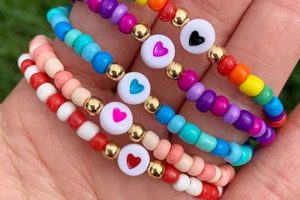
The creation of personalized wrist adornments through beadwork offers a diverse avenue for self-expression and crafting skill development. These handcrafted items, designed and assembled by individuals, incorporate various beads, stringing materials, and closure mechanisms to form unique wearable art. For instance, an individual might combine glass seed beads, gemstone accents, and a toggle clasp on a stretch cord to produce a colorful and easily removable bracelet.
Engaging in beadwork for personal adornment provides several advantages. It fosters creativity, improves fine motor skills, and yields tangible, personalized items. Historically, beaded bracelets have served as decorative elements, indicators of social status, and components of cultural traditions across various societies. The act of creating these bracelets can be a therapeutic activity, offering a relaxing and focused outlet for creative energy.
Subsequent sections will delve into specific techniques for crafting beaded wristwear, including knotting methods, wiring techniques, and the incorporation of different bead types. The article will also examine design considerations, material selection, and project inspiration for achieving professional-looking results in handcrafted bead projects.
Crafting Superior Beaded Wristwear
The following guidance aims to enhance the quality and durability of individually created beaded bracelets. Adherence to these suggestions will contribute to aesthetically pleasing and long-lasting finished products.
Tip 1: Employ High-Quality Stringing Material: Select stringing cords or wires specifically designed for beadwork. Inadequate materials may fray, stretch, or break, compromising the integrity of the finished bracelet. For heavier beads, consider using thicker gauge wire or multiple strands of cord.
Tip 2: Secure Closure Mechanisms Effectively: Ensure that clasps, toggles, or magnetic closures are securely attached to the bracelet ends. Weak or improperly fastened closures represent a common point of failure. Reinforce connections with multiple passes of the stringing material or by using specialized adhesive designed for jewelry making.
Tip 3: Prioritize Consistent Bead Spacing: Maintain uniform spacing between beads for a polished and professional appearance. Inconsistent spacing can detract from the overall aesthetic. Employ bead stoppers or temporary clamps to secure bead placement during the stringing process.
Tip 4: Protect Against Abrasive Wear: Utilize bead caps or spacers to prevent beads from rubbing directly against each other. Such friction can damage the bead surfaces and weaken the stringing material. These components also enhance the bracelet’s design by providing visual separation between beads.
Tip 5: Knot Securely and Conceal Effectively: When knotting cord or thread, employ strong and reliable knotting techniques such as square knots or surgeon’s knots. Conceal the knot within a bead or crimp bead for a clean finish. Ensure knots are adequately tightened to prevent slippage.
Tip 6: Consider Bead Size and Weight: Balance bead sizes and weights to create a comfortable and aesthetically pleasing bracelet. Uneven distribution of weight can lead to discomfort and may affect the bracelet’s drape. Experiment with different bead combinations to achieve optimal balance.
Tip 7: Use Appropriate Tools: Invest in quality jewelry-making tools, such as pliers, wire cutters, and bead boards. These tools facilitate precise handling of materials and contribute to a more efficient and professional crafting experience.
By integrating these guidelines, individuals can produce beaded bracelets that exhibit superior craftsmanship and durability, resulting in long-lasting and visually appealing accessories.
The next section will explore advanced techniques and design principles to further refine skills in the art of beaded bracelet creation.
1. Bead Material Variety

The breadth of available bead materials forms a foundational element in successful “diy bead bracelet ideas.” Material choice directly influences the aesthetic, durability, and comfort of the finished bracelet. The selection process necessitates careful consideration of the desired visual impact, the intended use of the bracelet, and the interaction of different materials within the design. For example, a bracelet designed for daily wear might benefit from durable materials such as glass, metal, or acrylic beads, while a bracelet intended for occasional wear might incorporate more delicate materials such as pearls, gemstones, or intricately crafted ceramic beads. Failure to adequately consider material properties can result in a bracelet that is either aesthetically unappealing or structurally unsound.
Further examples illustrate the practical significance of material diversity. Seed beads, due to their small size and uniform shape, are frequently used for intricate patterns and detailed designs, allowing for complex visual textures. Conversely, larger focal beads, often made of semi-precious stones or sculpted glass, serve as central elements, drawing the eye and establishing the overall style of the bracelet. The combination of different material types, such as metal spacers interspersed with gemstone beads, can enhance the bracelet’s visual interest and prevent abrasion between the more delicate beads. Material also impacts ease of construction. Some beads are easier to work with using specific stringing materials and require certain tools for handling.
In conclusion, a thorough understanding of bead material variety is essential for the realization of effective “diy bead bracelet ideas.” The choice of materials directly impacts the bracelet’s aesthetic appeal, structural integrity, and overall suitability for its intended purpose. Careful consideration of material properties and interactions is paramount to achieving successful and satisfying results. Challenges in bracelet creation often stem from neglecting this crucial aspect of design. This understanding bridges directly to broader considerations of design and practical execution in “diy bead bracelet ideas,” demonstrating the interconnectedness of these various elements.
2. Stringing Method Selection

The success of “diy bead bracelet ideas” is fundamentally linked to stringing method selection. The chosen technique directly affects the bracelet’s durability, flexibility, drape, and overall aesthetic. Stringing method is not merely a technical detail; it is a critical design decision with far-reaching consequences. An inappropriate selection can result in a bracelet that is prone to breakage, uncomfortable to wear, or visually unappealing, undermining the entire creative effort. For instance, using a non-stretchy wire for a bracelet design intended to be easily slipped on and off will inevitably lead to the clasp being strained wit
h repeated wear, increasing the likelihood of failure.
Practical examples illustrate this connection. For bracelets incorporating heavy beads or those requiring a rigid structure, wire wrapping or knotting techniques employing durable cords are often preferred. Wire wrapping provides enhanced security and allows for intricate designs, while knotting offers a more organic and textured appearance. Conversely, for lightweight beaded bracelets designed for comfort and ease of use, elastic cord is frequently chosen. However, the elasticity comes at the cost of long-term durability as elastic cords degrade over time. Understanding the properties of different stringing materials and their compatibility with various bead types is crucial for preventing premature wear or breakage. Furthermore, the chosen stringing method dictates the appropriate tools and techniques required for successful construction.
In summary, the selection of a suitable stringing method is paramount to realizing the full potential of “diy bead bracelet ideas.” It dictates the bracelet’s functional and aesthetic characteristics, influencing its durability, comfort, and overall visual appeal. A thorough understanding of the available stringing materials, their properties, and their suitability for different bead types is essential for crafting successful and long-lasting beaded bracelets. Overlooking this critical aspect will frequently lead to disappointing results, highlighting the integral relationship between technique and outcome. The choice leads directly into discussions on “Closure System Integrity”, continuing our series of design considerations.
3. Closure System Integrity

Closure system integrity represents a non-negotiable aspect within “diy bead bracelet ideas.” Functioning as the point of connection and disconnection, the closures reliability directly impacts the bracelet’s security, longevity, and user satisfaction. A compromised closure not only risks the loss of the bracelet but also diminishes the value of the time and resources invested in its creation. Therefore, diligent attention to closure selection and secure attachment methods constitutes a vital element in “diy bead bracelet ideas.”
- Type Selection and Suitability
The range of available closures lobster clasps, toggle clasps, magnetic clasps, hook-and-eye closures, and adjustable slide closures necessitates careful evaluation based on bracelet design, bead weight, and intended use. A delicate glass-bead bracelet might be well-suited for a lightweight lobster clasp, while a heavier stone-bead bracelet requires a more robust toggle or magnetic clasp. Incorrect closure type can cause stress on the closure or stringing material, leading to failure. The aesthetic should harmonize with the bead design and overall bracelet style.
- Attachment Method and Security
The method of attaching the closure to the bracelet ends directly affects the system’s integrity. Crimp beads, wire guardians, and strategically placed knots are employed to ensure a secure connection. Improper crimping, loose knots, or inadequate wire wrapping compromise the closure’s ability to withstand daily wear. Reinforcement techniques, such as multiple passes through the crimp bead or the use of adhesive, can enhance the security of the attachment.
- Material Quality and Durability
The inherent quality and durability of the closure material are critical determinants of its long-term performance. Inexpensive metal alloys can corrode, tarnish, or break under stress, leading to premature failure. Opting for closures crafted from durable materials such as sterling silver, gold-filled metal, or stainless steel enhances both the aesthetic appeal and the structural integrity of the bracelet. Prioritizing material quality represents an investment in the bracelet’s longevity.
- Functionality and User Experience
Beyond mere security, a closure system should also offer ease of use. Complicated or difficult-to-manipulate closures can detract from the wearer’s overall experience. Individuals with dexterity limitations may benefit from magnetic or toggle clasps, while those seeking adjustability might prefer slide closures. Balancing security with user-friendliness is a crucial consideration in closure selection for effective and satisfying “diy bead bracelet ideas.”
These facets emphasize the profound connection between closure system integrity and the realization of successful “diy bead bracelet ideas.” By carefully considering closure type, attachment method, material quality, and user experience, creators can ensure that their handcrafted bracelets not only possess aesthetic appeal but also offer security, durability, and lasting enjoyment for the wearer. The next critical component to analyze will be “Color Palette Harmony”.
4. Color Palette Harmony

Color palette harmony constitutes a pivotal element in the creation of aesthetically pleasing “diy bead bracelet ideas.” It directly influences the overall visual impact, evoking specific emotions, and enhancing the bracelets perceived value. A well-considered color scheme can elevate a simple beaded bracelet to a sophisticated piece of wearable art, while a discordant palette can render an otherwise well-crafted bracelet visually unappealing. The principles of color theory, including complementary, analogous, and triadic color schemes, provide a framework for achieving color palette harmony, thus, skillful application of these principles contributes significantly to the success of the bracelet.
The practical application of color palette harmony is observed in numerous examples. A bracelet featuring analogous colors, such as varying shades of blue and green, creates a serene and calming effect. Conversely, a bracelet incorporating complementary colors, such as red and green or blue and orange, generates a more vibrant and dynamic visual contrast. The choice of color palette often reflects the wearer’s personal style and preferences, as well as the intended use of the bracelet. A bracelet designed for a formal occasion might incorporate sophisticated color combinations such as black and gold or silver and pearl, while a casual bracelet might feature brighter, more playful colors. Ineffective use of color theory might result in visual disharmony, detracting from the bead work itself.
In conclusion, color palette harmony is undeniably crucial in the realm of “diy bead bracelet ideas.” Its careful consideration not only enhances the aesthetic appeal of the bracelet but also contributes to its overall value and wearability. While mastery of color theory requires study and practice, the principles provide a solid foundation for creating visually cohesive and emotionally resonant beaded bracelets. Failing to acknowledge or appreciate the importance of color can result in bracelets that lack visual impact and fail to achieve their full potential. This aspect segues naturally to “Pattern Complexity Level,” influencing design approach.
5. Pattern Complexity Level
Pattern complexity level represents a significant determinant in the success and accessibility of “diy bead bracelet ideas.” It
dictates not only the visual intricacy of the finished product but also the skill, time investment, and frustration level experienced by the creator. An appropriate level of complexity ensures a satisfying and achievable crafting experience, while an ill-considered choice can lead to project abandonment or a substandard outcome.
- Skill Assessment and Matching
Accurate self-assessment of beading skills is paramount. A novice beader attempting an intricate, multi-layered pattern is likely to encounter difficulties, leading to discouragement. Conversely, an experienced beader may find a simple, repetitive pattern unstimulating. Matching the pattern complexity to the beader’s skill level is crucial for maintaining engagement and fostering a sense of accomplishment. This alignment enhances the overall enjoyment and likelihood of project completion.
- Time Commitment Considerations
Intricate patterns inherently demand a greater time investment. Complex designs involving numerous bead types, intricate weaving techniques, or meticulous color placement require significantly more time than simpler patterns. Individuals with limited time available should opt for patterns that can be completed within a reasonable timeframe. Failure to account for the time commitment can lead to project stalls and unfinished bracelets. This is a core element of planning successful “diy bead bracelet ideas.”
- Visual Impact versus Execution Difficulty
A visually stunning pattern does not necessarily equate to a complex execution. Some patterns achieve a high level of visual impact through strategic color placement or clever use of bead shapes, while employing relatively simple techniques. Conversely, other patterns achieve their intricacy through highly complex and technically demanding methods. Balancing visual impact with execution difficulty is essential for selecting a pattern that is both aesthetically pleasing and achievable.
- Adaptability and Customization Potential
Simpler patterns often provide greater opportunities for adaptation and customization. Novice beaders can easily modify simpler patterns to incorporate their personal preferences or experiment with different color combinations. Complex patterns, however, typically offer less flexibility for customization, requiring a more rigid adherence to the original design. The capacity for adaptation contributes to the personal investment and ownership the creator feels in the product.
These multifaceted considerations underscore the intrinsic connection between pattern complexity level and the effective realization of “diy bead bracelet ideas.” Skill assessment, time commitment, visual impact, and adaptability converge to determine the suitability of a given pattern for a particular beader. Thoughtful selection of a pattern that aligns with these factors ensures a rewarding and successful crafting experience, resulting in a cherished, handcrafted piece of wearable art.
6. Size Adaptability

Within the domain of “diy bead bracelet ideas,” size adaptability constitutes a crucial consideration, influencing not only comfort and aesthetics but also the practicality and wearability of the finished product. An inadequately sized bracelet can render it unwearable, negating the time and effort invested in its creation. Therefore, a comprehensive understanding of sizing principles and adjustment techniques is essential for successful bracelet design and construction.
- Wrist Measurement Precision
Accurate wrist measurement forms the foundation of size adaptability. Employing a flexible measuring tape ensures precise determination of wrist circumference. The measurement should be snug but not constricting. Furthermore, consideration should be given to the intended fit. A bracelet designed for a looser fit necessitates the addition of extra length to the wrist measurement. This precise measurement and mindful adjustment prevent discomfort and ensure proper bracelet drape.
- Bead Size and Quantity Adjustment
The size and quantity of beads directly impact the overall length of the bracelet. Larger beads contribute to a shorter bracelet, while smaller beads allow for a longer design. Careful calculation of bead dimensions and their cumulative length is essential for achieving the desired bracelet size. Adjustments to bead quantity or the incorporation of spacer beads can fine-tune the bracelet’s length to accommodate individual wrist sizes. An appropriate balance between bead size and quantity enhances both the aesthetic and functional aspects of the finished piece.
- Adjustable Closure Mechanisms
Adjustable closures offer a versatile solution for size adaptability. Slide closures, chain extenders, and adjustable knotting techniques allow for fine-tuning the bracelet’s length to accommodate variations in wrist size or personal preference. Adjustable closures enhance wearability by providing a customizable fit. This flexibility makes the bracelet suitable for a wider range of individuals and allows for adjustments based on seasonal changes in wrist size. Implementing adjustable mechanisms into bracelet creation makes for a versatile final product.
- Elasticity and Stretch Considerations
Bracelets utilizing elastic cord offer a degree of inherent size adaptability. The elasticity allows the bracelet to stretch comfortably over the hand and conform to the wearer’s wrist. However, overstretching the elastic cord can compromise its durability. The choice of elastic cord thickness and the incorporation of reinforcement techniques, such as knotting or crimping, can mitigate the risk of breakage. Calculating the proper elastic length, accounting for the bead size and desired tension, is vital to the final product.
These interconnected facets demonstrate the critical role of size adaptability in “diy bead bracelet ideas.” Precise measurement, bead adjustment, adjustable closures, and elastic considerations converge to ensure a comfortable, aesthetically pleasing, and wearable bracelet. Thoughtful application of these principles results in handcrafted bracelets that cater to individual preferences and provide lasting enjoyment for the wearer, elevating the final product of the creative process.
7. Durability Considerations

Durability considerations form a cornerstone in the effective realization of “diy bead bracelet ideas.” The lifespan and resilience of a handcrafted bracelet directly impact its value and the wearer’s satisfaction. Neglecting durability aspects during the design and construction phases can result in a piece that quickly deteriorates, diminishing its aesthetic appeal and rendering it unwearable. Material selection, stringing method, closure system integrity, and construction techniques all contribute to the overall durability of the bracelet. For instance, using inexpensive metal components prone to tarnishing or selecting a weak stringing cord can drastically reduce a bracelet’s lifespan, regardless of the initial aesthetic design. The inverse holds true as well; robust materials and strong techniques can extend the usability of any project. In summary, proper durability directly effects the wearers overall impression of the bracelet’s quality and longevity, making durability considerations essential during creation.
Practical app
lications of durability considerations are evident in various bracelet designs. Bracelets intended for daily wear benefit from the incorporation of durable materials such as stainless steel, high-quality glass beads, and strong synthetic cords. Utilizing secure knotting techniques and reinforcing closure attachments further enhances their resistance to wear and tear. Conversely, bracelets designed for occasional wear might incorporate more delicate materials, such as pearls or semi-precious stones, provided that these materials are properly protected from abrasion and impact. Understanding the trade-offs between aesthetic appeal and durability is crucial for creating bracelets that meet the wearer’s needs and expectations. For example, choosing higher quality jump rings when using a lobster clasp will greatly increase the closure durability and could prevent a common breaking point. These materials are slightly more costly, but will improve the overall project.
In conclusion, durability considerations are inextricably linked to the success of “diy bead bracelet ideas.” A comprehensive understanding of material properties, construction techniques, and wear patterns is essential for creating bracelets that not only exhibit aesthetic appeal but also withstand the rigors of daily use. Prioritizing durability ensures that handcrafted bracelets remain cherished possessions, reflecting the creator’s skill and attention to detail. While design, color, and aesthetics all play vital roles, a failure to account for durability will invariably undermine the long-term value and satisfaction derived from these projects. Therefore, a balanced approach, integrating both aesthetic vision and durability awareness, is crucial for realizing the full potential of “diy bead bracelet ideas.”
Frequently Asked Questions
The following addresses common inquiries and concerns pertaining to the creation of individualized beaded wristwear. This information seeks to provide clarity and guidance for individuals pursuing such projects.
Question 1: What constitutes the most durable stringing material for beaded bracelets?
The selection of stringing material hinges upon bead weight and intended wear. For heavier beads, consider nylon-based threads or wire. For lighter beads, elastic cords can suffice, although nylon threads provide superior long-term durability.
Question 2: How should closure mechanisms be securely attached to beaded bracelets?
Attachment methods vary. Crimp beads, when properly secured with specialized crimping pliers, provide a robust connection for wire-based bracelets. Knots, such as surgeon’s knots, secured with jewelry adhesive, offer a secure connection for thread-based bracelets.
Question 3: What considerations are relevant to sizing beaded bracelets accurately?
Wrist circumference measurement is paramount. Add approximately 0.5 to 1 inch to the measurement for a comfortable fit. Account for bead size; larger beads require fewer beads to achieve the target length.
Question 4: What strategies mitigate bead abrasion in beaded bracelets?
The incorporation of bead caps or spacer beads between potentially abrasive beads minimizes direct contact. Coatings, such as clear nail polish, can provide an added protective layer on delicate beads.
Question 5: How can knot slippage be prevented in beaded bracelets?
Employing robust knotting techniques, such as square knots or surgeon’s knots, reduces slippage. Securing knots with jewelry adhesive provides additional reinforcement. Conceal knots within beads to prevent unraveling and improve aesthetics.
Question 6: How do material choices impact beaded bracelet durability?
Materials significantly influence durability. Opt for high-quality glass beads, gemstones, or metal beads over inexpensive plastic alternatives. Stainless steel or sterling silver components offer superior corrosion resistance compared to base metals.
In summary, achieving satisfactory results in personalized beaded wristwear projects depends significantly on meticulous material selection, secure attachment methods, accurate sizing, and proactive abrasion mitigation. These considerations are crucial for producing bracelets that exhibit both aesthetic appeal and long-term durability.
The subsequent section will examine advanced design techniques and innovative approaches to further enhance individualized beaded wristwear projects.
Conclusion
The preceding discussion has illuminated the diverse facets integral to crafting individualized wrist adornments via beadwork. Considerations ranging from material selection and stringing methods to closure integrity, color harmony, pattern complexity, size adaptability, and durability have been examined. A comprehensive understanding of these elements empowers creators to produce bracelets exhibiting both aesthetic appeal and structural soundness. These aspects of design converge to transform simple materials into personalized expressions of creativity and craftsmanship.
Effective execution of “diy bead bracelet ideas” requires meticulous planning and thoughtful application of established techniques. It is anticipated that continued exploration and innovation within this craft will yield even more sophisticated and enduring forms of wearable art. The synthesis of technical skill and artistic vision remains the key to unlocking the full potential of this engaging and rewarding endeavor.