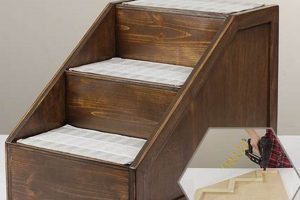
The construction of elevated platforms intended to aid canines in accessing higher surfaces, undertaken independently by an individual, represents a specific type of pet product creation. For example, an owner might create a small set of steps to allow their aging pet to reach a favorite sofa. This act involves design, material selection, and assembly, differing from purchasing a pre-made item.
Providing enhanced accessibility for animals yields various advantages. It can reduce strain on joints, particularly beneficial for older or smaller breeds. Furthermore, a custom-built solution allows for personalization regarding dimensions, aesthetics, and integration with existing home dcor. Historically, owners have sought creative solutions to accommodate their companions’ physical limitations, leading to the development of diverse assistive devices.
The ensuing discussion will delve into the crucial factors involved in constructing such an item, encompassing material choices, structural integrity considerations, and safety measures to ensure the well-being of the animal. Subsequent sections will address specific design approaches and construction techniques.
Construction Guidance
The following guidelines aim to provide direction in creating a safe and functional assistive structure for canines. Attention to detail during the planning and building phases is paramount.
Tip 1: Material Selection: Prioritize durable and pet-safe materials. Untreated wood requires sealant to prevent splintering and moisture damage. Consider carpeting or non-slip surfaces for traction.
Tip 2: Structural Integrity: Implement robust joinery techniques. Screws and wood glue provide more stability than nails alone. Internal bracing can reinforce larger structures.
Tip 3: Dimensional Accuracy: Measure the target surface height precisely. Divide this height into evenly spaced steps to minimize strain. Step depth should accommodate the dog’s full paw.
Tip 4: Slope and Angle: Avoid excessively steep angles. A gradual incline is easier for animals to navigate. Consider a ramp alternative for severe mobility issues.
Tip 5: Weight Capacity: Design the structure to support the animal’s weight and any potential jumping forces. Over-engineering is preferable to under-engineering.
Tip 6: Safety Features: Round sharp edges and corners. Secure the finished product to prevent tipping. Consider side rails to guide the animal’s movement.
Tip 7: Non-Slip Surfaces: Ensure each step has a non-slip surface. Carpet, rubber mats, or specialized non-slip coatings can enhance grip and reduce the risk of falls.
Tip 8: Gradual Introduction: Introduce the new structure to the animal gradually. Use positive reinforcement and treats to encourage acceptance and proper use.
Adherence to these recommendations will contribute to a stable, secure, and animal-friendly result. A carefully constructed unit minimizes the risk of injury and maximizes its utility.
The concluding section will summarize the essential considerations and offer avenues for further exploration.
1. Material Durability

Material durability constitutes a critical factor in the design and construction of structures intended to aid canines in accessing elevated surfaces. The selection of appropriate materials directly impacts the lifespan, safety, and overall effectiveness of the finished product. Failure to prioritize material durability can result in structural compromise, posing a risk to the animal and negating the intended benefits.
- Wood Type and Treatment
The selection of wood species influences resistance to wear, moisture, and insect infestation. Hardwoods, such as oak or maple, offer superior durability compared to softwoods like pine. Furthermore, proper treatment with sealants or preservatives enhances resistance to environmental factors, preventing rot and extending the lifespan of the structure. Untreated wood is susceptible to damage, leading to structural instability.
- Fabric and Covering Quality
The application of fabric or carpeting to step surfaces enhances traction and provides a comfortable surface for the animal. The quality of these materials directly affects their resistance to wear and tear. Durable fabrics, such as those designed for upholstery, withstand repeated use and resist tearing or fraying. Similarly, high-quality carpets maintain their texture and provide consistent grip over time.
- Fastener Strength and Corrosion Resistance
The integrity of the structure relies on the strength and durability of the fasteners used to join components. Screws offer greater holding power than nails and are less prone to loosening over time. Furthermore, the use of corrosion-resistant fasteners, such as galvanized or stainless-steel screws, prevents rust and maintains the structural integrity of the unit in humid environments.
- Joint Strength and Construction Techniques
The manner in which components are joined significantly affects the overall durability. Strong joints, such as mortise-and-tenon or dovetail joints, provide superior stability compared to simple butt joints. Reinforcing joints with wood glue and screws further enhances their strength, ensuring that the structure can withstand the stresses of repeated use. Proper construction techniques are essential for creating a durable and long-lasting product.
In conclusion, material durability is paramount in the creation of safe and effective assistive structures for canines. The careful selection of materials, coupled with appropriate construction techniques, ensures that the finished product provides long-lasting support and minimizes the risk of injury to the animal. Neglecting these considerations can result in a structurally unsound and potentially hazardous outcome.
2. Structural Stability

Structural stability represents a non-negotiable element in the creation of assistive structures for canines. Its presence ensures the unit’s capacity to withstand both static and dynamic loads without deformation or collapse, thereby safeguarding the animal from potential harm. A lack of structural integrity renders the device unsafe and ineffective.
- Load Bearing Capacity
The ability of the structure to support the weight of the animal, plus any potential impact forces resulting from jumping or sudden movements, defines its load-bearing capacity. Insufficient load-bearing capacity can lead to catastrophic failure, potentially causing injury. A well-designed structure incorporates a safety margin, exceeding the anticipated maximum load by a significant factor. For example, a structure intended for a 50-pound dog should be engineered to support at least 100 pounds.
- Joint Integrity
The strength and rigidity of the connections between individual components contribute significantly to the overall structural stability. Weak or poorly executed joints represent points of potential failure. Techniques such as mortise-and-tenon joinery, reinforced with adhesives and fasteners, enhance joint integrity. Regular inspection of joints is essential to identify and address any signs of loosening or degradation.
- Material Rigidity
The inherent stiffness of the materials employed directly affects the structure’s resistance to bending or deformation under load. Materials with high flexural strength, such as hardwoods or steel, provide greater rigidity compared to more pliable materials. Selection of appropriate material thickness and cross-sectional dimensions contributes to overall rigidity. For instance, using thicker lumber for supporting beams increases resistance to bending.
- Base Stability
The stability of the base prevents tipping or rocking, which could unbalance the animal. A wide base provides a lower center of gravity, enhancing stability. Non-slip feet or anchoring mechanisms further prevent movement. Irregular surfaces necessitate adjustable feet to ensure a level and stable platform. For example, rubber feet prevent slippage on hardwood floors, while adjustable feet compensate for uneven flooring.
The interconnectedness of these facets dictates the overall structural stability. Compromising any single aspect jeopardizes the integrity of the entire structure. Diligent attention to load-bearing capacity, joint integrity, material rigidity, and base stability ensures a safe and functional assistive device for canines. The absence of robust structural engineering transforms the device from a helpful aid into a potential hazard, underscoring the paramount importance of stability in its construction.
3. Dimensional Accuracy

Dimensional accuracy, in the context of constructing assistive structures for canines, refers to the precision with which the physical measurements of the device are executed relative to the intended design. This element directly impacts the usability, safety, and effectiveness, and ultimately the value of stairs for dogs diy.
- Step Height Uniformity
Consistent step height is critical for minimizing strain on a canine’s joints. Variations, even minor ones, can disrupt the animal’s gait and increase the risk of stumbling or falling. If the stairs are not uniformly dimensioned, an elderly pet may find navigation challenging, negating the benefits the owner is trying to implement.
- Step Depth Sufficiency
Adequate step depth ensures the animal has sufficient surface area to place its paws securely. Insufficient depth requires the canine to overreach, creating instability. For example, a small dog might need a shallower step depth than a large breed. Miscalculation could make the DIY project pointless.
- Overall Structure Width
The overall width of the structure determines the animal’s freedom of movement. Insufficient width can create a feeling of confinement, deterring use, while excessive width may consume valuable space. A structure’s width should align with the dimensions of the space and the size of the animal. Incorrect measurements compromise the entire design.
- Incline Angle Calibration
The angle of the incline significantly affects the physical effort required to ascend or descend. An excessively steep angle places undue stress on the canine’s musculoskeletal system. A gradual incline promotes ease of use, particularly for animals with mobility limitations. Miscalculation of the incline leads to a device that is difficult or dangerous to use.
The culmination of these dimensionally accurate elements results in a safe and functional assistive structure. Conversely, a disregard for precision in measurements can render the device ineffective, uncomfortable, or even hazardous for the animal, highlighting the importance of dimensional precision in any assistive device project for pets.
4. Incline Graduality

Incline graduality directly affects the utility and safety of DIY canine stairs. A steeper incline necessitates greater exertion, potentially exacerbating joint issues or causing instability, especially for smaller breeds or senior animals. Conversely, a more gradual incline distributes the effort over a longer distance, minimizing strain. The practical significance of understanding this relationship lies in creating a structure that accommodates the physical limitations of the intended user, ensuring both accessibility and minimizing the risk of injury. For instance, stairs designed for a Dachshund require a gentler slope than those for a Labrador.
The optimal incline is not a fixed value but rather a variable determined by the dog’s size, age, and pre-existing physical conditions. Empirical observation of the animal’s natural movements and consultation with veterinary professionals can inform the design process. Constructing a prototype or adjustable model allows for fine-tuning the angle to suit the dog’s specific needs. Furthermore, implementing modular designs allows for incremental adjustments to the incline, facilitating adaptation to changes in the animal’s physical condition over time.
Ultimately, achieving appropriate incline graduality is central to the success of such a project. While challenges may arise in determining the ideal angle, prioritizing the animal’s well-being and carefully considering its individual characteristics will maximize the utility of the structure. The relationship between incline and canine comfort underscores the importance of thoughtful design and meticulous construction. Failure to address this critical factor can render the device ineffective or even detrimental to the animal’s health.
5. Weight Capacity

The load-bearing capability constitutes a critical design parameter in the creation of DIY canine stairs. The weight capacity of a set of stairs directly determines its suitability for a specific animal and affects its overall safety. Insufficient weight capacity can lead to structural failure, resulting in potential injury to the dog. The connection, therefore, is one of direct causality: the weight of the dog necessitates a corresponding structural strength in the stairs. As an essential component, the capacity has implications for material selection, joinery methods, and overall structural design.
A practical illustration emphasizes this point. Constructing stairs for a small Chihuahua, which weighs approximately 5 pounds, necessitates different considerations than building stairs for a Great Dane, whose weight can exceed 150 pounds. The Chihuahua’s stairs can be made from lighter materials, such as thinner plywood, and require less robust joinery. Conversely, the Great Dane’s stairs must be built from sturdier materials like solid hardwood and employ more advanced joinery techniques to withstand the significantly higher load. Ignoring these weight differences leads to potential collapse and injury.
In summary, determining the weight capacity is a fundamental step in any DIY canine stair project. Proper assessment of the dog’s weight, coupled with an adequate safety margin in the design, ensures the stairs will safely support the animal. Potential challenges include underestimating the dynamic forces generated by jumping and miscalculating the load-bearing capacity of the chosen materials. However, careful planning, material selection, and construction techniques mitigate these risks, resulting in a safe and functional set of stairs.
6. Surface Traction

Surface traction is an indispensable element in the design and construction of assistive structures for canines. Its primary function is to provide sufficient grip, preventing slippage and minimizing the risk of falls, particularly on inclined planes. The efficacy of canine steps is inherently linked to the frictional properties of the surface material.
- Material Selection and Coefficient of Friction
The choice of surface material directly influences the coefficient of friction. Materials such as carpet, rubber, or textured polymers offer enhanced grip compared to smooth surfaces like polished wood or tile. The coefficient of friction quantifies the resistance to sliding; a higher coefficient indicates greater traction. For example, a low-pile carpet bonded to each step provides substantial traction, particularly when compared to a varnished wood surface, reducing the likelihood of a slip-related injury. Appropriate material selection significantly mitigates the inherent risks associated with inclined surfaces.
- Textural Considerations and Paw Contact
Surface texture impacts the contact area between the canine’s paw and the step. A rougher texture increases the surface area in contact, augmenting friction. However, excessive roughness can cause discomfort or irritation to the paw pads. The optimal texture balances grip and comfort. Ribbed rubber surfaces, for instance, provide excellent traction while remaining relatively gentle on the paws. Conversely, an excessively smooth or polished surface diminishes paw contact, reducing friction and increasing slip risk.
- Environmental Factors and Traction Degradation
Environmental factors can degrade surface traction over time. Moisture, dirt, and debris can accumulate on the surface, reducing friction. Regular cleaning and maintenance are essential to preserve traction. Porous materials may absorb moisture, further diminishing grip. Impervious surfaces, while easier to clean, may lack sufficient initial traction and require the application of non-slip coatings. Routine cleaning and periodic reapplication of traction-enhancing treatments are crucial for maintaining optimal safety conditions.
- Step Angle and Traction Requirements
The steepness of the steps directly correlates with the traction needed. Steeper inclines require higher coefficients of friction to prevent slippage. As the angle increases, the gravitational force pulling the canine downward increases, necessitating greater resistance from the surface. Gentler inclines require less traction. Therefore, the selection of surface material must be informed by the steepness of the steps. Insufficient traction on a steep incline poses a significant safety hazard. Consideration of the design, therefore, necessitates an iterative optimization of angle and surface treatment.
The interaction between material selection, surface texture, environmental factors, and step angle collectively defines the overall surface traction of the stairs. Effective implementation of these considerations results in a safer and more accessible structure. Neglecting this element can lead to reduced functionality, injury, and potential abandonment of the structure by the canine. Therefore, thoughtful engineering is critical.
Frequently Asked Questions
The following addresses commonly raised inquiries regarding the independent construction of stair-like aids for dogs, emphasizing critical design and safety considerations.
Question 1: What constitutes the most suitable material for constructing assistive steps for canines?
The selection of materials should prioritize durability, safety, and ease of cleaning. Solid wood, such as pine or maple, provides a stable base. Carpeting or rubber treads enhance traction, minimizing the risk of slipping. Avoid materials with sharp edges or splinters.
Question 2: How does one determine the optimal step height and depth for a canine’s assistive structure?
Step height should be low enough to minimize strain on the animal’s joints. A range of 4 to 6 inches is generally suitable for smaller breeds, while 6 to 8 inches may be appropriate for larger breeds. Step depth should accommodate the dog’s entire paw, typically 8 to 12 inches.
Question 3: What safety precautions should be implemented during the construction of these structures?
Ensure all joints are securely fastened with screws and glue. Round all sharp edges and corners to prevent injury. Apply a non-toxic sealant to protect the wood from moisture. Test the structure’s stability before allowing the dog to use it.
Question 4: Is it necessary to incorporate a non-slip surface on the steps?
The inclusion of a non-slip surface is paramount to prevent slips and falls. Carpet, rubber treads, or textured paint can enhance traction. Replace worn or damaged surfaces promptly to maintain safety.
Question 5: How does the incline angle affect the usability of the structure?
A gradual incline is easier for dogs to navigate, particularly those with mobility issues. Steeper inclines require more effort and may increase the risk of injury. Adjust the incline to suit the animal’s physical capabilities.
Question 6: How does one acclimate a canine to using a newly constructed assistive structure?
Introduce the structure gradually, using positive reinforcement techniques such as treats and praise. Guide the dog up and down the steps, initially with assistance if needed. Patience and consistency are essential for successful acclimation.
These FAQs serve as a baseline; individual circumstances may necessitate adjustments to materials, dimensions, and techniques.
The subsequent discussion will delve into advanced design considerations for specialized canine assistive structures.
Concluding Remarks
The preceding analysis addressed the multifaceted aspects of creating “stairs for dogs diy”. It highlighted the significance of material durability, structural stability, dimensional accuracy, incline graduality, weight capacity, and surface traction. These considerations collectively determine the safety, functionality, and long-term effectiveness of the finished product. Proper execution minimizes risk and maximizes the benefit to the animal.
The construction of “stairs for dogs diy” is not merely an exercise in amateur carpentry; it represents a commitment to enhancing an animal’s quality of life. By adhering to sound engineering principles and prioritizing the well-being of the animal, individuals can create assistive devices that promote mobility, independence, and a stronger bond between owner and pet. Continued research and refinement in design methodologies remain crucial for advancing this area of pet care.