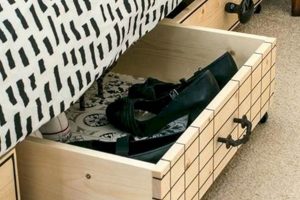
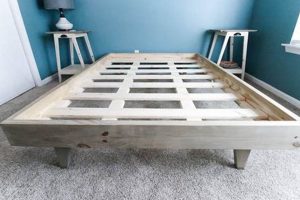
A platform bed constructed from reclaimed wooden shipping skids represents an accessible and budget-conscious furnishing option. These structures typically involve dismantling, cleaning, and reassembling the skids to form a solid base suitable for supporting a mattress. Examples range from simple, low-profile designs to more elaborate constructions incorporating headboards, storage compartments, and integrated lighting.
Utilizing these repurposed materials offers several advantages, including reduced landfill waste and lowered expenditure on conventional bed frames. Historically, resourceful individuals and communities have long employed readily available materials to create essential household items. This approach aligns with contemporary sustainability practices and promotes a minimalist aesthetic. The adaptability of the material also allows for significant customization to fit individual space constraints and design preferences.
The subsequent discussion will address essential considerations for constructing a durable and aesthetically pleasing platform bed, focusing on material selection, safety precautions, and various design options to maximize functionality and visual appeal. The information aims to provide readers with a comprehensive guide to successfully completing this project.
Tips for Constructing a Platform Bed from Reclaimed Skids
The following recommendations are intended to facilitate the successful construction of a durable and aesthetically pleasing platform bed utilizing repurposed wooden shipping skids. Careful consideration of these guidelines will contribute to a safer and more satisfying outcome.
Tip 1: Material Selection is Paramount. Prioritize skids marked with the “HT” stamp, indicating heat treatment rather than chemical treatment, to minimize the risk of off-gassing or exposure to harmful substances. Thoroughly inspect each skid for structural integrity, discarding any with significant damage, rot, or insect infestation.
Tip 2: Safety Precautions are Essential. Wear appropriate personal protective equipment, including gloves, safety glasses, and a dust mask, throughout the project. Thoroughly clean and sand each skid to remove splinters, dirt, and potential contaminants. Exercise caution when handling power tools and ensure proper ventilation during sanding and staining processes.
Tip 3: Design Planning Enhances Functionality. Measure the intended mattress dimensions precisely and plan the bed frame accordingly, accounting for any desired overhang or integrated features such as a headboard or storage. Consider the overall height of the bed frame and adjust the number of stacked skids to achieve the desired elevation.
Tip 4: Secure Fastening Promotes Stability. Use appropriate fasteners, such as wood screws or construction adhesive, to securely join the individual skids. Reinforce critical joints with metal brackets or additional wood supports to enhance structural stability and prevent shifting or separation over time.
Tip 5: Finishing Enhances Aesthetics and Protection. Apply a sealant or stain to protect the wood from moisture and wear. Choose a finish that complements the surrounding dcor and is compatible with the wood type. Consider using multiple coats for enhanced durability and a smoother surface.
Tip 6: Ventilation is Important. Ensure adequate airflow beneath the mattress by leaving gaps between the skids or incorporating ventilation holes. This helps to prevent moisture buildup and promotes a healthier sleep environment.
These guidelines highlight critical considerations for successfully constructing a stable, safe, and aesthetically pleasing platform bed. Adhering to these recommendations will maximize the project’s benefits, contributing to a sustainable and personalized sleep solution.
The subsequent section will explore advanced design options and creative adaptations, providing further inspiration for tailoring the platform bed to individual needs and preferences.
1. Material Sourcing Criticality

Material sourcing represents a fundamental consideration in the construction of a shipping skid bed. The selection of appropriate skids directly influences the bed’s structural integrity, safety, and overall aesthetic appeal. Inadequate attention to this phase can compromise the entire project, leading to premature failure or potential health hazards.
- Treatment Method Identification
The presence of specific markings on skids is crucial for determining prior treatment. Skids labeled with “HT” indicate heat treatment, a safer alternative to chemical fumigation using methyl bromide (“MB”). Utilization of “MB”-treated skids poses a risk of off-gassing, potentially exposing occupants to harmful chemicals. Selecting “HT”-marked skids is thus paramount for mitigating health risks.
- Structural Soundness Evaluation
Prior to incorporation into the bed frame, each skid requires thorough inspection for structural deficiencies. Signs of rot, cracking, or insect infestation necessitate rejection of the compromised skid. Using damaged skids can lead to instability and eventual collapse of the bed frame, potentially resulting in injury. Careful evaluation of structural soundness ensures a safe and durable finished product.
- Wood Type and Uniformity Assessment
Different wood types possess varying levels of strength and resistance to environmental factors. Selecting skids constructed from consistent wood types contributes to uniform load distribution and prevents differential expansion or contraction. Using a mixture of hardwoods and softwoods can create stress points within the structure, reducing overall longevity. Assessing wood type uniformity is vital for achieving a stable and long-lasting bed frame.
- Contamination and Cleanliness Protocols
Shipping skids are frequently exposed to a range of contaminants during transport. Thorough cleaning and disinfection are essential to remove dirt, debris, and potential pathogens. Failure to adequately clean skids can introduce allergens and bacteria into the sleeping environment. Implementing rigorous cleaning protocols contributes to a healthier and more hygienic final product.
The considerations outlined above underscore the critical role of material sourcing in the successful construction of a shipping skid bed. Attentive selection and preparation of skids directly impact the bed’s safety, durability, and long-term usability. By prioritizing these factors, constructors can minimize potential risks and ensure a robust and aesthetically pleasing outcome, consistent with sustainable and resource-conscious practices.
2. Structural integrity verification

The construction of a bed frame from repurposed shipping skids necessitates rigorous structural integrity verification to ensure user safety and prevent premature failure of the structure. This process involves a comprehensive assessment of each component and connection point to identify and mitigate potential weaknesses.
- Assessment of Wood Condition
Each shipping skid must undergo a thorough inspection for signs of rot, decay, insect infestation, or significant cracking. These conditions compromise the wood’s load-bearing capacity and can lead to structural failure. Skids exhibiting such defects should be rejected and replaced with sound materials. This evaluation forms the foundation of structural verification.
- Connection Point Reinforcement
The junctions where skids are joined together are critical stress points. These connections require reinforcement using appropriate fasteners, such as wood screws or lag bolts, in conjunction with construction adhesive. Metal brackets or additional wood supports can further enhance the strength and stability of these junctions, mitigating the risk of separation or collapse under load. Proper reinforcement is vital for overall structural integrity.
- Load Distribution Analysis
The design of the bed frame should ensure even distribution of weight across all supporting members. Uneven load distribution can concentrate stress on specific areas, leading to localized failure. Reinforcing vulnerable areas and strategically positioning supporting skids are essential for optimizing load distribution and preventing structural weaknesses. Careful analysis of load paths is crucial for achieving a stable and durable bed frame.
- Stability Testing and Evaluation
Following assembly, the bed frame should undergo stability testing to assess its resistance to tipping or swaying. This testing may involve applying weight to various points on the frame and observing its response. Any signs of instability necessitate further reinforcement or design modifications to ensure a safe and secure sleeping platform. Comprehensive testing validates the effectiveness of structural integrity measures.
These facets of structural integrity verification are paramount in the construction of a bed frame from reclaimed shipping skids. Neglecting these considerations can result in a hazardous sleeping environment. By diligently implementing these measures, constructors can ensure the safety, durability, and long-term usability of the finished bed.
3. Surface preparation protocol

Surface preparation represents a critical phase in the construction of a bed from repurposed shipping skids. The thoroughness of surface preparation directly influences the aesthetic appeal, durability, and hygienic properties of the finished piece. Inadequate surface preparation can lead to premature deterioration, aesthetic imperfections, and potential health risks.
- Decontamination and Cleaning Procedures
Shipping skids, by their nature, are exposed to a variety of environmental contaminants and potential biological hazards. Effective decontamination and cleaning procedures are essential to remove dirt, debris, mold, and other substances that may compromise the finished product. This involves the use of appropriate cleaning agents and scrubbing techniques to ensure a hygienic surface. Failure to adequately decontaminate can lead to the persistence of allergens or pathogens within the sleeping environment.
- Sanding and Smoothing Techniques
The rough-hewn nature of shipping skids necessitates extensive sanding to achieve a smooth and uniform surface. Sanding removes splinters, sharp edges, and surface imperfections, enhancing both the aesthetic appeal and the safety of the bed. Employing progressively finer grits of sandpaper is crucial for achieving a professional finish. Inadequate sanding can result in an uncomfortable and aesthetically unappealing surface.
- Repair and Patching Methods
Shipping skids often exhibit minor damage, such as cracks or small holes. Repairing these imperfections through patching methods is essential for creating a structurally sound and visually appealing surface. Appropriate wood fillers or epoxy resins can be used to fill voids and restore the integrity of the wood. Failure to repair damage can lead to further deterioration and compromise the overall aesthetic of the bed.
- Sealing and Priming Applications
Applying a sealant or primer to the prepared surface creates a protective barrier against moisture, insects, and decay. Sealing also enhances the adhesion of subsequent paint or stain finishes. Selecting an appropriate sealant or primer that is compatible with the wood type is crucial for achieving optimal protection and aesthetic results. Failure to seal or prime the surface can lead to premature deterioration and discoloration of the wood.
The outlined facets highlight the importance of a comprehensive surface preparation protocol in the successful construction of a bed frame from repurposed shipping skids. Diligent attention to these details ensures a safe, hygienic, and aesthetically pleasing final product. The benefits of proper surface preparation extend beyond mere aesthetics, contributing to the longevity and overall value of the finished bed.
4. Assembly technique precision

The successful construction of a bed frame from reclaimed shipping skids hinges significantly on the precision employed during the assembly phase. The accuracy with which individual components are joined directly impacts the bed’s structural integrity, stability, and overall longevity. Deviations from precise assembly techniques can compromise the bed’s safety and aesthetic appeal.
- Dimensional Accuracy in Component Alignment
Precise alignment of individual skids during assembly is paramount for ensuring a level and stable sleeping surface. Misalignment, even by small increments, can accumulate and result in a warped or uneven bed frame. Utilizing measuring tools and levels throughout the assembly process is essential to maintain dimensional accuracy and prevent structural imbalances. This accuracy directly translates to user comfort and prevents undue stress on the mattress.
- Joint Integrity Through Fastener Selection and Placement
The selection of appropriate fasteners, coupled with precise placement, is crucial for establishing strong and durable joints between skids. The type of fastener (e.g., wood screws, lag bolts, construction adhesive) must be compatible with the wood type and designed to withstand the anticipated load. Moreover, fasteners must be strategically positioned to maximize their holding power and prevent splitting or weakening of the wood. Joint integrity directly contributes to the bed’s resistance to movement and collapse under weight.
- Squareness and Perpendicularity Verification
Ensuring that the assembled bed frame is square and that all corners are perpendicular is essential for stability and aesthetic consistency. Deviations from squareness can result in an unstable frame that is prone to wobbling or tilting. Employing framing squares and measuring diagonals during assembly allows for verification of squareness and correction of any discrepancies. Maintaining proper angles guarantees a visually appealing and structurally sound bed frame.
- Consistent Torque Application During Fastening
Applying consistent torque during the tightening of fasteners is critical for achieving uniform clamping force and preventing over-tightening or under-tightening. Over-tightening can strip the threads of screws or damage the wood fibers, weakening the joint. Under-tightening can result in loose connections that are prone to movement and failure. Using a torque wrench or carefully monitoring fastener resistance ensures consistent clamping force and optimal joint strength. This uniform application extends the lifespan of the joints and prevents premature degradation of the structure.
In conclusion, the successful creation of a durable, stable, and aesthetically pleasing bed frame from reclaimed shipping skids necessitates meticulous attention to assembly technique precision. The careful alignment of components, the selection and placement of appropriate fasteners, the verification of squareness, and the application of consistent torque during fastening all contribute to the bed’s overall structural integrity and longevity. These factors collectively transform reclaimed materials into a functional and enduring piece of furniture.
5. Fastener selection relevance

The structural integrity of a platform bed constructed from reclaimed shipping skids is inextricably linked to fastener selection relevance. The choice of fastener directly impacts the bed’s ability to withstand static and dynamic loads, resist shear forces, and maintain its form over prolonged use. Inadequate fastener selection can lead to joint failure, instability, and ultimately, a compromised and potentially hazardous sleeping surface. For example, utilizing finishing nails instead of wood screws in connecting skid components would result in a significantly weaker structure prone to separation under minimal stress. Therefore, a comprehensive understanding of fastener properties and their suitability for specific wood types and load-bearing applications is paramount.
Appropriate fastener selection necessitates considering factors such as wood density, fastener material, thread design, and shank diameter. Denser woods require fasteners with greater shear strength and holding power to prevent loosening or stripping. Fasteners constructed from corrosion-resistant materials are essential for applications exposed to moisture or humidity, preventing premature degradation and structural weakening. For instance, when constructing a bed intended for heavier occupants, longer and thicker wood screws, potentially supplemented with construction adhesive, are critical to ensure the joints can bear the increased weight. The failure to consider these parameters results in a diminished lifespan of the finished bed frame.
In summary, fastener selection is not a trivial detail, but a critical engineering consideration in the construction of a skid-based platform bed. A well-informed approach to fastener selection, considering the wood properties, anticipated loads, and environmental conditions, significantly enhances the bed’s structural integrity, safety, and longevity. Ignoring these principles can lead to structural failure and compromise the user’s well-being, highlighting the practical significance of this understanding.
6. Finishing agent applicability

The selection and application of appropriate finishing agents are integral to the successful creation and longevity of a platform bed constructed from repurposed shipping skids. The applicability of a specific finishing agent is directly linked to the material properties of the wood, the intended use environment, and the desired aesthetic outcome. The choice of finish influences resistance to moisture, abrasion, and ultraviolet degradation, factors which directly impact the lifespan and hygienic properties of the bed frame. For instance, untreated wood is highly susceptible to moisture absorption, leading to warping, mold growth, and eventual structural failure. Conversely, a properly applied sealant creates a barrier that mitigates these risks, extending the bed’s usability and preventing the propagation of harmful microorganisms.
Different finishing agents offer varying degrees of protection and aesthetic qualities. Polyurethane coatings provide a durable, water-resistant finish suitable for high-traffic areas or environments with elevated humidity. However, polyurethane can yellow over time and may not be ideal for achieving a natural, matte appearance. Oil-based finishes, such as linseed oil or tung oil, penetrate the wood fibers, providing a subtle sheen and highlighting the wood’s natural grain. These oils offer less surface protection than polyurethane but are easier to repair and maintain. Water-based finishes offer low volatile organic compound (VOC) emissions and dry quickly, making them an environmentally conscious choice. Proper preparation of the wood surface, including sanding and cleaning, is crucial for ensuring optimal adhesion and performance of the chosen finishing agent. The incorrect choice or application can result in peeling, cracking, or uneven coloration.
In summary, the careful consideration of finishing agent applicability is essential for realizing the full potential of a repurposed shipping skid platform bed. Selecting a finish that aligns with the wood type, environmental conditions, and desired aesthetic properties enhances both the functional performance and the visual appeal of the final product. This attention to detail safeguards the bed against premature degradation, promotes a hygienic sleeping environment, and ensures long-term satisfaction with the finished construction.
7. Design adaptability scope

The inherent design adaptability scope of shipping skids directly contributes to their popularity as a construction material for platform beds. The modular nature of skids allows for significant variation in bed size, height, and integrated features. This adaptability stems from the readily available dimensions of standard skids, which can be easily modified or combined to meet specific spatial requirements or aesthetic preferences. The availability of a standardized component significantly reduces the complexity and cost associated with custom bed frame construction. Consequently, individuals can tailor the bed’s dimensions precisely to accommodate a specific mattress size or room layout, maximizing space utilization and minimizing material waste.
Furthermore, the design adaptability extends beyond simple dimensional adjustments. The open structure of skids lends itself to the integration of storage solutions, such as drawers or shelving, beneath the sleeping platform. This is particularly relevant in smaller living spaces where maximizing storage capacity is paramount. Headboards can be readily incorporated by attaching additional skids or reclaimed lumber to the main frame. Integrated lighting, using LED strips or recessed fixtures, can be seamlessly integrated into the skid structure, providing ambient illumination and enhancing the bed’s aesthetic appeal. The versatility of the material enables the creation of personalized and functional sleeping environments, catering to individual needs and preferences. An example includes a low-profile bed designed for minimalist aesthetics, contrasting with a raised platform bed incorporating ample under-bed storage in a compact apartment.
The design adaptability scope, therefore, is a critical component of the widespread adoption of shipping skids as a bed construction material. It allows for a high degree of customization, enabling individuals to create unique and functional sleeping environments that reflect their personal style and meet their specific needs. While challenges exist in ensuring proper skid preparation and structural integrity, the inherent versatility of the material offers a cost-effective and sustainable alternative to conventional bed frames, showcasing the practical significance of its adaptable nature.
Frequently Asked Questions About Platform Beds Constructed From Reclaimed Shipping Skids
The following addresses common inquiries regarding the construction, safety, and suitability of platform beds created utilizing repurposed shipping skids. The information is intended to provide clarity and guidance for those considering this furnishing option.
Question 1: Are all shipping skids safe for use in constructing a bed frame?
No. Skids treated with methyl bromide (indicated by the “MB” stamp) should be avoided due to potential off-gassing of harmful chemicals. Heat-treated skids (indicated by “HT”) are a safer alternative. Further, all skids should be thoroughly inspected for signs of rot, insect infestation, or chemical contamination before use.
Question 2: How is structural integrity ensured in a skid platform bed?
Structural integrity is achieved through careful material selection, robust connection methods, and appropriate weight distribution. Skids exhibiting damage should be rejected. Connections must be reinforced with screws, adhesive, or metal brackets. The overall design should distribute weight evenly across the supporting skids.
Question 3: What precautions are necessary to minimize the risk of splinters or injuries?
Thorough sanding of all skid surfaces is essential to remove splinters and sharp edges. Protective gloves should be worn during construction. Applying a sealant or finish can further smooth the surface and prevent splintering over time.
Question 4: How is adequate ventilation maintained beneath the mattress?
Adequate ventilation is crucial to prevent moisture buildup and mold growth. This is achieved by leaving gaps between the skids or drilling ventilation holes. A breathable mattress material can also contribute to improved airflow.
Question 5: What are the environmental benefits of using reclaimed skids?
Utilizing reclaimed skids reduces landfill waste and decreases the demand for newly manufactured lumber. This promotes sustainable resource management and minimizes the environmental impact associated with furniture production.
Question 6: How can the design be adapted to accommodate different room sizes or storage needs?
The modular nature of skids allows for flexible design adaptations. Skids can be cut to specific lengths to fit room dimensions. Additional skids can be added to increase the bed’s height or create integrated storage compartments beneath the platform.
These answers provide a foundation for understanding the key considerations surrounding the construction of platform beds from repurposed shipping skids. Careful attention to these aspects will contribute to a safer, more sustainable, and aesthetically pleasing outcome.
The subsequent section explores specific design variations and creative adaptations for platform beds crafted from reclaimed materials.
Considerations Regarding Diy Pallet Bed Construction
This exploration has detailed essential factors for constructing a platform bed from repurposed wooden shipping skids. Material selection, structural integrity, surface preparation, assembly precision, fastener selection, finishing agent applicability, and design adaptability have each been addressed. Adherence to these guidelines contributes to a finished product exhibiting both structural soundness and aesthetic merit.
The implementation of a diy pallet bed presents an opportunity for sustainable resource utilization and cost-effective furnishing. However, potential constructors must prioritize safety and adherence to established best practices to mitigate risks and ensure a durable, functional, and aesthetically pleasing outcome. Diligence in these areas translates to a positive and long-lasting contribution to both personal space and environmentally conscious practices.